
Iron Ladies

In Daniel Draper’s impassioned documentary, the women who played a vital role in the UK’s 1984/85 Miners’ Strike look back forty years.
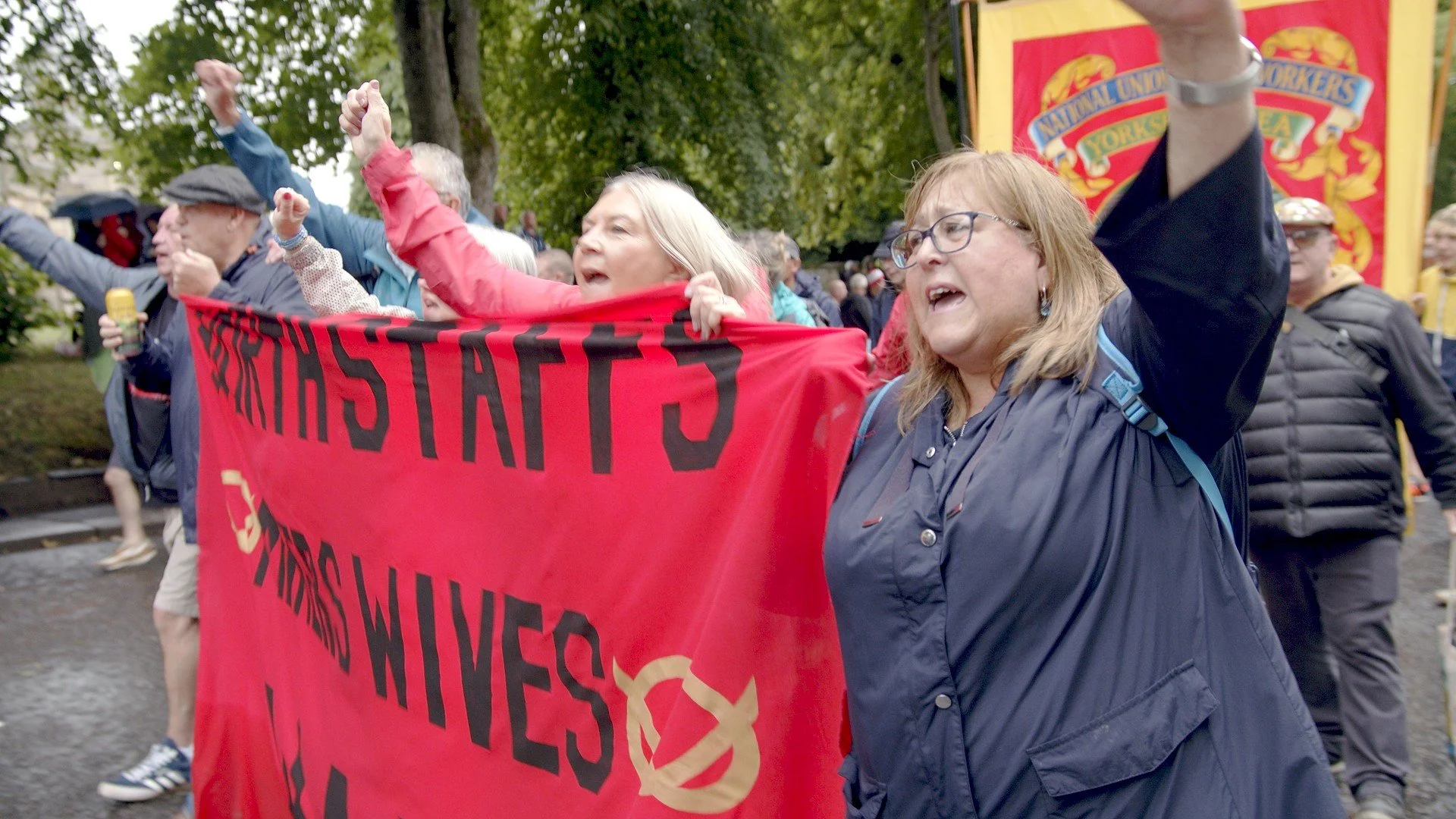
Image courtesy of Shut Out The Light.
This is the sixth feature film to have been made by Daniel Draper and all of them have been impassioned. That is only natural because he is an independent filmmaker who has set up his own company, Shut Out The Light Films, and has kept to subject matter which concerns him deeply. Three of his films were centred on Liverpool where he was born and the three located elsewhere, including Iron Ladies, are linked to his deep- rooted left-wing beliefs. His first work was Dennis Skinner: Nature of the Beast (2017), a biopic about the socialist MP, The Big Meeting (2019) was concerned with the Durham Miners’ Gala and now he gives us a film which has at its centre twenty or so women who reflect on their activism during the Miners’ Strike of 1984/85 and thereafter.
Draper’s films also have other elements in common since all of them have been adroitly edited by Christie Allanson (also regularly listed alongside Draper as a producer) and one can depend on his films being very well photographed (on this occasion that credit goes to Cameron Brown and to Draper himself). However, despite the fact that Iron Ladies has a male director, its title is indicative of its most significant feature which is that it concentrates throughout on the role taken by women. Some were born into decidedly left-wing families, some would see themselves as inspired by the example of the suffragettes and many were drawn into activism by the situation which the miners faced in Britain in the 1980s. The emphasis on this aspect and on the continuing need for women to fight for their rights generally gives his film its own angle and one that helps to distinguish it from Daniel Gordon's 2024 documentary Strike: An Uncivil War which in looking back to 1984 centred specifically on the violence suffered by protesters at what became known as the Battle of Orgreave.
There is a telling moment in Iron Ladies when this issue of the violence involved is described in terms that refute the way in which the media generally expressed it: "Police didn't clash with the miners. They attacked the miners". However, the earlier film was the one which contained relevant, newly-seen documents and video footage and, in consequence, it is the work which has the wider appeal in that its depth and insight were such that it patently transcended party politics. In Iron Ladies too one finds personal insights and interesting details. The latter include comments on the support for the striking miners which came in the form of food parcels from abroad as well the financial help received including a large and unexpected cheque from Bruce Springsteen. Nevertheless, and regardless of the inclusion of old TV footage and the like taken at the time, the emphasis here on talking heads does at times make one feel that this is first and foremost a film for viewers whose political views are already aligned with what is being said. Thatcher, hardly surprisingly seen as the arch villain, is accused of setting out to kill the mining communities as punishment for their role in bringing down Edward Heath’s government. It's neatly put by these sturdy women when they describe the situation and their role in it as one involving one iron lady against hundreds. The intensity of feeling about her that still exists is summed up in the additional comment that “She's dead and we're all still here and it gives us great pleasure to say it”. More unexpected is the fact that this comment leads on to another one about a politician in which the labour leader Neil Kinnock is accused of betraying them.
While there are no male contributors to this film, its concerns in geographical terms are wide-ranging and it includes interviews with women from such diverse areas as Durham, Yorkshire, Staffordshire, Derbyshire, Nottinghamshire and South Wales in addition to stretching from Fife in the north to Kent in the south. Although it keeps moving around in this way, the number of the faces seen become familiar to us as they continue to make contributions throughout and to provide variety there are at intervals scenes relating to celebrations in 2024 commemorating the events of forty years ago. However one defines the aims that exist today, the importance for women to fight on is emphasised and their spirit is such that it is possible to say - as one person here does indeed say - that they lost the strike but were not defeated.
The fact that so many women contribute does mean that to some extent their views come across in a generalised way rather than through clear-cut detailed portraits that would have resulted from using a smaller number. Consequently, the film’s final section with its further glimpses of faces now known to us feels somewhat overextended rather than touchingly intimate. But, if the character of Iron Ladies is such that its appeal is not of the widest, it should be pointed out that the present-day footage of various derelict colliery buildings shows the photography at its finest and that within the strong emphasis on talking heads there are variations of angles and close-ups which illustrate the quality of the editing. The more individual sequences include one in which comparisons are made between feminism as such and a belief in women taking control and it is also suggested that the history of what these women did forty years ago remains highly relevant today. In keeping with that belief this film is dedicated to "Iron Ladies Past and Present".
MANSEL STIMPSON
Featuring Aggie Currie, Lorraine Stansbie, Kate Flannery, Betty Cook, Maxine Penketaman, Linda Allbutt, Rose Hunter, Kate Alvey, Janet Wilson-Cunningham, Christine Powell, Kay Case, Sally Higgins, Sue Piotrowski, Carol Ross, Linda Erskine, Liz French, Kay Sutcliffe, Lynn Gibson, Juliana Heron, Heather Wood.
Dir Daniel Draper, Pro Christie Allanson and Daniel Draper, Screenplay Daniel Draper, Ph Cameron Brown and Daniel Draper, Ed Christie Allanson.
Shut Out The Light Films-Shut Out The Light.
98 mins. UK. 2025. UK Rel: 17 October 2025. Cert. 15.
