
I’ve Seen All I Need To See

Zeshaan Younus’ indie American thriller about loss and grief is pretentious and self-conscious to a disastrous degree.
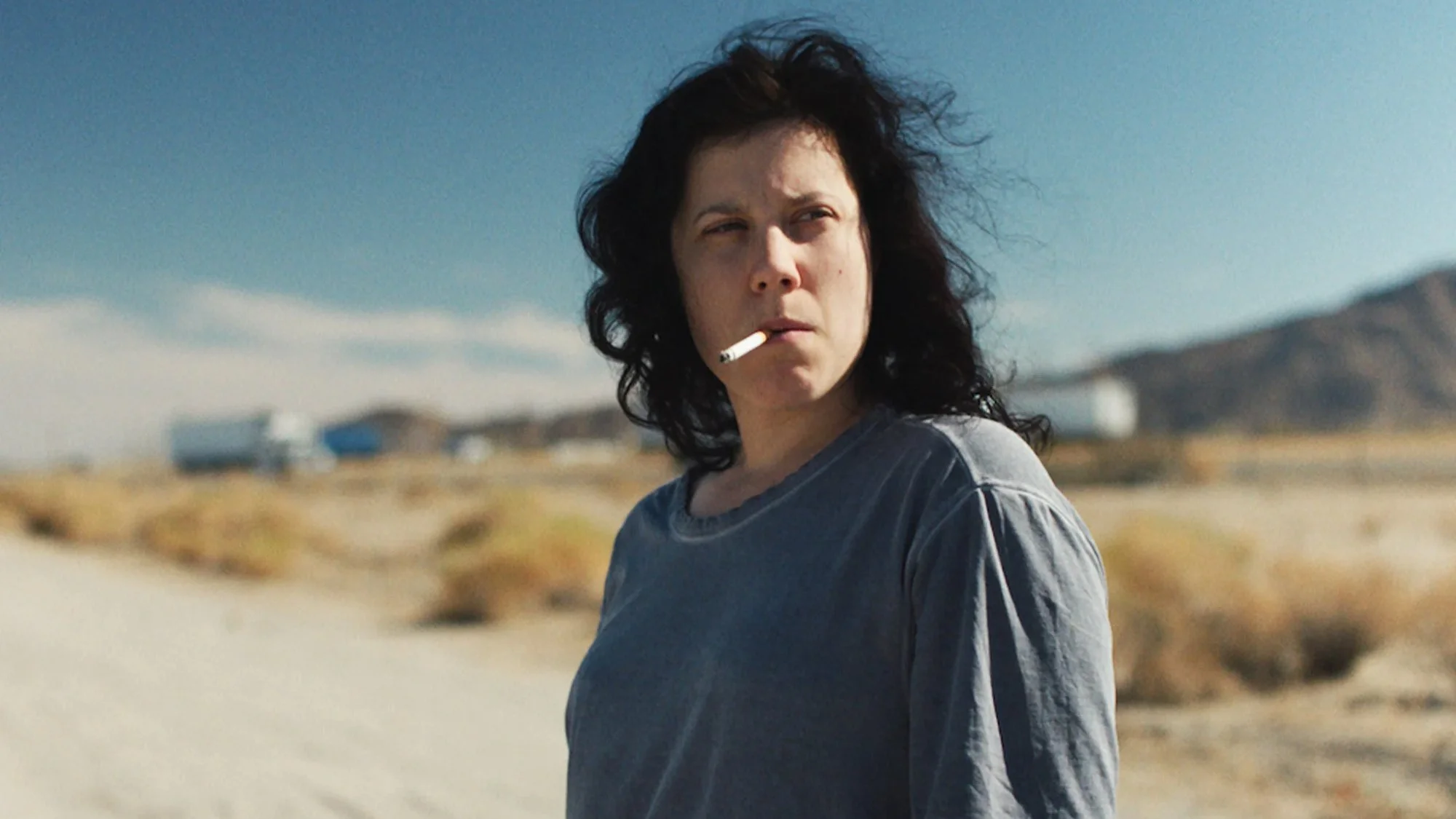
Renee Gagner
Photo courtesy of Bulldog Film Distribution.
by MANSEL STIMPSON
This film introduces us to the work of Zeshaan Younus, who is based in Orange County, California, and is first generation American (his father was from Pakistan and his mother from Mexico). Before writing and directing I've Seen All I Need To See he had made two shorts and one feature, 2024’s The Buildout, which was not distributed in Britain. All four films have won awards (this latest work was a winner last year at film festivals in Rhode Island, Anchorage and Sherman Oaks) and that means that some people like what he does. I do not. It is bizarre that the title should come up over half an hour into the picture but, when it did, it felt all too apt since by then I had already seen enough to know that only my duty as a critic prevented me from opting to watch no further.
Since Younus also shares in the credits for editing and producing, this piece is clearly his to a degree and must represent his idea of what makes effective cinema. But his approach is one that puts style above content or good storytelling and does so without possessing the skills to carry that off. Instead, his film comes over as pretentious in every way. The online description of the plot tells us that it is about two sisters one of whom is an aspiring actress, Parker (Renee Gagner), who has moved to Los Angeles in the hope of building a career there. The other, Indiana (Rosie McDonald), has stayed put in Arizona but is desperate to get out. Indeed, she is hoping that she can bring off some kind of deal with drug runners which will enable her to leave. Instead, she is killed and some admirers of the film have described it as a meditation on grief. However, the piece is already about a third of the way through when Parker hears that her sister has died so sibling loss as a theme arrives rather late on in the day.
However, it could be argued that more relevant to the overall tone and mood of the tale is what is established at the outset through one of the many voice-overs spoken by Parker. Following on from written words which state "Things have gotten worse since you left”, the film opens with one of Parker's heard comments: "I am never fully anything or anyone. You were right. I am practically everyone and everything". This is followed by a scene shot with huge facial close-ups in which the words are now visibly spoken by Parker but are then revealed to be part of an audition which she subsequently learns that she has failed. We then abruptly come to a different location and see a different woman, this being her sister in Arizona although it might take quite a while to work out her identity if you see the film without any foreknowledge about its sibling theme. We do hear a voicemail sent by Indiana to Parker advising her not to come looking if things should go wrong, but for some reason we also witness Parker at a theatre session about the suitable boundaries that apply when actors have to touch which in the event she chooses to sit out. Rather more to the point, there is further footage of Indiana asking a friend to be an extra presence when she contacts the drug dealers in case things go awry. But this is done with minimum detail and consequently little tension is built up.
Thereafter we follow Parker after her sister’s death choosing to return to Arizona to find out more about what happened despite Indiana having warned against it. She meets her sister’s lover June (Sydney McCarthy) and a bearded man (John R. Smith Jnr.) appears whom we recognise from the earlier scenes with Indiana as a disturbing presence. But again, this is much less dramatic than it sounds. There is in fact limited action but what abounds along with dreams, memories and hallucinations is the sense of the pretentious. Thus, Parker muses on her sister’s death in these terms: “Where are you? Drifting? Swallowed by a cosmic nothingness?” And just as off-putting is the directorial mode which could hardly be more mannered. There are many long-held close ups, loud music that sounds all too obviously imposed and increasingly stylised imagery that often seems keen to echo the work of David Lynch but without ever managing to approach the impact of, say, Mulholland Drive. On occasion scenes view the characters from the back in a manner that seems precious.
In a small cast the two leading actresses are absolutely central and do all they can. But, although Younus may think that his arty approach is capturing the inner turmoil of his characters, unfortunately it plays throughout as something which speaks instead of the director’s unjustified belief in his own brilliance. Despite those awards I gather that this view of the film is shared by a number of others. I’ve Seen All I Need To See is a work in marked contrast to the recently released Olivia. Whereas that was a difficult film of specialised appeal which nevertheless clearly contained real artistry, one finds here a work in which genuine art is sadly missing. I feel too that the film’s final written statement that “Memory is a mirror” is just one more example of the pretentious nature of this piece.
Cast: Renee Gagner, Rosie Mcdonald, Sydney McCarthy, Nick Samson, John R. Smith Jnr.
Dir Zeshaan Younus, Pro Zeshaan Younus, Trevor Dillon, Chris Heck and Matt Latham, Screenplay Zeshaan Younus, Ph Justin Moore, Pro Des Sydney McCarthy, Ed Matt Latham and Zeshaan Younus, Music Benjamin Doherty,
Coyote Blood LLC-Bulldog Film Distribution.
84 mins. USA. 2025. UK Rel: 1 May 2026. Cert. 15.
