
Jimpa

Olivia Colman triumphs in a deeply sincere drama that reflects the changing attitudes of people who identify as LGBTQ+.
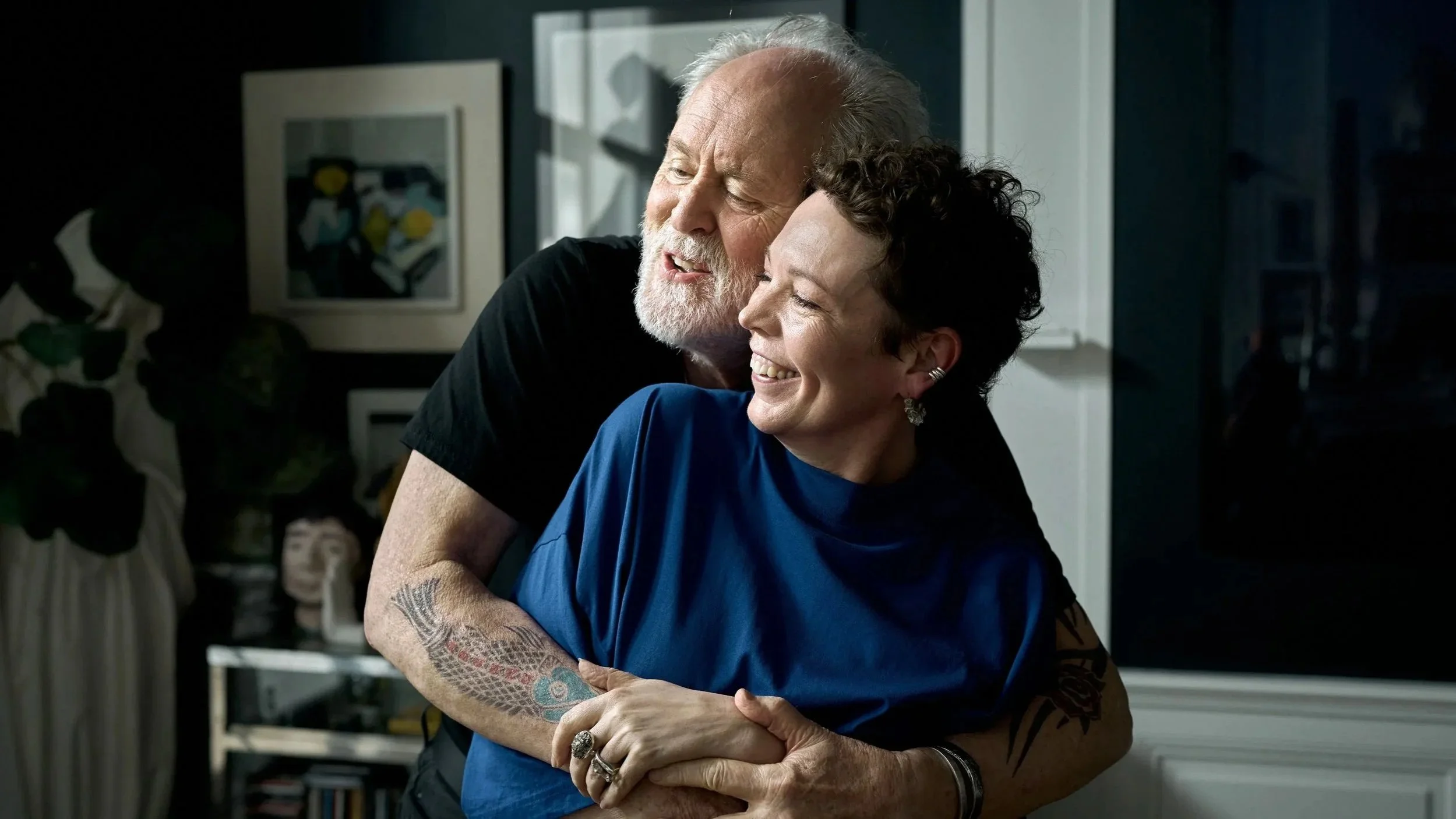
John Lithgow and Olivia Colman
Image courtesy of Signature Entertainment.
by MANSEL STIMPSON
I first became aware of the talent of the Australian director Sophie Hyde when Animals was released in the UK in 2019. She had a very sympathetic rapport with her two leading actresses, Holliday Grainger and Alia Shawkat, and that quality was even more in evidence when she directed Emma Thompson who was at her very best in Good Luck to You, Leo Grande (2022). Although Hyde was not the writer of these two films, her approach to them displayed a deep warmth and sympathy for the characters which carried over into the way in which she handled scenes that were sexually frank without ever feeling exploitative. Those characteristics are again apparent in her latest work, Jimpa, on which she shares the writing credit with Matthew Cormack. Since their joint work treats subject matter that often draws on events in Hyde’s own life, there can be no doubt about this film being in her eyes her most important yet. That makes it all the sadder that the critical response so far has been far less favourable than it was to this film's predecessors. I must admit that I can to some extent see why (Jimpa is indeed very far from being a perfect film), but I nevertheless consider its positive qualities to be significant enough to support the view that judgment on this film has been unduly harsh.
Jimpa tells of a mother, Hannah (Olivia Colman), who flies from Adelaide to Amsterdam with both her husband, Harry (Daniel Henshall), and their 16-year-old child, Frances (Aud Mason-Hyde). Frances, who prefers to be addressed as they, is trans and non-binary and the purpose of their journey is to see the grandfather whom Frances much admires. He is Jim (John Lithgow) who, now elderly, likes the nickname Jimpa and he is a man famed for his work as a gay activist who, despite having become HIV positive, had survived the AIDS crisis. Hannah and her sister, Emily (Kate Box), get on well with their father but that has involved accepting his decision to move to Amsterdam and to live there as a gay man. To achieve that he had left behind his family in Australia, this at a time when Hannah was only thirteen. However, she has now become a filmmaker and is planning to make a film about her parents and their ability to separate amicably. What Hannah and Harry have not anticipated is that on boarding the flight to Holland Frances will indicate that she is hoping to delay her return and to spend a year with Jim taking in LGBTQIA+ lifestyles in his community.
There are certainly fictional embellishments here, but Hyde is in a number of important ways exploring elements of her own life and doing so to a striking extent. She is the mother of Aud Mason-Hyde who, like Frances, is indeed ready to be known as queer and trans and no less significantly Hyde’s father, Jim, was a gay man who moved away from his family when Sophie Hyde was herself thirteen. He became HIV positive but survived eventually dying in his late sixties in 2018. In reality that happened just too soon for Aud and Jim to get together and to have the kind of discussions portrayed in this film so in that respect this is a portrayal of what might have been. Similarly, the Dutch setting was chosen as a useful asset to the movie whereas Jim Hyde stayed in Australia and became a noted activist there. For that matter the screenplay takes the opportunity to contrast the different outlook of today's generation of LGBTQIA+ people from that of those born in the middle of the 20th century, changing viewpoints which at times challenge Frances's respect for Jim (making him a disbeliever in the possibility of being genuinely bisexual seems a rather extreme and untypical stance which may well be present as part of the fiction that adds to the drama).
The opening scenes of Jimpa are very good indeed and the film is helped not only by Hyde’s compassionate view of all concerned but by the quality of the acting. Olivia Colman is on her very best form and John Lithgow is well cast in the title role while Aud Mason-Hyde in her first major role plays in an admirably naturalistic style and justifies her casting. The film’s weakness lies in the fact that the real-life events at the heart of it do not lend themselves readily to a drama with an effective shape. That the focus keeps shifting is an inherent part of the problem. It seems apt enough that Colman should have top billing and the opening scenes immediately give her a central place. How Hannah will handle Frances and her concerns and whether or not being in Amsterdam will help Frances – be it a brief visit or a longer term one – seem central to the story. Jim certainly has an important part to play in this, but not even calling the film Jimpa makes us see him as the film’s key figure. It is the case that what happens to him in the second half seems to dominate the narrative but it is as though the course of the film has been changed in the process. Furthermore, the wider view of how so much in the gay community has changed in Jim's lifetime sometimes take us away from concentrating on the personal tale and suggests that rather too much is being attempted here.
Jimpa received its world premiere in March 2026 and the unenthusiastic reviews that appeared tended to stress the fact that it was much too long. References then to a running time of just over two hours suggest that it may have been shortened subsequently (the present version last for 113 minutes). If so, it may or may not be the case that a sometimes-irritating tendency to favour intercutting - either between two scenes played alongside or by way of brief flashback shots - is part and parcel of these changes. But, whatever the case, there remains a sense that Jimpa is a film in which it was never quite decided who should be the central figure. In many ways it is about a mother and child but the dedication in the end credits states that it is in memory of Jim Hyde and others we lost too soon. Not knowing quite how to balance the various elements does undermine the impact of the film. Even so, the prime impression is of a deeply sincere work which, enhanced by fine acting (from Colman in particular), seeks to extend understanding and approval of a world in which common humanity should counter any prejudices connected with issues of sexual orientation and sexual identity.
Cast: Olivia Colman, Aud Mason-Hyde, John Lithgow, Daniel Henshall, Romana Vrede, Zoë Love Smith, Kate Box, Eamon Farren, Deborah Kennedy, Erle de Lanooi, Jean Janssens, Hans Kesting, Cody Fern.
Dir Sophie Hyde, Pro Sophie Hyde, Liam Heyen, Bryan Mason and Marleen Slot, Screenplay Matthew Cormack and Sophie Hyde, Ph Matthew Chuang, Pro Des Bethany Ryan, Ed Bryan Mason, Music Nick Ward, Costumes Renate Henschke.
Closer Productions/Mad Ones Films/Viking Film/Rosewood Pictures-Signature Entertainment.
113 mins. Australia/Netherlands/Finland. 2025. US Rel: 6 February 2026. UK Rel: 11 May 2026. Cert. 15.
