
Kokuho

The stage craft of kabuki plays a central role in Sang-il Lee’s epic historical drama.
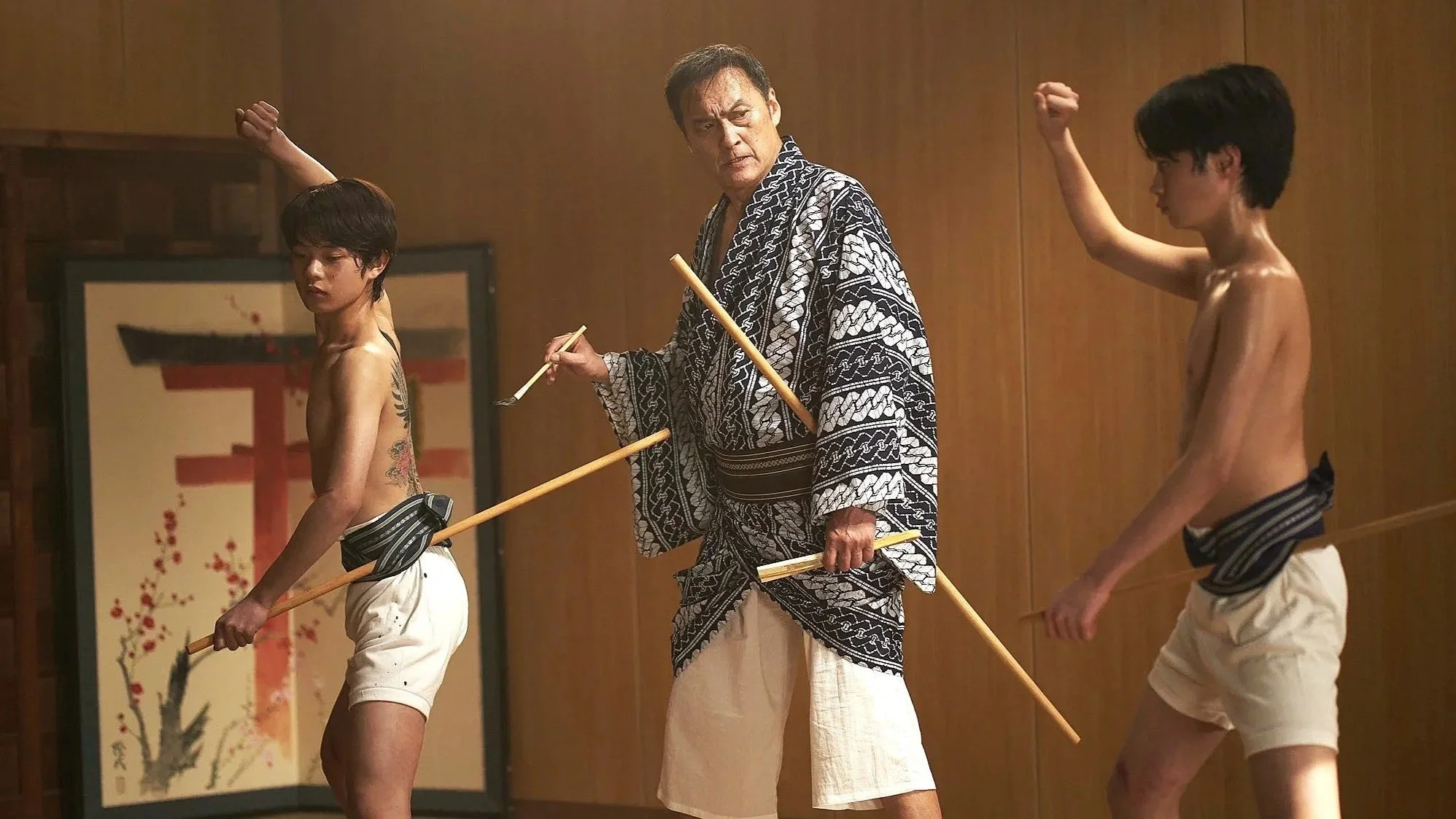
Image courtesy of Vue Lumière.
by MANSEL STIMPSON
The fact that Kokuho has become the highest grossing Japanese live-action film of all time is a fact that should sell it internationally despite the fact that its director and lead actors are not well-established outside of Japan. It is a film set in the world of kabuki theatre, an art formed three centuries ago that blends dance, music and drama in a unique way and in which the female roles are taken by men who specialise in that and are known as onnagata. Given that kabuki is so stylised that it requires specialised knowledge to appreciate it to the full, it was something of a surprise when the great Japanese director Kon Ichikawa made a film in which it played a central role, that being An Actor's Revenge (1963). His film was an international hit thus confirming that this quintessentially Japanese art by being so colourful could appeal worldwide when it was featured as the setting for a compelling drama.
Sang-il Lee’s Kokuho, the title being a word that translates as national treasure, is a work that faces the same challenge so it might seem that Ichikawa’s film is the one which those who have seen it would regard as apt for comparison. But unexpectedly the key work in that respect is not one set in Japan but is instead a work centred on the Peking Opera. The film in question is Chen Kaige’s highly acclaimed Farewell My Concubine made in 1993. Kokuho is based on a novel by Shûichi Yoshida published in 2018, but the story that it tells is in many respects remarkably close to that found in FarewellMy Concubine which was also taken from a novel. In each case we have a tale covering fifty years or so and centred on two men who, starting out when boys, make a career playing female roles on stage and hope for stardom. What happens to these two over the years is a central thread and both works take their time over this (Farewell My Concubine lasted for 156 minutes and Kokuho is even longer notching up 175 minutes).
For the first half of Kokuho it is possible to believe that it will be no less successful than the film it echoes so closely. The first forty minutes or so are set in the 1960s starting in Nagasaki where we meet 14-year-old Kikuo who is already involved in a kabuki staging playing a geisha where he is seen by a master of the art, Hanjiro Hanai (Ken Watanabe). Kikuo is the son of a yakuza who is murdered and the boy gets into trouble when he attempts to kill his father's assassin. However, Hanjiro had been impressed by Kikuo's promise on stage and within two years he is taken up to be trained by Hanjiro in Osaka and virtually adopted into the master’s family. In these circumstances he becomes close to Hanjiro’s son Shunsuke who is of the same age and due to follow in his father's footsteps. The training can be very tough indeed, but Kikuo appreciates how much he gains from it and regards working hard for stardom in this field as a means of overcoming his unfortunate background. Shunsuke is a natural companion but is in time put out on realising that, despite being the heir expected to follow his father, it is Kikuo who is recognised by Hanjiro as more dedicated to his work and furthermore the one possessed of the greater talent.
In the childhood scenes, Kikuo and Shunsuke are played by Soya Kurokawa and Keitatsu Koshiyama respectively and when they become adults Ryô Yoshizawa and Ryûsei Yokohama take over. All four give excellent performances (with Kurokawa revealed as an outstanding child actor) and the film is intensely colourful throughout (all credit to the photography, production design and costumes). Yet another asset is the film’s chosen approach to the numerous extracts in it from kabuki works. In each case, we are given the title of the piece and a brief but useful description of its plot. Early on relatively short segments are included, but then as we grow more used to the kabuki style the film increases their length and seeing at this stage the adult Kikuo and Shizuko perform enables us to recognise the emotional impact inherent in this art form.
But, if Kokuho is very effective for half of its length, what follows is far less satisfactory and Farewell My Concubine emerges as by far superior. In that work the long time span was necessary and very effective because the personal drama was one in which the passage of time between 1925 and 1977 conveyed a great deal about political changes in China over that period: quite intentionally that gave weight to the piece. Kokuho is far more limited but does show how Kikuo's family background threatens his chances while at the same time Shunsuke’s position is eased by the tradition in kabuki that the son of a master is always expected to succeed him. Nevertheless, while the screenplay is able to explore the contrasts between Kikuo and Shiunsuke and to expose Kikuo’s willingness to further his career in ways that find him acting without regard for others, the second half of Kokuho comes to feel like a work being dragged out. Its plot developments seem to echo those lengthy TV works that the public seem to like but which are drawn out beyond their natural length in order to fit that format. There are plenty of supporting characters available to put to this use but only one stands out: seen most memorably early on, this is an aged actor named Mangiku Onogawa played with distinction by Min Tanaka. However, the film’s most serious weakness lies in the way in which the screenplay increasingly turns up the amount of melodrama present in the tale. The first half of the film avoids this and by doing so provides a narrative that is readily believable and which can involve us. But, thereafter, in addition to feeling unnecessarily over-extended, Kokuho becomes a film which in seeking ways to extend the story wallows in melodramatic scenes at odds with its initial tone. Viewers with more of a taste for melodrama may, of course, welcome this. But, despite the obvious quality of the lead performances and the stunning look of the piece, I found Kokuho very much a film of two halves – the first decidedly impressive and the second alienating.
Original title: Kokuhô.
Cast: Ryô Yoshizawa, Ryûsei Yokohama, Ken Watanabe, Mitsuki Takahata, Shinobu Terajima, Nana Mori, Takahiro Miura, Ai Mikami, Soya Kurokawa, Keitatsu Koshiyama, Masatoshi Nagase, Kyûsaku Shimada, Emma Miyazawa, Min Tanaka, Ganjiro Nakamura.
Dir Sang-il Lee, Pro Atsuhiro Iwakami, Hiroyuki Araki, Minami Icjikawa, Shinzo Matsuhashi and Akihito Watanabe, Screenplay Satoko Okudera, from the novel by Shûichi Yoshida, Ph Sofian El Fani, Pro Des Yöhei Taneda, Ed Tsuyoshi Imai, Music Marihiko Hara, Costumes Kumiko Ogawa.
Credeus/Myriagon Studio/Amuse/Aniplex/Lawson-Vue Lumière.
175 mins. Japan. 2025. US Rel: 14 November 2025. UK Rel: 8 May 2026. Cert. 15.
