
Kikuyu Land

Andrew H. Brown and Bea Wangondu’s well-intentioned documentary examines the history of Kenya and the human exploitation there.
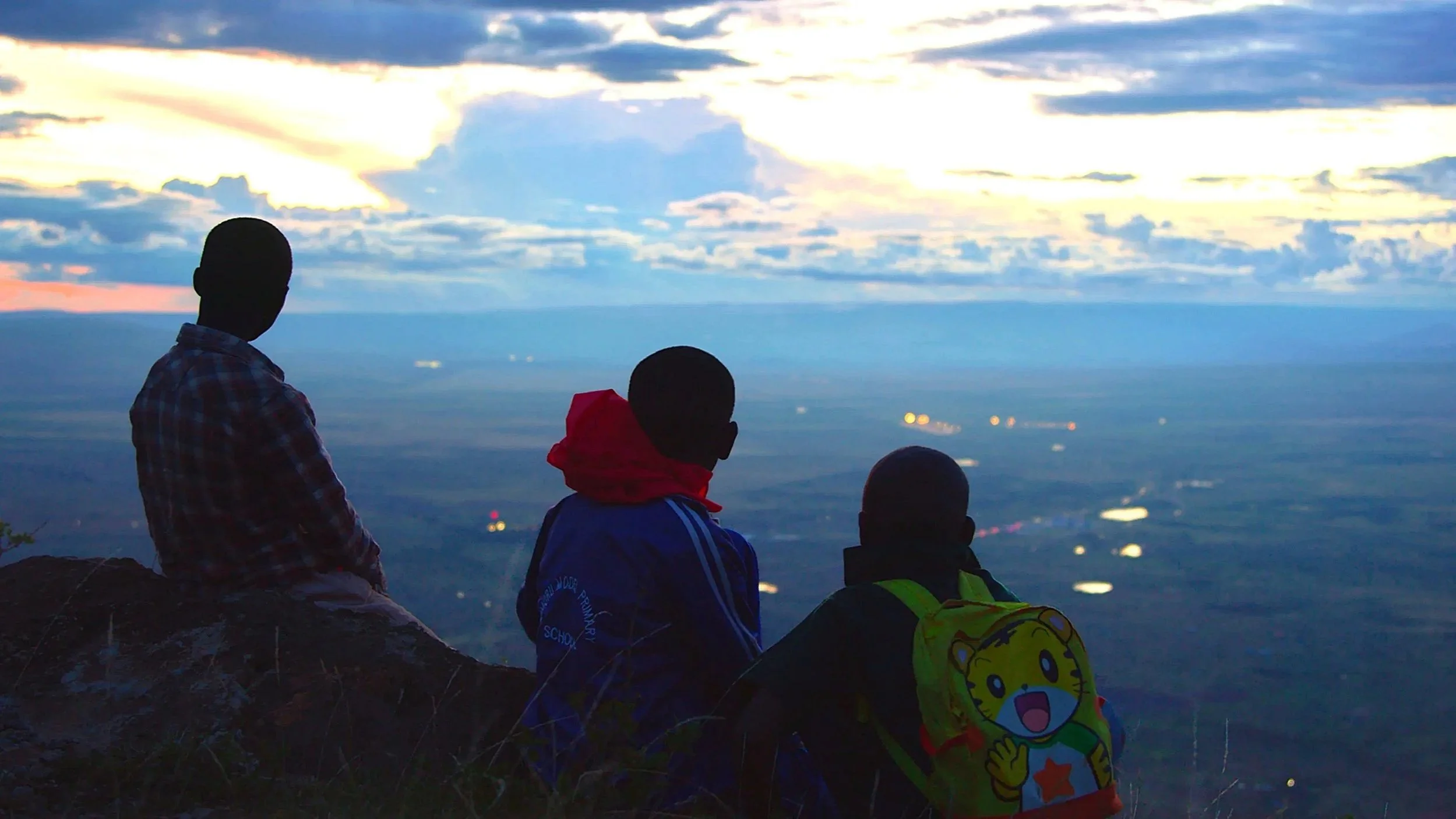
Image courtesy of Journeyman Pictures.
by MANSEL STIMPSON
The abuse of human rights is one of the great tragedies of history and because it remains so prevalent there have been many documentaries in recent times concerned with it. However, until now I have not seen any film tackling that issue head-on in relation to Kenya and furthermore covering both the past and the present. Kikuyu Land seeks to do just that and that gives it importance. It is a work containing sequences that stand out and achieve exactly what was intended. But, when viewed as a whole, it has to be said that the film is sadly lacking in effective organisation and shaping.
Kikuyu Land was made by two directors, Andrew H. Brown and Bea Wangondu both of whom have special links with Kenya. In Brown's case, although he was born and raised in Alaska and is of mixed ancestry (part Huron-Wendat and part Scottish), he has now spent a considerable time working in sub-Saharan Africa. Indeed, his first feature film, Between the Rains (2023), was like this one made in Kenya. For that earlier work he shared the directorial credit with a Kenyan, Moses Thuranira, and he does so again in Kikuyu Land since Bea Wangondu is from Nairobi. She is also the founder of one of the companies which produced this film and, being in addition a journalist, we see her here as a key on-screen investigative figure. Brown's contribution balances out however in that, in addition to their shared directorial credit and to both being listed among the film’s producers, he is also the editor and the photographer.
Well qualified as these two are, their decision to create a documentary which weaves in and out between several story threads proves ill-advised. All the stories are worth telling, but jumping from one to another arbitrarily results in a film of bits and pieces. Consequently each one lacks the power and impact which a narrative gains if it is built up step-by-step without turning aside to catch up on some other thread.
At the outset Kikuyu Land introduces us to N’Ganga Mungai who is seeking to reclaim the land that had been his family's ancestral home but which was taken away from them in the 1930s. He has the paperwork to back up his claim and is intent on submitting it for consideration by an independent body, the National Land Commission. His situation is one that links up with enquiries being undertaken by Bea Wangondu. She is bent on investigating current conditions in Kenya's tea plantations which exist on land in the ownership of wealthy corporate owners who keep journalists at bay. But, if Bea is uncovering information about the exploitation of those employed, it soon emerges that a personal story about her own family history is also significant in this context. When she visits relatives, their talk makes it clear that they revere the memory of her grandfather, Joseph Murage Nguribu, as a man of some prominence. However, in the course of her subsequent inquiries about injustices suffered under colonialism she learns that her ancestor had supported the colonialists in ways that make her see him through different eyes altogether.
These specific storylines are joined by yet another one probably intended to underline the lack of education available for poor children in the past but also to stress that, even if things are better now, the pressure on a family to survive may yet prove a decisive factor. Stephen is the 13-year-old son of a tea worker keen on learning and with a lively interest in ants which he studies. Nevertheless, he finds that the need for him to help in supporting his family will override everything else and he eventually concludes that dreams are no longer possible once a child becomes an adult. The scenes with Stephen are certainly valid, but they tend to hold up the other narratives.
Furthermore, in addition to the individual tales that are being followed in the present, Kikuyu Land is also seeking to look back over years of Kenyan history. It is a film about the abuse of rights in colonial times as well as today and this means that a place also has to be found for much historical footage. It ranges from a broadcast by Sir Evelyn Baring, the colonial governor from 1952 to 1959, to the successful bid in 2022 of William Ruto to become president. This aspect extends to newsreel of the arrival in Kenya of King Charles and Queen Camilla sixty years after the country became independent, this material from 2023 being presented with the comment that although some past atrocities were acknowledged there was no apology for them.
Seeking to cover all this ground in a film lasting little more than an hour and a half results in a sometimes rushed work and one which leaves one wishing on occasion that the subtitles had been extended to comments made in English which are sometimes lacking in clarity. But, paradoxically, what makes one most aware of the film’s shortcomings are those sequences that possess the power to stand out and thus contrast with what has been lost elsewhere by bringing too much together. Outstanding is the episode in which one plantation worker speaks out openly whereas others who would probably suffer if identified can only comment anonymously. This is Jecinta Gathoni who, being old now, can afford to have her say about what she endured when she run away to work on a tea farm in 1968. What she describes as pure torture extended to field managers not being held back from making sexual demands and raping those who resisted. They knew full well that with the victims being dependent on their work silence was their only option.
Hardly less striking is the testimony of Officer X who, speaking of modern times, describes his work as including intimidation, torture and assassinations, these being related to both the world of politics and that of business. It is also instructive to learn that the departure of the colonisers did not end oppression since African businessmen adopted the same attitudes and behaviour. Furthermore, in connection with the claim being put forward by Mungai it becomes a major issue when Ruto, a president hostile to the National Land Commission, chooses in October 2025 to shift evaluation authority to the Ministry of Lands instead.
The scenes in the film that most stay in the mind have a force lacking elsewhere due to the structuring problem which is felt for much of the time. One tends to feel that Andrew H. Brown is more talented as a photographer than he is as an editor or director and this comes over the more strongly because the subject matter dealt with in Kikuyu Land deserved a more compelling film. Nevertheless, this piece does have its highlights and what it says emphatically matters.
Featuring N’Ganga Mungai, Bea Wangondu, Jecinta Gathoni, Njenga Mungai, Melanie Jacques and Stephen.
Dir Andrew H. Brown and Bea Wangondu, Pro Moses Bwayo, Andrew H. Brown, Bea Wangondu, Mike Morrisroe and Joseph Njenga, Ph Andrew H. Brown, Ed Andrew H. Brown, Music Nyokabi Kariuki and Keir Vine.
Trifilm Studios/The Bea Company/Journeyman Pictures-Journeyman Pictures.
94 mins. USA/Kenya. 2026. UK Rel: 2 October 2026. Cert. 15.