
Derek vs Derek

Featuring two men named Derek with opposing views, James Dawson’s documentary is the best yet about wilding.
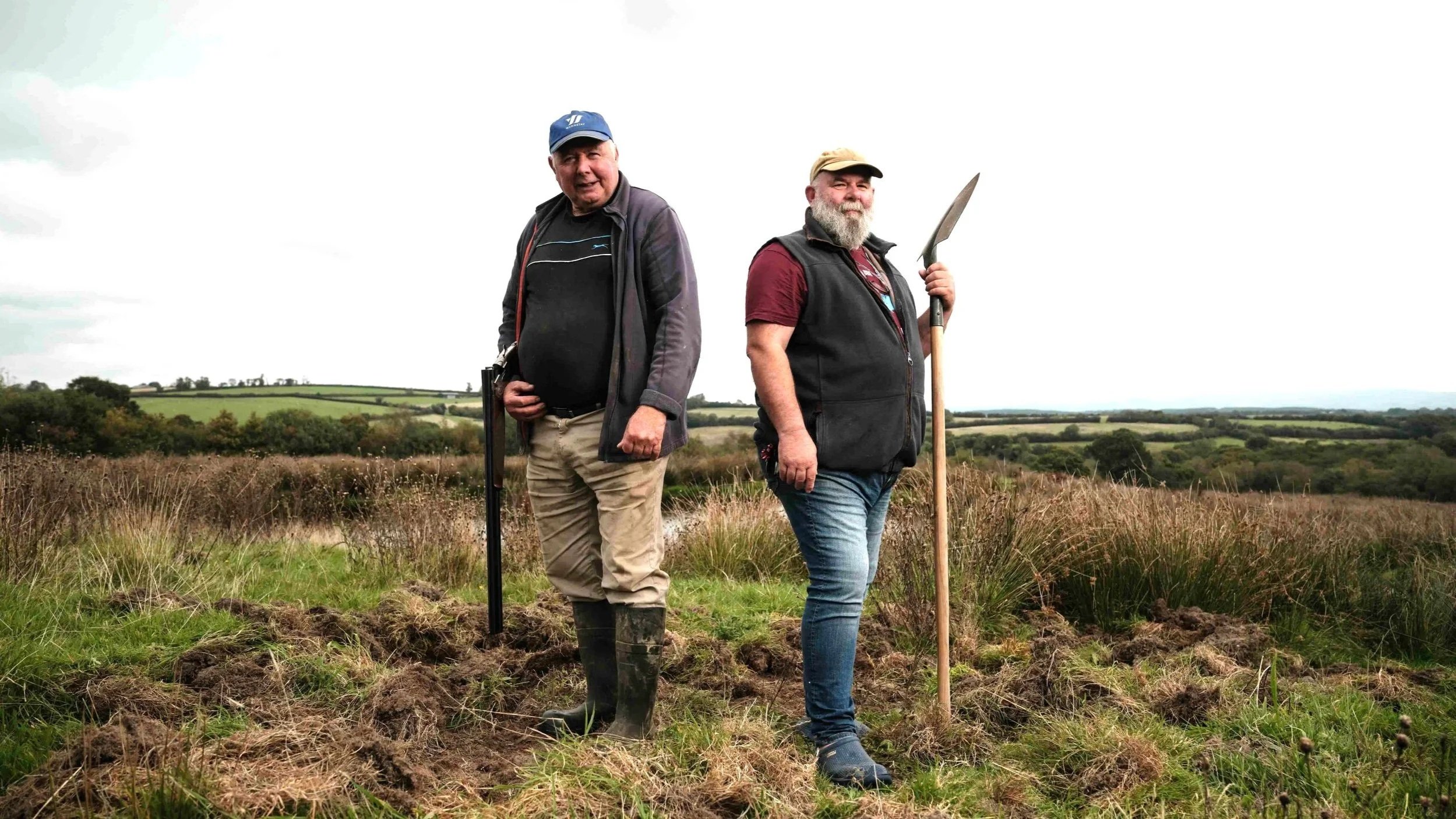
Image courtesy of Dartmouth Films.
by MANSEL STIMPSON
This is the third documentary film that I have seen which deals directly with the subject of rewilding, the belief of many these days that land needs to be returned to its uncultivated state thus encouraging the return of animals some of which are close to extinction. The first of these works I saw was British, David Allen's Wilding which concentrated on how this was being done on the Knepp estate in West Sussex. The second was an American work, Escape from Extinction: Rewilding which looked at rewilding in a wider sense and travelled the world to report on the need to save threatened species. Despite being set in a single location, Devon, this latest piece is in its own way a thorough all-round look at the issue of rewilding. It has at its centre two neighbouring farmers with totally opposite attitudes to it both of whom happen to have the same first name thus prompting the title: Derek vs Derek. In passing I should add that I have also seen The Shepherd and the Bear, but that film rather stands to one side since when touching on rewilding within its broader picture of rural life in France it very much concentrates on one issue arising from that, namely damage done by bears brought in from Slovenia to help animal re-population in the area.
James Dawson’s Derek vs Derek could be considered a modest work but it has been made with remarkable skill and is to my mind far and away the best of these films concerned with rewilding. Although Dawson has mainly worked in television, he has with the aid of his photographer Jon Sayers and his editor James Gold created a work which is always very engaging in its images. Furthermore, having devoted three years to the shooting of it, he has given us a film which finds the two Dereks, who have known each other for twenty years, entirely at ease and natural in front of the camera. The one we meet first is Derek Banbury who inherited his farm from his father and has worked the land for some fifty years. He is devoted to his cows and also grows maize. He embraces intensive farming with a passion and has a son, James, ready to carry on the tradition. In total contrast Derek Gow has turned away from old-style farming and is committed to changing the character of his fields by bringing back wetlands. He talks of having been influenced by the views of the conservationist and naturalist Gerald Durrell and is now aided by an animal husbandry team. As his plans progress, his land is transformed and becomes a natural setting for insects, bees and butterflies and a home for beavers, storks, water voles and wild boar.
But even before the title comes up there is concern over wild boar escaping and not only Derek Banbury but another neighbouring landowner, Tony Bricknell-Webb, are concerned and not least about sheep being at risk. But throughout the film both Dereks are given equal space to express their views and, if Derek G. is passionate about ecological restoration, Derek B. is no less ardent in the cause of industrial dairy farming. We see how the latter loves the neat look of his hedges and how the former instead relishes the sight of uncut hedges which allow nature to flourish within them. As time passes it becomes clear that Derek Gow’s changes make his land ever more pleasing but we learn too of how conditions for traditional farmers are growing even harder and are leading to suicides. A further feature of Derek Gow’s own commitments is to be found in conferences which he sets up locally and one included in the film centres on wolves. Again it's a disputatious subject since wolves help to regulate animal life but this protected species can roam and kill so that in some countries wolfdogs are employed to keep them at bay.
The quality of the filming here and the balanced approach which prevents this film from seeming like a one-sided propaganda piece are enough to make this a winning work. Nevertheless, what makes it specially memorable is the appeal inherent in the personalities of the two Dereks. At times both of them – and indeed others in the film too – can be blunt (Derek vs Derek has a ‘15’ certificate largely due to some strong language) but the key factor about them is that, while not unusual enough to be labelled eccentrics, they can be seen as real characters, people whose outlook and manner especially in their interconnection makes them very engaging company. Banbury is the more outspoken but Gow, if less overtly hostile, never softens his views and one could imagine a TV comedy series based on their conflict. The situation has an inherently humorous side and that is added to by the fact that Derek Banbury’s wife, Linda, who benefits from letting out holiday cottages whenever Derek Gow holds one of his conferences, is somewhat sympathetic to Gow’s views and never fully endorses those of her husband.
All of this comes over very attractively helped by two special factors: one lies in the fact that the two Dereks never seem to be playing up to the camera for effect and the other is that, regardless of the conflict in their views, there is no sense of underlying personal hatred. Indeed I was reminded of the short story by W. Somerset Maugham entitled Sanatorium in which two inmates of that establishment, McLeod and Campbell, are famed for their hostility to one another despite which the eventual death of one leaves the other feeling bereft. The final scenes in Derek vs Derek find Derek Banbury less emphatic in his views and the film itself points to the fact that the two methods of farming should not be viewed in terms of either/or. Consequently James Dawson’s film scores both on the appealing personal level which is English through and through and as a study of rewilding which provides food for thought without being over-didactic. It’s a winner.
Featuring Derek Banbury, Derek Gow, Linda Banbury, James Banbury, Tony Bricknell-Webb.
Dir James Dawson, Pro Serena Kennedy, David Broder and James Dawson, Ph Jon Sayers, Ed James Gold, Music Alexander Parsons.
Damer Films/The Slate Works/The Redford Center/Loupe Films-Dartmouth Films.
88 mins. UK. 2026. UK Rel: 2 October 2026. Cert. 15.
