
Kinaesthesia

The fantastic side of silent cinema is celebrated in Gerald Fox’s valuable survey indebted to the ideas of Vlada Petrić.
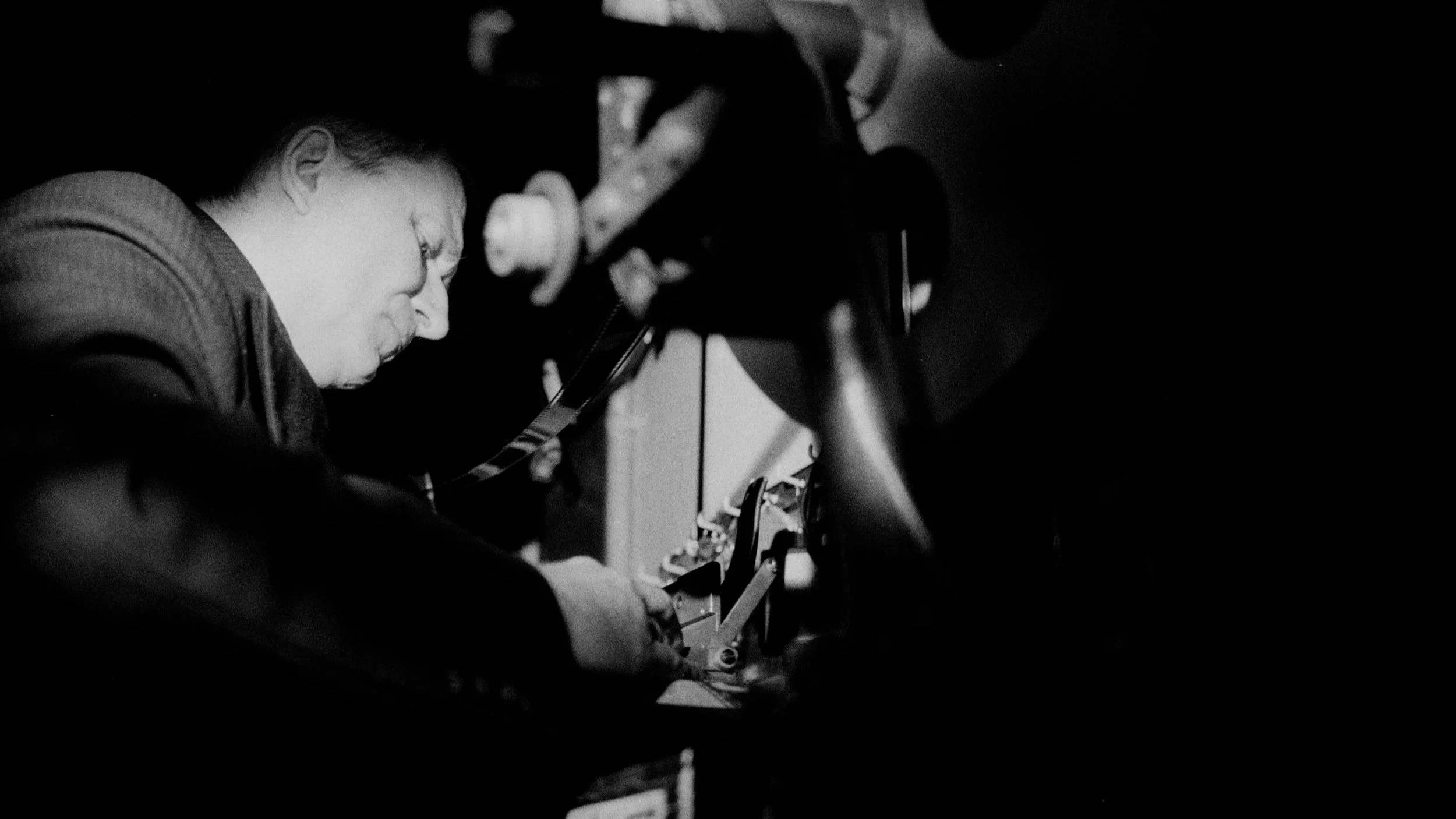
Image courtesy of Tull Stories.
by MANSEL STIMPSON
Described in its publicity as a documentary essay, Gerald Fox’s Kinaesthesia is both a homage to silent cinema and to an individual. The latter is Vlada Petrić who died as recently as 2019. He was a film historian and had been a professor of film studies at Harvard University where Fox studied under him. It is Fox himself who speaks the commentary to his film but, while also quoting from some of those who were directly involved, the text largely comes from an essay by Petrić which dates from 1978 and was entitled ‘Film and Dreams’. As for the title of the film, Fox recognises that the term ‘kinaesthesia’ will not to be familiar to all and accordingly offers a definition of it at the outset. We are told that it refers to the sensation of movement experienced when sensory motor centres in the brain are activated and this happens not only when human beings dream but also when an individual in a seat in a darkened cinema is impacted by screen images designed to encourage that response.
It is cases of this kind that Fox makes the focus of his film and that gives it a particular character. Cinema is a medium noted for two contrasted elements: on the one hand it can offer a sense of realism, of naturalism indeed, that puts it in a different world from that of the theatre but on the other hand it is capable too of flights of fantasy that cannot be matched on any stage. By bringing up the theme of kinaesthesia Fox is firmly opting to concentrate on non-realistic works which he finds in plenty in films made between 1902 and 1929. Indeed, by bringing together so many examples Kinaesthesia has no trouble at all in creating a sense of wonder in the viewer aided by the fact that the numerous extracts seen are from the BFI's National Film Archive and have been digitally remastered. If there are viewers who come to see this documentary having never previously viewed any silent films (and it would be a good place to start) they will surely be bowled over by the inventiveness revealed.
In effect Kinaesthesia is divided into five sections. It begins with the work of the early pioneers including Georges Méliès, Edwin S. Porter and D.W. Griffith and already it reveals how the titles selected will often be relatively little known. Thus, Griffith is represented by his 1914 short The Avenging Conscience: or ‘Thou Shalt Not Kill’ based on a work by Edgar Allan Poe. Going from country to country (Victor Sjöström in Sweden, René Clair in France etc.), the first part of the film follows developments in chronological order. Both features and shorts are included here and among the longer films there are both those which are essentially dreamlike disturbing works and a number which appear because a dream sequence is included at some point. Abel Gance’s Napoleon is an instance of the latter category while the short films include both the unfamiliar (1928’s The Life and Death of 9413 a Hollywood Extra) and the famous (Germaine Dulac’s The Seashell and the Clergyman and Jean Epstein's The Fall of the House of Usher both from 1928). Intriguingly one short item of which I was ignorant is Dimitri Kirsanoff’s Ménilmontant (1926) which was an absolute favourite of the critic Pauline Kael.
The second and fourth sections of Kinaesthesia take a look at German and Soviet Cinema respectively thus bringing in many famous titles and distinct national styles, German expressionism as developed early on (The Cabinet of Dr Caligari, 1919; Nosferatu, 1922) and the Russian emphasis on montage especially in the films of Eisenstein (a dream episode from 1929’s The General Line follows a less well-known example from the same year, Fridrikh Ermler’s Fragment of an Empire)). Between these two segments the film turns to comedy including fantasy scenes that feature Chaplin and Keaton.
The concluding part of Kinaesthesia brings us to the end of the silent period and to Buñuel’s Un Chien Andalou (1929) before going further ahead to cover relevant echoes of the style that had been established and which would appear in Vigo’s Zero de Conduite and L’Atalante in 1933 and 1934 respectively. Nor does Fox omit the work of Maya Deren whose famous short of 1943, Meshes of the Afternoon, was indeed silent. All told Kinaesthesia is a valuable and rewarding film, one that is further enriched by the excellent music score created for it by Alan Snelling.
The one reservation that I do have about this film covers the on-screen appearances of a man seen at intervals watching the old films. Not least when seeing him seated in a London cinema, the Phoenix at East Finchley, I assumed that he must be Gerald Fox, but apparently it is the actor Goran Kostic representing Professor Vlada Petrić to whom the film is dedicated. The use of his words in the commentary is ample tribute in itself and this extra visual touch is surely unnecessary. It even to my mind becomes disturbing when with technical virtuosity the actor is seen again, this time blended into the film extracts. This could be regarded as playful, or clever, or both, but I find it distracting and misguided. For some of course it may add extra appeal but, even if you should share my feelings, it doesn't prevent Kinaesthesia from being anything other than a most welcome and educational work. It even contains one moment of total surprise: given the character and charm long associated with the films of René Clair it is positively astonishing to discover that in 1926 he made a short film entitled Le Voyage imaginaire containing a violent nightmare scene featuring a dog and a guillotine!.
Cast: Goran Kostic, Ana Cilas, and the voice of Gerald Fox.
Dir Gerald Fox, Pro Gerald Fox, Screenplay Gerald Fox, Ph Douglas Hartington, Art Dir Ian White, Ed Dasha Cowley and Gerald Fox, Music Alan Snelling, Costumes Dasha Cowley.
Foxy Films/BFI/Kinopravda Institute-Tull Stories.
97 mins. UK. 2025. UK Rel: 17 April 2026. Cert. 15.