
Miroirs No. 3

Christian Petzold still manages to surprise with his intimate, psychological drama set in present-day Germany.
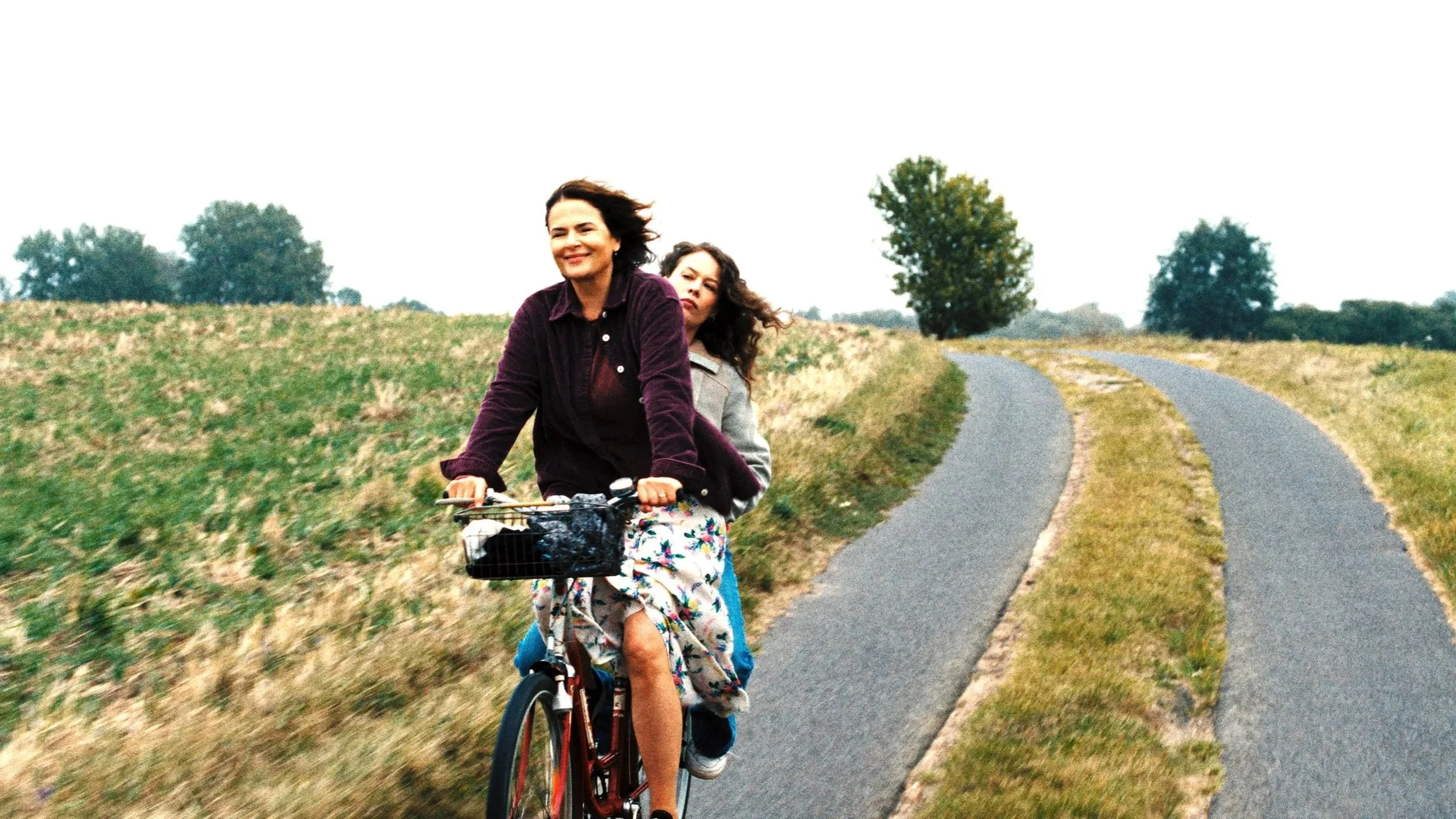
Image courtesy of New Wave Films.
by MANSEL STIMPSON
This is a film of such individual character that it might well be accurate to describe it as unique. It certainly surprised me since this is a work by the esteemed German director Christian Petzold and I thought that I knew what to expect from him. As it happens, I have often found that I was less enthusiastic about his films than most critics were and one reason for that lay in the fact that, despite being well acted and often possessed of strong potential, his offerings frequently developed in ways that to me came to seem contrived and unconvincing. This film’s immediate predecessor, 2023’s Afire, was seen as rather uncharacteristic being a more intimate work than usual with a relatively small cast, but it still in my eyes suffered from the same faults (its character may have been influenced by the shooting conditions since it was made during the Covid epidemic). However, with Miroirs No. 3, the title referencing Ravel’s piano composition also known as ‘Une barque sur l’océan’, we have a work which is even more distanced from what Petzold has given us before. In many ways I like it a lot, although I do have reservations about its conclusion.
While I can say that I regard this new film as well worth a look, I have to acknowledge that reviewing it poses a certain problem for the critic. That is because I regard it as one of those works that ought to be viewed with as little knowledge of what unfolds as possible. Indeed, I think that even disclosing in any detail what happens about ten minutes in would be a mistake. I can however state that once again the leading actress is the ever-excellent Paula Beer (this being her fourth such role in a row for Petzold) and that here she appears as a piano student named Laura. Berlin is Laura's home but most of the film takes place in a rural area consequent on an accident that finds Laura herself being looked after by a local woman who is unknown to her, Betty (Barbara Auer). What follows is very much centred on these two women, on Betty's husband, Richard (Matthias Brandt), and on their son, Max (Enno Trebs).
We are aware from the outset that Miroirs No. 3 has a different flavour from Petzold’s other films. Although not without drama (as instanced by that accident) this is a quiet film even in the sense that it does not feature a music score. Because Laura has been studying music we do hear her at the piano playing Chopin and Ravel but very briefly (a fact that renders the choice of title for the film rather strange)). It is possible that we are being invited to regard both Laura and Betty, who is older, as akin to boats adrift in that we come to realise that both have encountered unsettling problems in their lives – what Betty’s is will ultimately be revealed, but Laura's is less clear although we find her ill-at-ease at the very outset of the film.
The way in which Betty looks after Laura is motivated in many ways that we may soon start to guess. But, while the sense of everyday reality is maintained in preference to moving into big dramatic gestures, there is a strange sense that the meeting of Laura and Betty was predestined and that their involvement, whether it proves beneficial or not, is a matter of fate. Although Paula Beer's Laura is the pivotal figure, Barbara Auer is very well cast as Betty and both actresses capture the feelings of these two women very well indeed. The other players are fine too, so we find ourselves held by the narrative despite its lack of big bold gestures.
If in the past I have often criticised Petzold's writing, I have in contrast to that always admired his directorial skills and, working here with such regular associates as photographer Hans Fromm, editor Bettina Böhler and costume designer Katarina Ost, he once again comes up to the mark. Even such details as the choice of a song which we hear being played – ‘The Night’ by Frankie Valli and The Four Seasons – add to the film’s particular atmosphere. But what looks set to be satisfyingly original and intriguing ultimately seems to go somewhat awry. For one thing that sense of predestination which is so well caught at the start doesn't really follow through. But the main problem lies in the way in which the film concludes. Given that I have often accused Petzold’s screenplays of being guilty of contrived and unconvincing plot elaborations, it is rather ironic that the trouble with Miroirs No. 3 lies in its ending being not only abrupt but underdeveloped.
That said, I still find this a pleasingly individual film. Bearing in mind too the quality of the acting, I find that, regardless of any ultimate sense of disappointment, Miroirs No. 3 is far more to my taste than Petzold’s previous work.
Cast: Paula Beer, Barbara Auer, Matthias Brandt, Enno Trebs, Philip Froissant, Hendrik Heutmann, Victoire Laly, Christian Koerner, Mehmet Kucak, Yee Him Wong, Marcel Heuperman.
Dir Christian Petzold, Pro Florian Koerner von Gustorf, Michael Weber and Anton Kaiser, Screenplay Christian Petzold, Ph Hans Fromm, Pro Des Kade Gruber, Ed Bettina Böhler, Costumes Katarina Ost.
Schramm Film Koerner Weber Kaiser/ZDF/Arte-New Wave Films.
86 mins. Germany. 2025. US Rel: 20 March 2026. UK Rel: 17 April 2026. Cert. 15.
