
Kontinental ’25

Following his masterly Do Not Expect Too Much from the End of the World, Radu Jude’s latest critical look at Romanian life has little to add.
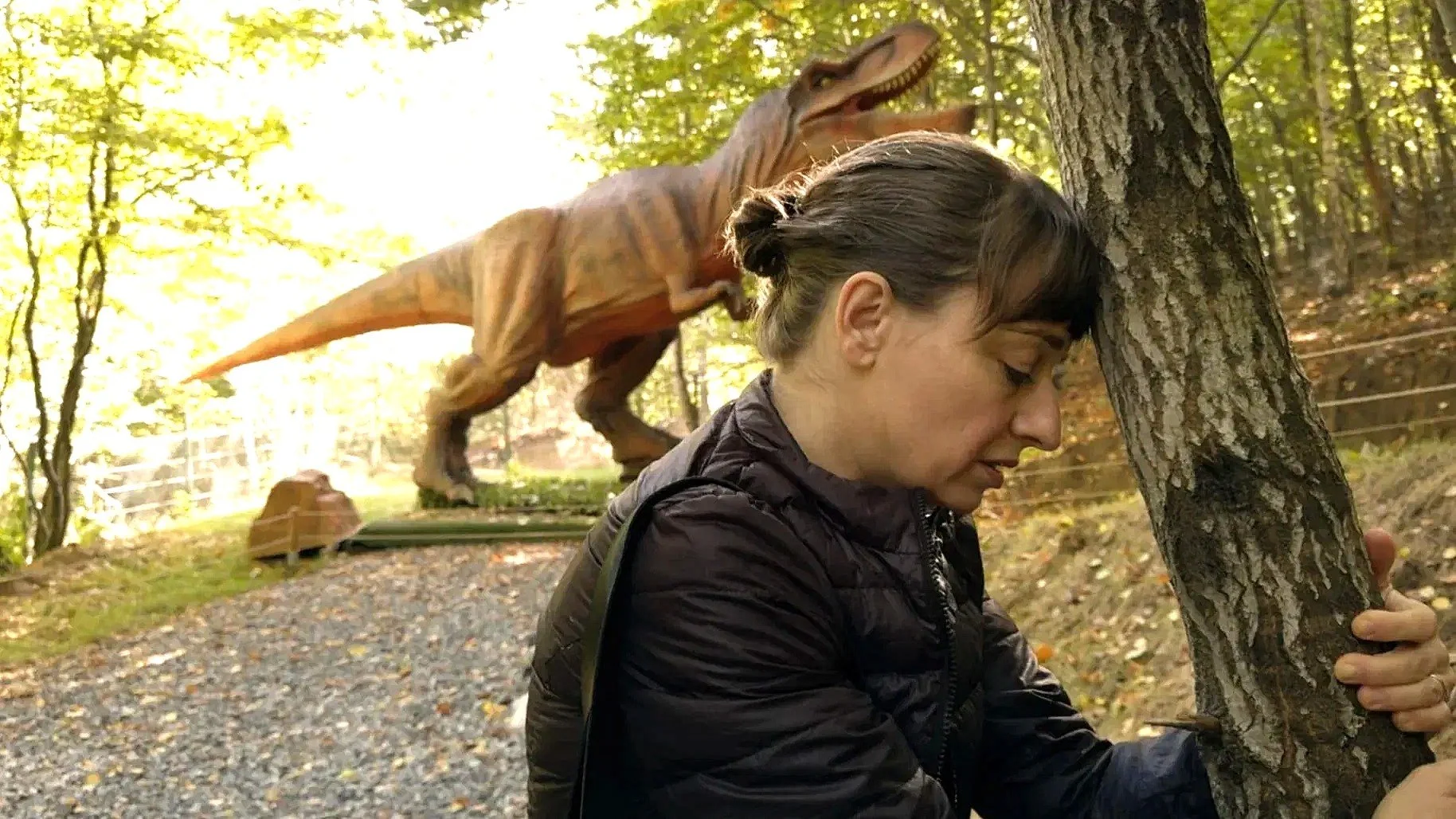
Park life: Eszter Tompa
Image courtesy of Sovereign Films.
Romania's Radu Jude is a prolific filmmaker and Kontinental ’25 is the fourth feature of his to be released in the UK. The first of these was 2009’s ironically titled The Happiest Girl in the World which I described as the bleakest of comedies and which left me not entirely sure how to respond to it. It was not until I saw his 2021 movie Bad Luck Banging or Loony Porn that I had the opportunity to get a clearer view of the extent to which Jude's view of life in the 21st century blends the tragic and the comic. It was also a work that has confirmed his reputation as a provocateur but, if its title played up to his wish not to censor out depictions of sex, the film also underlined his serious concerns over such matters as racism, antisemitism and homophobia. But, while Jude’s aims were already becoming clearer, it was with 2023's Do Not Expect Too Much from the End of the World that he found a way to express to the full and in his own unique style his despairing view of contemporary society, its absurdities and its deep-seated prejudices. Lasting all of 163 minutes, this bold venture may have been overlong but it still came close to being a masterpiece, a skewering of Romanian society which seemed equally devastating as a view of the wider world today.
That is the context in which Kontinental ’25 reaches us and unfortunately the success of its large-scale predecessor makes it feel redundant. Since making it Jude has filmed his own version of Dracula and is even now working on a Romanian tale which will be linked to the Frankenstein story so, while these may well prove unconventional treatments, they may nevertheless evidence a break from his previous concerns. But for now Kontinental '25 offers exactly the same kind of critique of society that was so effectively present in Do Not Expect Too Much from the End of the World but far less adroitly handled here and without sufficient new insights to justify making it. This time the setting is Cluj-Napoca the Romanian city in the country’s Transylvania region, an area in which the presence of various peoples (Hungarians, Germans and Roma as well as Romanians) makes it a hotbed of nationalism linked to strong hostility to foreigners and migrants. That aspect is certainly emphasised here, but it was also central in another recent Romanian film, Cristian Mungiu’s R.M.N. (2022), which was more conventional than Jude in its approach but was also far more effective.
Although Kontinental ’25 proves to have so much in common with what Jude has done before, a description of its plot could lead one to expect something rather different than what is actually on offer. The pivot of the film is the reaction of a bailiff named Orsolya Ionescu (Eszter Tomba) to the fate of a 62-year-old man, Ion Glanetaşu (Gabriel Spahiu). He is somebody who had in his youth been an Olympic athlete but who in later life following an accident had become first an alcoholic and then homeless. The opening scenes of the film show him wandering around muttering obscenely the while and picking up litter. He also regularly accosts people initially asking them for a job but then simply begging for money. He is at this time living in a basement boiler room but has been served with an eviction notice which he is ignoring. This is where Orsolya comes to his door and if this were a Ken Loach film she might well be portrayed as a heartless figure. But not so here. She has tried to help Ion before and now gives him time to collect his things together before getting him to leave. However, when she returns, she finds that he has hanged himself. What follows portrays her feelings of guilt over this even though she had not been legally to blame and had been as sympathetic as possible in carrying out her job as bailiff.
Such a plot suggests the kind of film which would be in line with past humane social dramas told in a straightforward manner and which cause one to sympathise with the put-upon characters while simultaneously registering the potential heartlessness of the system. However, Kontinental ’25 turns out to be a very different proposition, a stylised work which in telling this personal story largely features a series of conversations shot in static takes. These find Orsolya talking in turn to a friend, Dorina (Oana Mardare), to her mother (Annamária Biluska), to a former student from the days when she was a teacher, Fred (Adonis Tanta) and to a priest (Serban Pavlu). Each time Orsolya repeats the story of what happened to Ion just as she had done when reporting it in the first place. Rather indirectly we learn of how the incident became a news story with the media blaming her and emphasising that it was a case in which she, a Hungarian, was involved in the cruel death of a Romanian. That element would be a reason to be sorry for her but, since her sense of guilt does not seem to be built on disgust of the system as such, one feels that her criticism of herself is not really understandable.
Nevertheless, the film would seem to approve of her self-criticism, despite it being a stance not echoed by those to whom she talks. Dorina is far more guilty as appears from her own story about another homeless man and throughout the film features intercut images of the city which lead up to a final lengthy montage emphasising the building development going on for profit and all too clearly for the upper classes at the expense of the poor. But Orsolya’s personal story hangs fire being repetitive and with little development. Furthermore, if she is to be seen as the one person with a conscience it seems inappropriate that she should respond positively to the inhumane views expressed by the priest in the film’s strongest scene. Her own religious beliefs do not excuse this. Meanwhile Jude adds another element by incorporating many references to films (the titles that come up in passing include Perfect Days, Detour, Europa ’51 and even the 1962 Romanian film A Bomb Was Stolen). More relevant are references to Gaza and Ukraine and to Hungary’s Viktor Orbán approved of by her mother but not by Orsolya herself. But if this is slightly more up-to-date it still only echoes much of what Jude had commented on earlier, his satire is no longer fresh and this time around it is contained in a story with characters who, well enough acted, mean much less to us. The one positive feature here is that although shot on an iPhone the photography, which is once again by Marius Panduru, is very fine indeed. There are times when Jude makes us feel uncomfortable which is often one of his aims, but if one has seen Do Not Expect Too Much from the End of the World there seems little reason to seek out Kontinental ’25.
MANSEL STIMPSON
Cast: Eszter Tompa, Gabriel Spahiu, Adonis Tanta, Annamária Biluska, Ilinga Manolache, Oana Mardare, Serban Pavlu, Adrian Sitaru, Marius Damian, Nicodim Ungureanu, Dan Ursu, Vlad Semenescu.
Dir Radu Jude, Pro Alexandrou Teodorescu and Rodrigo Teixeira, Screenplay Radu Jude, Ph Marius Panduru, Pro Des Andreea Popa, Ed Catalin Cristutiu, Music Matei Teodorescu, Costumes Ciresica Cuciuc.
Saga Film/RT Features/Bord Cadre Films/Sovereign Films/Paul Thiltges Distribution-Sovereign Films.
109 mins. Romania/Brazil/Switzerland/UK/Luxembourg. 2025. UK Rel: 31 October 2025. Cert. 15.
