
Palestine 36

What Palestinians suffered in the 1930s is unconventionally but brilliantly recalled in Annemarie Jacir’s drama that is all too relevant now.
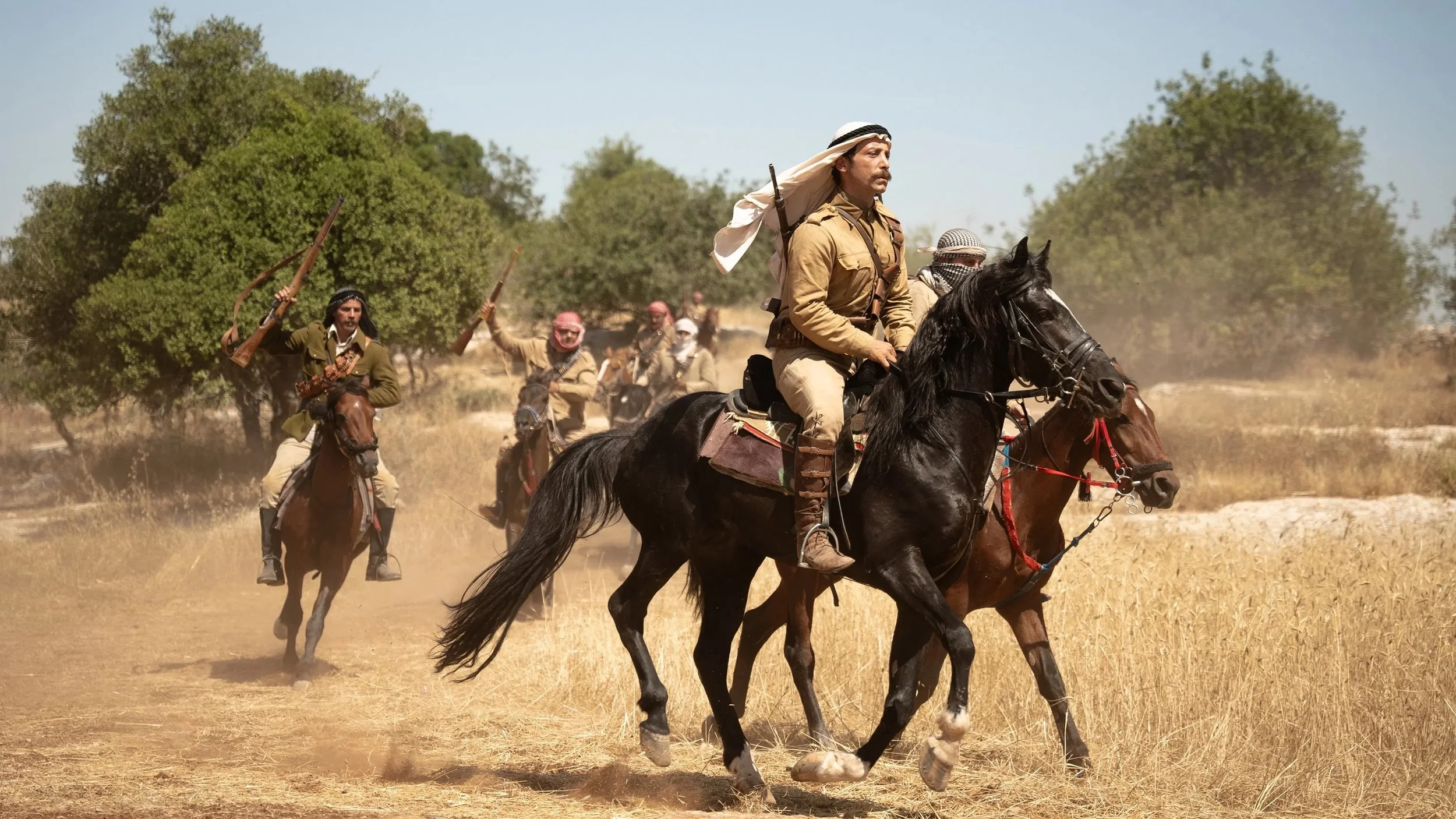
Image courtesy of Curzon Film Distributors.
This truly remarkable film is a triumph for its writer/director Annemarie Jacir. She is Palestinian and that fact is reflected in the subject matter of her films including the impressive Wajib made in 2017. In Palestine 36 she offers a period piece with fictional characters yet one firmly rooted in the events of 1936 and 1937 when her country was under what virtually amounted to colonial rule by the British. That control was pursuant to a League of Nations Mandate in 1917 which implemented the Balfour Declaration supporting the creation of a natural home for the Jews and encouraging the arrival in Palestine of Jewish immigrants from Europe. In showing how the Palestinians suffered in consequence – a situation seen at its most extreme when the village of Al Bassa was the scene of a massacre by British forces in September 1938 – this film is a potent reminder that any view of current events in Gaza needs to be considered in the context of much older history than the appalling attack on Israel by Hamas on 7th October 2023. By recreating on screen the events of the months leading up to what happened at Al Bassa, Jacir's film might have emerged as an exercise in propaganda but it has such depth and conviction that that potential limitation is transcended.
What Jacir does here is to bring back to life history that should not be forgotten but there is added interest in the fact that the form which she has used to do this has resulted in a film structured in a way that is most unusual but also very effective indeed. In the course of a running time of two hours Palestine 36, admirably shot in widescreen by three photographers including the great Hélène Louvart, takes on an epic quality with occasional echoes of the large-scale works of David Lean. Nevertheless, it handles its very wide range of characters in a most novel way. The setting switches back-and-forth between Jerusalem and the village of Al Bassa and if the narrative has a central figure, it is a young man named Yusuf (Karim Daoud Anaya). His role is pivotal in that he is the link between the two locations since he comes from the village but is employed as a driver by a noted journalist, Amir (Dhafer L’Abidine), who lives in Jerusalem.
As the film proceeds, we meet a large number of people. Those in the village include one family in particular. It consists of a young widow, Rabab (Yafa Bakri), who is friendly with Yusuf, her parents (Hiam Abbass and Kamel El Basha) and her daughter, Afra (Wardi Eilabouni). The latter is close to Kareem (Ward Helou) who is of a similar age and the son of the village’s Christian priest (Jalal Altawil) and in this rural setting we encounter too a freedom fighter, Khalid (Saleh Bakri), who is a leading figure amongst those rebelling against the changes taking place. Meanwhile in Jerusalem we find not only Yusuf’s employer Amir but also his wife Khuloud (Yasmine Al Massri) who is also a journalist in her own right and one who proves to have very different views to those of Amir when it comes to taking a stand politically. It is, of course, also in Jerusalem that we are introduced to those who have come out from Britain to be present in their professional capacities. These include the rather wry but dutiful high commissioner (Jeremy Irons), his secretary Thomas (Billy Howle) who becomes disturbed by how the Palestinians are being treated and Captain Wingate (Robert Aramayo) a staunch supporter of Zionism notably lacking in humanity. Wingate is the one figure who is undoubtedly seen as a villain but it seems fair enough to believe that such people did exist and the fact that Aramayo is cast in this role does enable him to show his range since this character could hardly be further away from the sympathetic lead role that he took recently in I Swear.
In a conventional film all of these characters would be treated as being involved in various little plot lines that would to some extent thread together but in Palestine 36 the central narrative essentially consists of a portrait of the situation in Palestine over these months with matters intensified when the Peel Commission recommend that the land be partitioned into an Arab state and a Jewish state accompanied by the relocation of people necessary to do that. The characters invented by Jacir are subsidiary to that history and function less as individuals caught up in personal tales than as figures representing a range of people who find themselves in this situation. As such they are part of a mosaic which amounts to a portrait of Palestine at this time. It is an approach that could have yielded figures set up all too obviously to fill this function. But fortunately, the fine cast, who play admirably as an ensemble, and the quality of the writing, which renders all of these people so real, together yield a film which feels absolutely authentic. The music score by Ben Frost is suitably controlled, the period sense is admirably managed and the thirties are further evoked by the inclusion of archive footage from that period colourized to fit in but made to feel part and parcel of the whole.
In theory jumping from figure to figure could have made the film feel disjointed but placing the tide of events at its centre gives the film its unity and unexpectedly it was only the last section which seemed a mite fictional on account of the way in which the fate of the various characters brings them closer together to form a climax. That reservation on my part may have been unfair and it might have been alleviated had I known beforehand that the massacre in Al Bassa was a tragically real event. It is only in the end credits that this is stated and looking up the historical details subsequently on the internet revealed to me just how close to the facts the film is. But any weakness here is a minor point given that Palestine 36 is so original in character and so successful both as a powerful historical drama reflecting real-life events and as a stark comment underlining the need to regard what is happening in Gaza today as part of a continuing history. Annemarie Jacir could not be more forthright regarding her intentions here. The film’s end credits include a specific dedication which reads "For our people in Gaza in the years the world failed you".
MANSEL STIMPSON
Cast: Karim Daoud Anaya, Hiam Abbass, Yafa Bakri, Ward Helou, Robert Aramayo, Saleh Bakri, Wardi Eilabouni, Yasmine Al Massri, Dhafer L’Abidine, Billy Howle, Jalal Altawil, Jeremy Irons, Liam Cunningham, Kamel El Basha.
Dir Annemarie Jacir, Pro Ossama Bawardi, Screenplay Annemarie Jacir, Ph Hélène Louvart, Sarah Blum and Tom Fleming, Pro Des Nael Kanj, Ed Tania Reddin, Music Ben Frost, Costumes Hamada Atallah.
Philistine Films/BBC Film/BFI/Autonomous/Film i Väst/Snowglobe Films/Cocoon Films-Curzon Film Distributors.
120 mins. France/Occupied Palestinian Territory/Qatar/Saudi Arabia/UK/Denmark/Jordan/Norway/USA/Sweden/Australia. 2025. UK Rel: 31 October 2025. Cert. 12A.
