Late Fame

Kent Jones’ fourth feature, about a rediscovered poet, is inconclusive and unclear, but Willem Dafoe is outstanding.
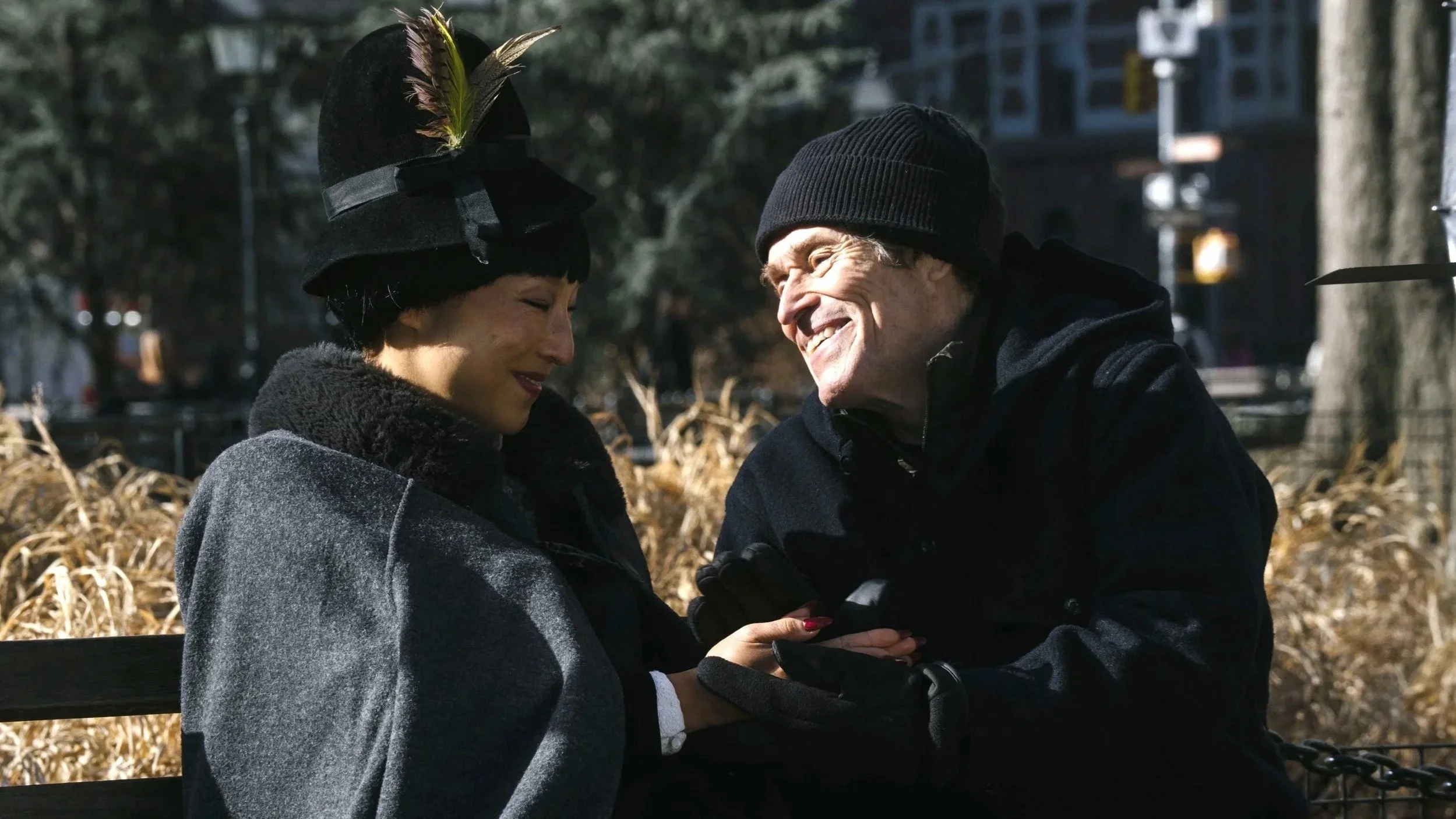
Greta Lee and Willem Dafoe
Image courtesy of Vertigo Releasing.
by MANSEL STIMPSON
Until now I knew the work of Kent Jones only through his 2015 documentary Hitchcock/Truffaut. Three years later he would direct his first feature with actors, Diane, for which he also wrote the screenplay, but that film was not distributed in the UK. Consequently, I was not quite sure what to expect of his latest piece, Late Fame. He is not the writer this time, but this new work again features actors and it suggests that Jones is a filmmaker drawn to material for thoughtful audiences. Indeed, Late Fame is an adaptation of a novella by the distinguished Austrian author Arthur Schnitzler as undertaken by Samy Burch previously known as the author of the screenplay of the Todd Haynes film May December (2023). Schnitzler’s work had been written in 1895 but was only published in 2014 after the lost manuscript of it was found. However, this film treatment transfers the setting from Vienna to New York and, while being somewhat vague as to any exact date, chooses to modernise it.
Many critics have already described Late Fame as a piece reminiscent of the work of Whit Stillman and that seems entirely apt especially if one considers it in relation to Stillman's very first feature, Metropolitan (1989). That movie like this one was set in Manhattan and both films while sensitive to the New York setting are works in which dialogue rather than action is the key feature. When Metropolitan appeared and earned Stillman an Oscar nomination for best screenplay, it caused me to reflect that films with literate and witty screenplays (the kind of thing which some forty years earlier had been associated with Joseph L. Mankiewicz in particular - works such as A Letter to Three Wives and All About Eve) had become all too rare. If that was true by 1990, it has become even more pronounced today with far too little coming out of present-day Hollywood that offers writing of that quality. The fact that Late Fame echoes such works is an attraction in itself and, in addition to that, it enables its leading actor, Willem Dafoe, to give a performance that could well be his best yet.
The style and tone of Late Fame may put one in mind of Metropolitan but in point of fact the similarities do not end there. Despite major differences in its development, the plot itself is reminiscent of Stillman's film. It too featured a group of well-off New Yorkers who, being young adults from elite families, had limited experience of life. Nevertheless, having been well educated, they sought to meet regularly and to socialise while talking about philosophy and art. Stillman introduced us to these people by making the film’s central character an outsider from New York's West Side who is enticed into joining them when he meets the leader of the group. That is also the way in which Late Fame begins, but here the outsider is not a youngster but a man named Ed Saxberger who, like Dafoe who plays him, is about seventy years old. He is somebody who works as a post office sorter and has done so for many years. However, back in his youth he had been an aspiring poet and in 1979 had published a book of poems entitled Way Past Go.
It is a copy of this book which has been unearthed by Meyers (Edmund Donovan) who is the head of a writers’ group largely made up of his rich male friends. They are all would-be writers of various kinds and among them we find Carmichael (Arthur Langlie), Winn (Luca Padovan), Sherfey (Graham Campbell) and Brussard (Clay Singer). Also attached to the group is the only woman, Gloria (Greta Lee). She belongs despite being somewhat older and from a different background and she alone is employed since she works as an actress and as a singer. In contrast Meyers and his male friends, whether or not possessed of some talent, give the impression of being dilettantes who pride themselves on their cultural interests. They admire writers of an earlier age such as the poet William Carlos Williams and the poet and novelist Charles Bukowski and despise young men of their own age who, far from being appreciative of the written word, spend their time talking on their phones. Indeed, in emulation of past artistic groups Meyers has named his group The Enthusiasm Society.
It is this outlook that has led Meyers to recognise Ed Saxberger on the street and to his telling him that, although his book has been largely forgotten, he regards Way Past Go as a work of genius ripe for rediscovery. Having persuaded Ed to meet the group, he eventually proposes that a reading from his work be included as part of a presentation that the group is planning - possibly even a new poem although Ed has become resigned to regarding his poetry as a thing of the past. That he is lured in by this proposal and ready to agree to it is partly down to his being attracted by the flirtatious Gloria.
Despite the early echoes of Metropolitan, Late Fame becomes in thematic terms something entirely different. It is in part a study of a man who, having become content with a quiet and very ordinary life, is attracted by the adulation now offered up to him. He even toys with the idea of resuming his role as an artist although it will soon become apparent that he has now lost his skill as a poet. What unfolds is also a tale which contrasts real artists with those who just play at it. From what we hear of Ed's work (a poem of his from Way Past Go features in a key scene), it is clear that his talent had been authentic and, similarly, although Gloria is always play-acting to appeal to those around her, a full-length rendition by her of the Brecht-Weill song ‘Surabaya Johnny’ is evidence that she too is the real article. By comparison Meyers and his buddies seem like poseurs, although that may be too harsh a term for young men whose entitlement has left them free to see themselves as potential playwrights or essayists.
All of this makes for interesting material that is refreshingly different from the kind of films dominant today. The ideas in play are involving, but ultimately the screenplay feels too inconclusive as to what it wants to say. Meyers and his friends are not caricatured but if they are self-deluded that could make them figures of underlying pathos, something which is never even touched on here. In Gloria’s case, we learn late on something of the reality behind her facade but cannot be certain how we are meant to regard her eventual fate. Even Ed himself is not really fully rounded out as a character in that we learn of him distancing himself from his family including a dying brother but the reason for this and its significance in his life remains unclear. But, if such issues mean that Late Fame ultimately falls short, it is nevertheless well directed and competently played by the supporting cast. Turn to the leading roles and as Gloria, Greta Lee, an actress currently on a roll (as witness Past Lives, Tron: Ares and The Last House), is excellent. But, even so and in spite of the screenplay’s failure to examine Saxberger fully, the film belongs to Willem Dafoe. He lives the role with that kind of in-depth, unshowy acting which only great players can achieve. It's a performance well worthy of awards and should not be missed.
Cast: Willem Dafoe, Greta Lee, Edmund Donovan, Luca Padovan, Arthur Langlie, Clark Johnson, Clay Singer, Graham Campbell, Jake Lacy, Ava Eisenson, Tony Torn, William Hill.
Dir Kent Jones, Pro Pamela Koffler, Mason Plotts, Christine Vachon, Danny Roberts, H.S. Naji, Jackie Langelier, Taylor Shung and Ethan Lazar, Screenplay Samy Burch, based on the novella by Arthur Schnitzler, Ph Wyatt Garfield, Pro Des Tommaso Ortino, Ed Mike Selemon, Music Don Fleming, Costumes Carisa Kelly.
Killer Films/Fresh Fish Films/Working Barn Productions/Morning Moon Productions-Vertigo Releasing.
97 mins. USA/France. 2025. US Rel: 7 August 2026. UK Rel: 4 September 2026. Cert. 15.