Lomu

A new documentary on the great rugby player Jonah Lomu falls a little short.
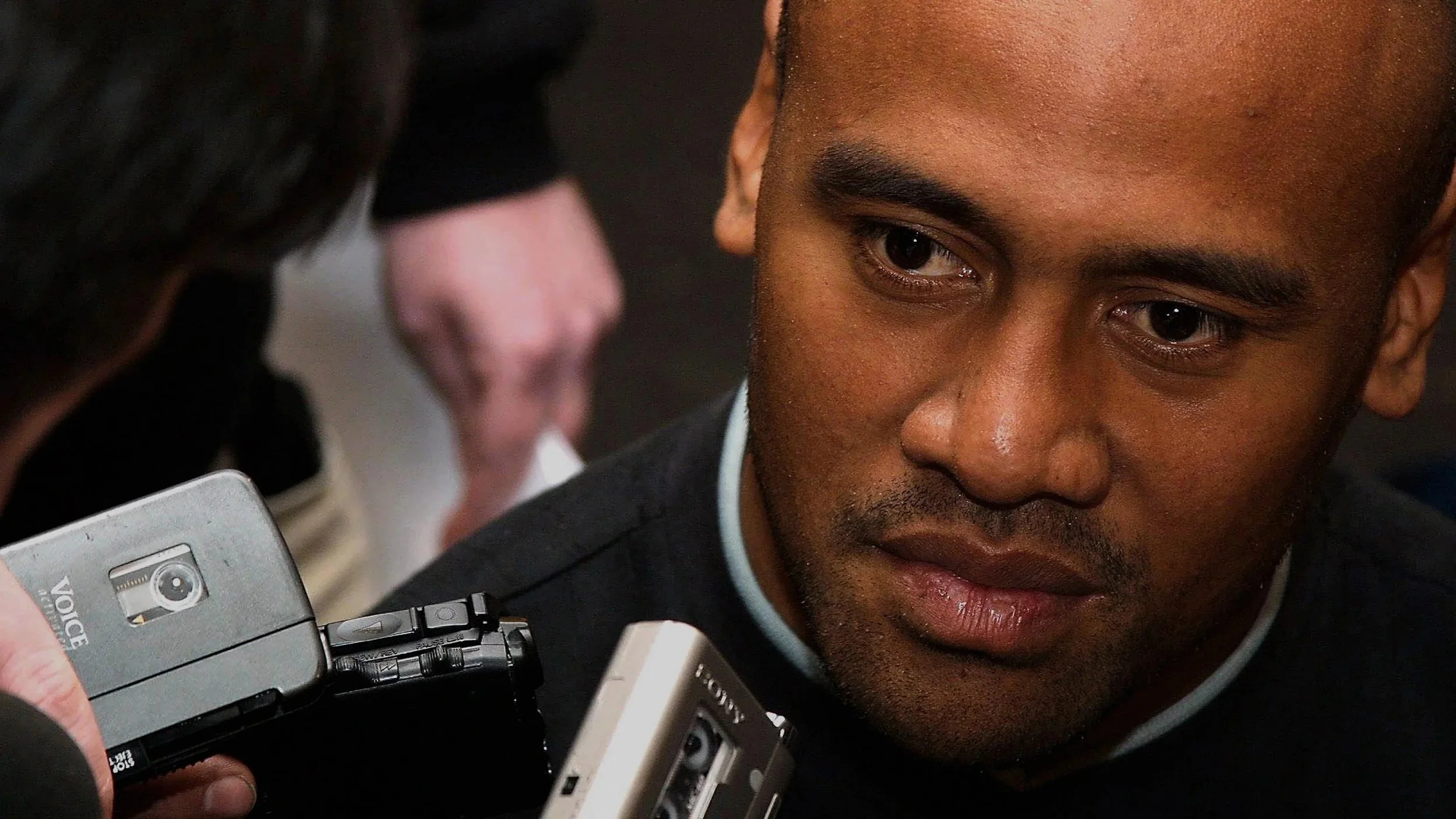
Jonah Lomu
Image courtesy of Dogwoof Releasing.
by MANSEL STIMPSON
Jonah Lomu was a distinguished rugby player who died in Auckland in 2015 at the early age of forty. He had lived there for the greater part of his life and made his name on becoming the youngest ever player in New Zealand's national rugby union team, the All Blacks, at the age of nineteen. But, although he had been born in that country in the town of Pukekohe, his parents were Tongan and that heritage played a great part in his upbringing. His education was in Auckland, but he had spent his early years with relatives in the village of Holopeka from which his parents had immigrated and he learnt to speak in Tongan. Consequently, as he grew up he was aware of the prejudice against Pasifika people and on becoming known as a sports hero and celebrity he found himself caught between the two cultures and their different attitudes as to how one should behave. He had had a strict religious upbringing and that made his father, a man known for his drinking, impose strict discipline. That had also involved beating his young son who became distanced from him. However, late in Jonah's life he would be reconciled with his father and together with his third wife, Nadene, he joined the Mormon Church.
Given this background there is much of interest in Jonah Lomu's story quite apart from his sporting talent and other elements take that even further. Not least there was the terrible misfortune of being diagnosed with a genetic kidney disease only a year or so after being acclaimed as a top player for the All Blacks in the 1995 World Cup. Keeping his serious condition secret, he continued to play in international test matches until November 2002. After having a kidney transplant in 2004 he attempted a comeback but then had to retire in 2007. Be it rugby or athletics, sport had been a crucial part of his life since his schooldays so to have his career cut short was tragic and there were other problems in his life too. His mother, Hepi, who is a strong presence in the film, always had a strong bond with him but she was offended when he married Tanya Rutter in 1996 without first telling his parents and that marriage ended in divorce. So did his second to Fiona Taylor. This second breakup was consequent on Jonah having an affair with Nadene Quirk who would become his third wife in a marriage that did last and with whom he had two sons.
Notably tall at 6'5" Jonah was seen by some as a gentle giant but on the field he was known as the raging rhino. Indeed, it does seem that his personality was complex. He could be generous and his health issues would lead him into much related charity work yet at the same time he was also regarded as somebody who chose to compartmentalise his life. He did this to such an extent that some close to him took the view that no one really knew the man. There was surprise at the time of his death when it became clear that despite the fame that he had achieved he was virtually broke.
Lomu is a film divided into four sections and each of them is introduced by a Tongan proverb written up on the screen. This approach suggests that the filmmakers, Ireland’s Gavin Fitzgerald and the Tongan-Kiwi Vea Mafile’o, were aiming to make a documentary which would not be limited to portraying Jonah Lomu as a sportsman. Nevertheless, aside from Jonah’s mother and his brother John, most of those interviewed for the film are people who, be it as coaches, teammates or members of his management team, are primarily linked to his role in sport. Archive material includes interview footage of Jonah himself but, if we get an outline of his life, we never feel that we are coming close to obtaining an understanding of exactly what it meant to be Jonah Lomu. To do that the film needed more interviewees willing and able to talk in depth and from the inside about what they as friends or family knew of him. It is significant and, I think, a loss that we do not hear from his widow or his sons. However, this could be down to the fact that Nadene Lomu took legal action over the making of the film claiming unsuccessfully that Jonah’s executor who had approved the filming had infringed her own exclusive rights to authorise works involving his name and image.
It is just because one feels that a biopic covering all aspects of Jonah’s life in depth would be so interesting that I found this to be a film which offered much less than I wanted. But it is only fair to say that those who unlike myself have a strong interest in rugby may well be happy with what this film offers. Considered as a detailed study of the distinguished sporting career of a man who was widely considered one of the most outstanding left-wing players of all time, Lomu tells its story ably and there is plenty of footage of actual matches. The material relating to games which were part of the 1995 World Cup is particularly well built up. Meanwhile there are valuable comments behind the scenes from Vikki Kingsley-Jones the daughter of the man who, having become Jonah's mentor when the lad was fourteen, went on in 1994 to become his manager for a decade. For those wanting a full character study of Jonah, I feel that this film falls short, but it will do perfectly well for those who seek it out for its sporting interest.
Featuring Hepi Lomu, John Lomu, Vikki Kingsley-Jones, Sean Fitzpatrick, Laurie Mains, Amanaki Palavi, Jane Dent, Siale Foliaki, Manase Lua, John Hart, Glen Osborne, John Mayhew, Sinipata Kaufononga, Dobbo Dobson.
Dir Gavin Fitzgerald and Vea Maefile’o,Pro Victoria Barrell, Simon Lazenby, Emma Slade and Victoria Dabbs, Ph Dominic Fryer, Pro Des Emily Maefile’o, Ed Iseult Howlett,Music Tom Hodge.
Sylver Entertainment/Velvet Moss/Dogwoof-Dogwoof Releasing.
107 mins. New Zealand/UK. 2026. UK Rel: 7 September 2026. Cert. PG.