
Life Support

Daniele Rugo’s enormously significant documentary examines the evidence disclosed by doctors in Gaza between 2023 and 2025.
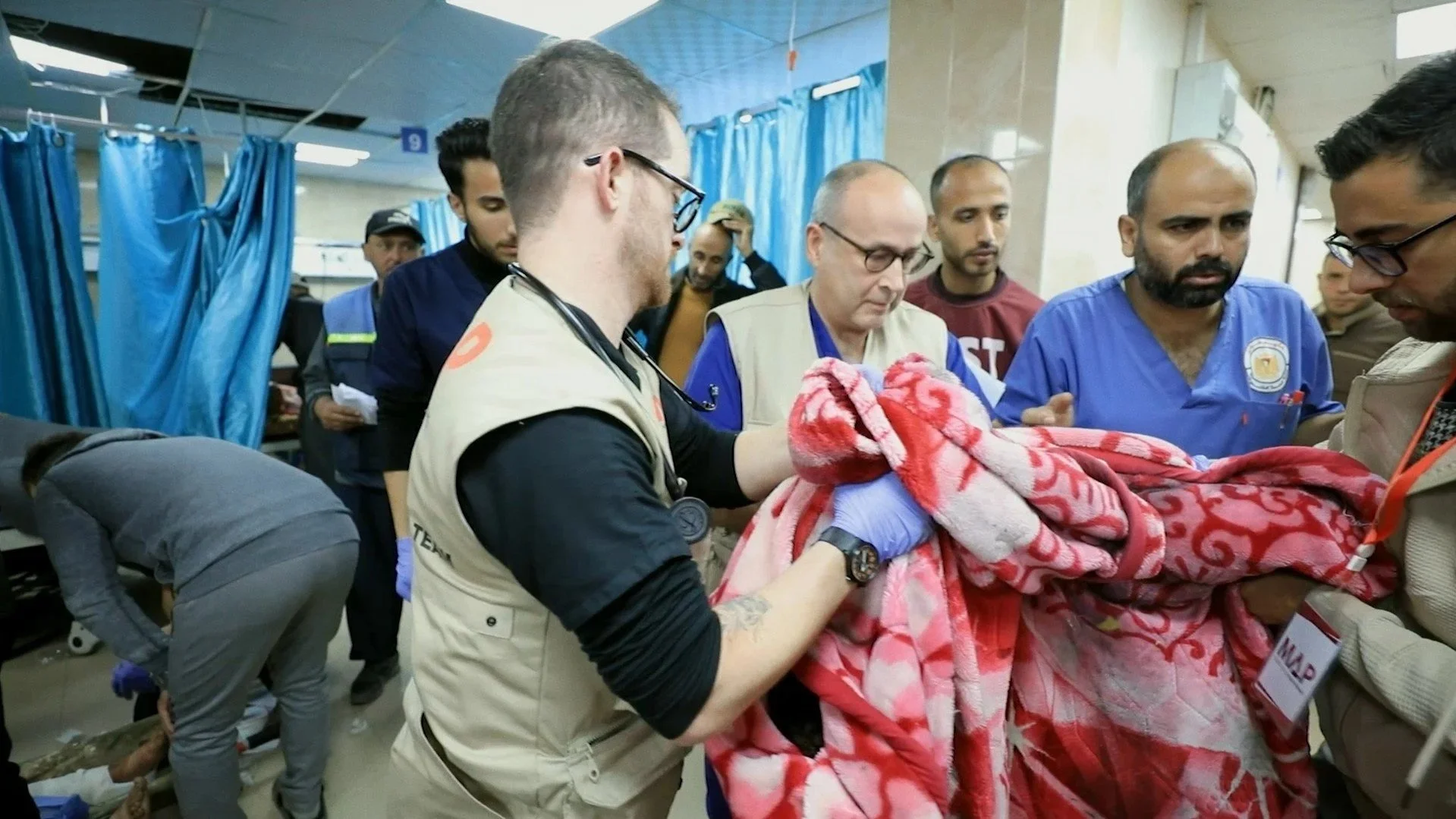
Image courtesy of Dogwoof Releasing.
by MANSEL STIMPSON
I have not seen his other work but I understand that Daniele Rugo is a documentary filmmaker with a particular focus on the subject of violence and post-conflict. That is certainly present in Life Support, a film about life in Gaza in recent times and it could well be that it is the most important film that he has yet made. When I reviewed Mstyslav Chernov’s 20 Days in Mariupol in 2023 I praised that magnificent film not just for its quality but for providing substantial evidence of Russian war crimes due to its portrayal of the extent to which civilians were being targeted. If Chernov’s film achieved that in the context of Ukraine, Life Support is no less confirmatory of the genocide that has been taking place in Gaza.
Indeed, I would say that Rugo's film which contains direct personal testimony from international doctors who have offered their services in Gaza is a work which, while allowing the facts to speak for themselves, has as its purpose the intention of revealing the self-evident truth that the violence done to Gaza between October 2023 and late 2025 cannot be seen as anything but genocide. It is a film which, despite the restrictions on reporting from inside Gaza, does show us how it looks from the ground. Actual on the spot footage from within hospitals or what is left of them is intercut with accounts given direct to camera of eleven outsiders who came to help and have been shocked by what they have found. They include surgeons in various fields – orthopaedic, gastrointestinal and those who specialise in plastic surgery and are there to apply their skills to improving the state of wounds – and most of them give their statements direct to camera while being filmed against a plain neutral backdrop so that nothing distracts from their words and from the obvious emotion that they feel when expressing them. This is a style of filmmaking that is very simplistic but which achieves an impact in a way that feels totally direct. Daniele Rugo's film gains from this and from the contrast between these passages and the images from Gaza itself. Some of the latter show general devastation and others convey the chaos of trying to treat patients in what are often damaged buildings. At one point reference is made to the fact that despite attempts at repair there have been times when only one hospital remained fully functional. A statement by one of the surgeons directly challenges the official Israeli justification for attacking hospitals by pointing out that he has never in all his experience seen evidence of Hamas operating within them.
Life Support moves back-and-forth between the various contributors, but for the most part it records the history in chronological order. Nick Maynard, a leading figure here, had already volunteered to help in October 2023 ahead of the Hamas attack on Israel but because of it was unable to get there until December of that year. By then those reaching Gaza were immediately aware of the smell of war that was present and were finding that using the allotted routes of entry at the times specified did not guarantee safety. In these early days the European Gaza Hospital in Khan Younis, later targeted, was so crowded with patients and with those finding shelter there that it felt like a concentration camp. Lack of supplies had terrible consequences (there were no antibiotics, for example, and cases of malnutrition proved fatal to many patients who had been successfully operated on). After Israeli forces left al-Shifa hospital following severe raids on it in April 2024 mass graves were found and 381 bodies exhumed. Dr Victoria Rose was just one of those who when first visiting believed that things could not get worse yet subsequently found on a later return that they had. The interviewees in the film are all from other countries but make a point of recognising that those deserving of the highest praise are the Palestinian surgeons who have worked on for so long in these appalling conditions.
By proceeding in date order the film makes it clear how the situation deteriorated. There was, for example the build-up of double or triple strikes so that those caught up in the first attack and those who were helping them became targeted again. What could be brought in to Gaza became increasingly limited (the lack of formula feed for injured babies led to fatalities) and earlier restrictions at the Rafah border bad as they were would give way to a far worse situation. The aid being provided by the UN was halted and the distribution of it handed over to the Gaza Humanitarian Foundation with limited collection sites and with Israeli soldiers present there. The readiness of the latter to shoot increased the number of patients with gunshot wounds in a significant way. The dehumanisation that we witness in this film is all too patent and abundant and in September 2025 a report by the UN's Independent International Commission of Enquiry concluded that Israel was guilty of genocide.
The Ukrainian film 20 Days in Mariupol was a masterly example of film craft in its own right and, while Life Support cannot quite match that, I do feel that Daniele Rugo has done a very good job. The one weakness that does emerge towards the close lies in the number of repetitive accusatory statements which echo each other when the point has already been made. All the doctors who speak have come to have a clear view, namely that it doesn't really matter whether you use the term "genocide" or prefer "ethnic cleansing" since what has been done to people in this war is, as the film puts it, "against every humanitarian principle we have and against international law". Furthermore, it is posited that the blame for it falls not only on the Israeli government (whose West Bank offensive is also referenced) but extends to other governments including that of the UK which have not recognised the need to speak out fully (“silence makes others complicit"). Whether or not going that far is the reason for it, one notes in the end credits a statement that "The views in this film are not those of the UN”. The importance of Life Support lies in the fact that it is difficult to believe that any unbiased viewer on seeing it would do other than feel that its clear summation of the facts proves the case that the film is seeking to make. The words heard and the images shown combine to challenge any other view and are unforgettable.
Featuring Nick Maynard, Victoria Rose, Tanya Haj Hassan, Deborah Harrington, James Smith, Ahmed El Mokhallalati, Khaled Dawas, Ana Jeelani, Graeme Groom, Mhoira Leng, Tom Potokar.
Dir Daniele Rugo, Pro William Parry, Ph Mahmoud Abou Hamda and Suleiman Hejiy, Ed Masahiro Hirakubo, Music Robert Del Naja, Euan Dickinson and Habib Shehada Hanna.
Pressure Cooker Arts/Metafora Production/Cocoonfilms-Dogwoof Releasing.
90 mins. UK. 2026. UK Rel: 10 July 2026. Cert. 15.
