
Menus-Plaisirs Les Troisgros

Now well into his nineties, Frederick Wiseman’s film about a French high-class rural restaurant contains some of his best work.
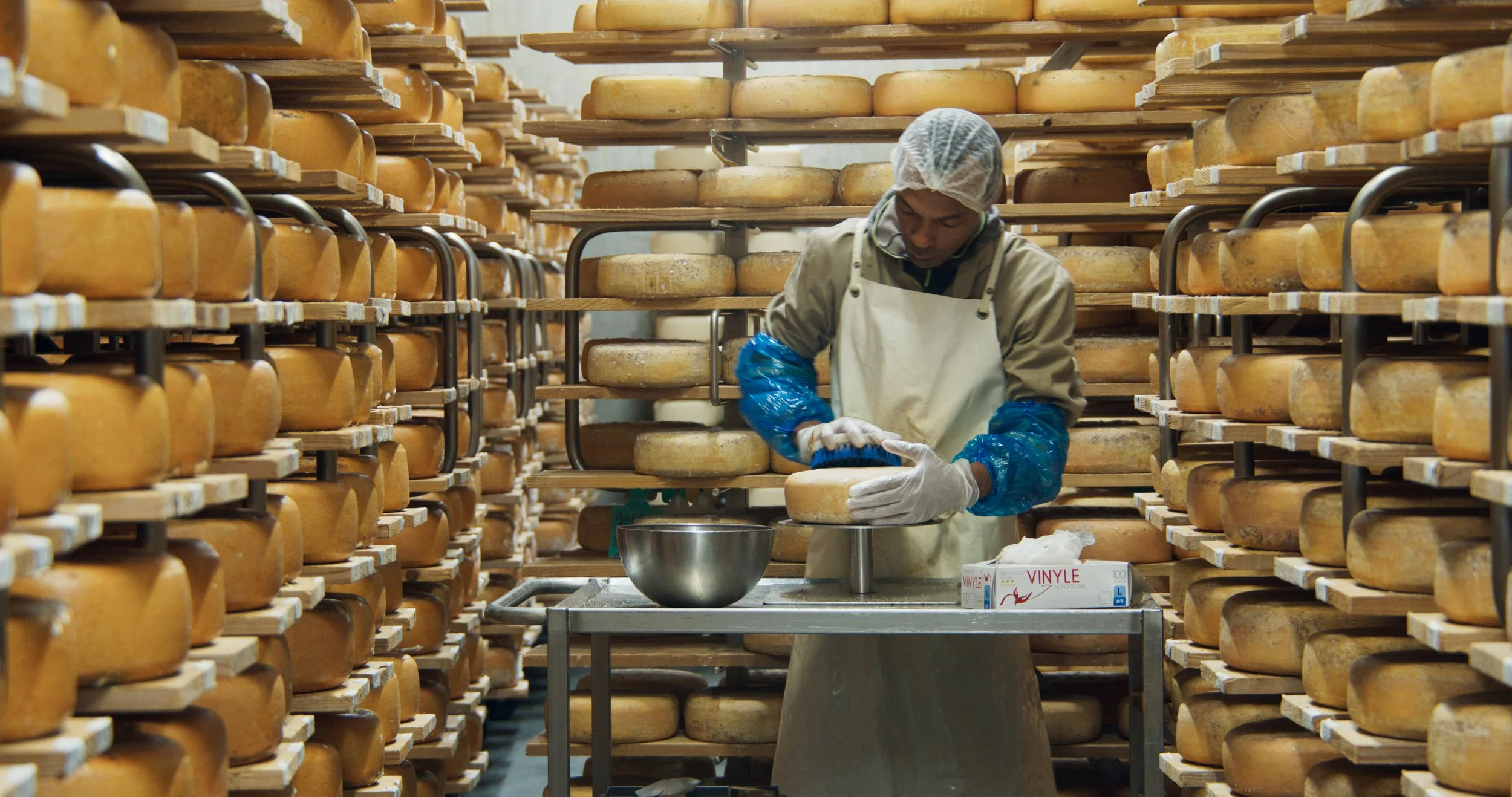
Image courtesy of Zipporah Films.
by MANSEL STIMPSON
The career of Frederick Wiseman is such that he is entitled to be regarded as cinema's most formidable documentarist. Born in Massachusetts as along ago as 1930 he has now directed some forty-five feature films since his debut in that capacity with Titicut Follies in 1967. Institutions of various kinds, often American but not exclusively so, have been the main focus of his work. That first piece was of standard length (84 minutes) but with Juvenile Court in 1963 the length increased to 144 minutes which was a sign of things to come since his more recent documentaries have often lasted three hours or more. One might have expected that by now he would have given up such huge enterprises, but this latest piece of his, shot in 2022 but only now getting a UK release, runs for four hours.
As its title indicates, this work takes place in France and it is centred on the Troisgros family who, headed by Michel, run a restaurant in a rural setting at Ouches in the Loire region. It opened in 2017 and is in a house that also comprises fifteen guest rooms but the family history in this sphere goes back three generations having started out in nearby Roanne in 1930. However, the focus in the film is primarily on this recent establishment,‘Le Bois sans feuilles’, and on Michel, his wife Marie-Pierre, and their sons – both chefs – César and Léo, while their daughter Marion is also involved but in reception. In turning his attention to this family and for the most part to this particular restaurant Wiseman has created a film which is at one and the same time deeply characteristic of his work and yet in some key aspects also individual and distinctive.
The elements that are constants in Wiseman's documentaries include the absence of any commentary, the lack of a music score and the observational tone which, allied to his filmmaker’s eye (he is editor as well as director), makes the films personal without Wiseman himself ever being an onscreen presence. It is also the case that his films have become meticulously photographed and in this film the superb colour photography is by James Bishop. But this time that leads into the fresh elements present because this is a work with so many appetising close-up shots of food that audiences who relish that will be drawn in even if the length of the film may become a problem for them. Furthermore, while other Wiseman works have often concentrated on complex institutions that involve a range of individuals, here there is a much more intimate feel to it since we are dealing essentially with just four members of the family and their highly experienced staff. There is always the sense that all of these people love what they are doing and, whatever function each of them has, everybody carries out their duties with an expertise and with a precision (table setting being a notable example for this) which is impressive to observe - and that’s so even if the world of expensive restaurants is not necessarily a sphere of strong appeal to you.
For quite a while it looks as though Menus-Plaisir - Les Troisgros will also have another element working in its favour and one not always to be found in Wiseman's films. By eschewing a commentary it makes it less easy to give shape to a film since a voice-over can always incorporate helpful hints in that respect. Consequently, many of his documentaries seem to range too widely to have a satisfying sense of structure. Here, however, once past a scene of vegetables being purchased and some detailed talk that immediately follows, we get the useful impression that the film is following a typical day at the restaurant in Ouches. Preparation of the food is followed by cooking, the setting of tables, issues around menu changes, special requests and what is required for food in the week ahead. All of this then leads up to the lunch itself, course by course, and includes exchanges between waiters and customers. With atmospheric rural shots also incorporated from time to time, the film thus far has a natural shape from which it benefits.
The one problem that I do have with this work is that I do eventually find its running length excessive and the fact that it loses that sense of structure contributes to this. The last hour or more of the film goes off at tangents – be it footage about goats, about plants in greenhouses, about bees or about a company specialising in the ripening of cheese – in addition to which it returns to further scenes in the kitchen and in the restaurant that are in effect mainly variations on what we have seen before. We do see the wine cellar for the first time and at least it can be said that the final scenes are well chosen. Earlier on we have observed the kind of conversation at the table appreciated by the customers in which waiters - or even members of the Troisgros family themselves - comment on what is being served. Now, however, we have longer comments by Michel and for the first time he talks more specifically about the family, their history and their restaurants. This is a satisfying addition to the personal side of the film and brings it to an effective conclusion.
For the critic assessing a film like this finding a suitable rating can be problematic. While there is no doubt that devotees of Wiseman's work should seek it out, it could be considered that my four-star rating is too generous for a film which most audiences are likely to find far too long. Nevertheless, in this case I regard well over two hours of it as an achievement that is both fresh and fascinating while also showing Frederick Wiseman at his best and that I would argue is value for money in itself.
Featuring Michel Troisgros, Marie-Pierre Troisgros, César Troisgros, Léo Troisgros.
Dir Frederick Wiseman, Pro Frederick Wiseman, Karen Konicek and Olivier Giel, Ph James Bishop. Ed Frederick Wiseman.
Zipporah Films/3 Star LLC Production/Public Broadcasting Service, GBH-British Film Institute.
240 mins. USA 2023. US Rel: 22 November 2023. UK Rel: 2 January 2026. Cert. PG.
