
Midwinter Break

Lesley Manville and Ciarán Hinds make a fine team in a less than wholly successful portrayal of a couple in old age reassessing their liaison.
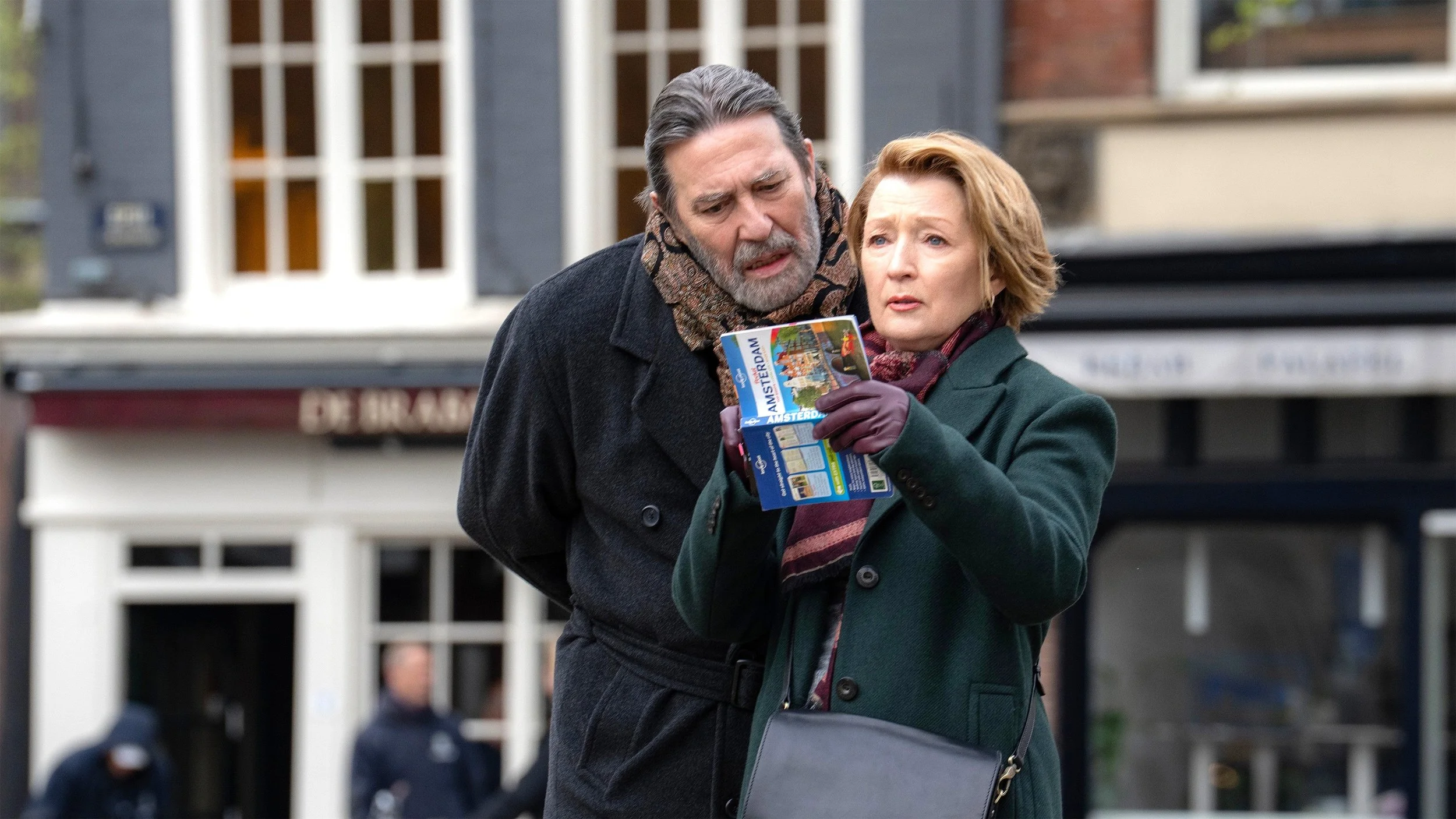
Ciarán Hinds and Lesley Manville
Image courtesy of Universal Pictures.
by MANSEL STIMPSON
Recently when reviewing A Pale View of Hills, the film version of Kazuo Ishiguro's novel, I welcomed it as an all too rare example of a film which, being one most likely to attract older viewers, had them in mind but refused ever to play down to them. When I heard of Midwinter Break, it sounded no less promising in this respect and perhaps even more so. Adapted from the 2017 novel of the same title by Bernard MacLaverty, it tells of a couple now in their seventies embarking on a trip to Amsterdam during which time underlying tensions in their marriage come to the surface. The couple, Gerry and Stella, are played by Ciarán Hinds and Lesley Manville, a supporting role is taken by Niamh Cusack and the screenplay is by MacLaverty himself together with Nick Payne.
A film involving such strong talents arouses strong expectations and two earlier works came to mind to endorse that feeling. Back in 1984 MacLaverty wrote the screenplay for Pat O'Connor's memorable screen version of his second novel, Cal, and the fact that Midwinter Break was centred on an older couple brought to mind a masterpiece from 2019, Ordinary Love. That film also starred Lesley Manville who was then playing a woman well into middle age who was diagnosed with breast cancer and it paired her memorably with Liam Neeson. Impending death is not the theme here, but this is again an intimate drama about later life which, coming relatively close to being a two-hander, is directly focused on Melville and on Ciarán Hinds. Just how good Hinds can be was evident in 2003’s Belfast and here he proves an admirable fit for Manville. All of this suggested that Midwinter Break might be something special although it received less coverage from critics on its UK release than one might have expected and its rating on IMDb came up as only 5.9. On the other hand, Peter Bradshaw gave it a five-star review in The Guardian and, since I had not had an opportunity to see it earlier, that encouraged me to seek it out at a cinema.
The director of Midwinter Break is Polly Findlay who, already well established as a theatre director and having been involved in works for National Theatre Live, is here making her first original screen feature. She has done a good job aided by the fact that Amsterdam always makes an appealing backdrop (photographed here by Laurie Rose). The weaknesses that emerge stem from the screenplay which is surprising given MacLaverty's own involvement. Nevertheless, it is indeed the case that the film gets off to a good start. We are quickly introduced to Stella and Gerry who had once lived in Belfast but are now in Glasgow. They are a couple who, long together, have reached the stage when they are alone in the family house and any connection with children or grandchildren has become relatively remote. Since we meet them at Christmas, it immediately becomes clear that Stella is religious, a Catholic who would not miss the Christmas service while Gerry having no such beliefs stays at home. This difference in outlook is something which they have accepted, but it will come to have importance after Stella surprises Gerry by booking a holiday break for both of them at a hotel in Amsterdam, that becoming the location where the rest of the film plays out. These opening scenes which establish our two main characters and then transport them to Holland are adeptly handled with Lucia Zucchetti as editor.
Once in Amsterdam, it becomes clear that Midwinter Break will take its time. The running length is only 90 minutes but for half of that it is content to depict the couple settling in and looking around the city without much occurring plot-wise although we do become aware that Gerry is drinking too much, often in secret. Given the quality of the acting by the two leads, this approach is acceptable enough and older viewers will readily identify with the situation depicted. The film conveys the sense of reaching that time of life when if you are retired (Gerry had been an architect and Stella a teacher) you start to question what your life has been for and what one has achieved - and in addition there is the issue of old age itself (when the talk involves references to the taking of statins one feels that many viewers will experience a direct connection). But, even though the film engages in this way, there is a sense that with such fine players involved it should be making a deeper impact. The failure to achieve that is not due in any way to the actors but to the screenplay being underwritten in the sense that Stella and Gerry tend overall to be representative figures rather than individuals who make us feel deeply for them even when little is happening.
Thus far Midwinter Break is pleasing enough even if it is slighter than one had anticipated. But, paradoxically, it is in its second half when the drama intensifies at last that it most disappoints. Peter Bradshaw's admiration for the film appeared to be due to its willingness to go deep and to its resolute avoidance of sentimentality. Those features are there and are to be admired but sadly misjudgments arise as well. A critic should not give away too much about the way in which a film develops but I can say that Stella visits the Begijnhof, the ancient courtyard where a Catholic sisterhood had flourished and which finds two churches standing beside almshouses. Early on in the film there had been a foreshadowing of an event which had actually occurred earlier in Stella's life in Ireland but it is only at this late stage that what was involved becomes clear. We now recognise that it has led to Stella considering the possibility of leaving Gerry and belatedly taking up a religious life. A past unfulfilled vow has played a part in this (a fact that indirectly prompts thoughts of Graham Greene's twice filmed novel The End of the Affair). The full details only emerge when Stella confides in Kathy (Niamh Cusack), a sympathetic Irish expatriate encountered by chance who turns out to be a fellow Catholic. Their scene together plays as a key moment but it is one which calls out for a reaction from Kathy leading to deeper discussion but instead an abrupt cut deprives us of that. What does follow is a conversation between Stella and Gerry at the airport when their plane back is delayed. The truths expressed here are bleak but what then transpires includes words about a miracle which not only sound somewhat fictional but come across as the film’s single yet significant moment of sentimentality. If one is charitable, one can view the conclusion of Midwinter Break as providing a somewhat open ending. Yet, as presented here, it feels more like a last-minute betrayal of the film’s raw honesty in its portrayal of a marriage and its compromises. Rather than being moved, I felt let down, but that is not to deny the quality of the acting or the importance of the issues raised in the course of the story.
Cast: Lesley Manville, Ciarán Hinds, Niamh Cusack, Leila Laaraj, Julie Lamberton, Ed Sayer, Lewis Harris, Tim Licata, Marco Horta Lopes, Elène Zuidmeer, David Gallacher, Vanashree Thapliyal.
Dir Polly Findlay, Pro Guy Heeley and Floor Onrust, Screenplay Bernard MacLaverty and Nick Payne from the novel by Bernard MacLaverty, Ph Laurie Rose, Pro Des Harry Ammerlaan, Ed Lucia Zucchetti, Music Hannah Peel, Costumes Bernadette Corstens.
Family Affair Films/Film4/Shoebox Films-Universal Pictures.
90 mins. Netherlands/UK. 2026. US Rel: 20 February 2026. UK Rel: 20 March 2026. Cert. 12A.
