
Mistura

When her husband leaves her, a socialite opens a restaurant in Ricardo de Montreuil’s misjudged foodie drama.
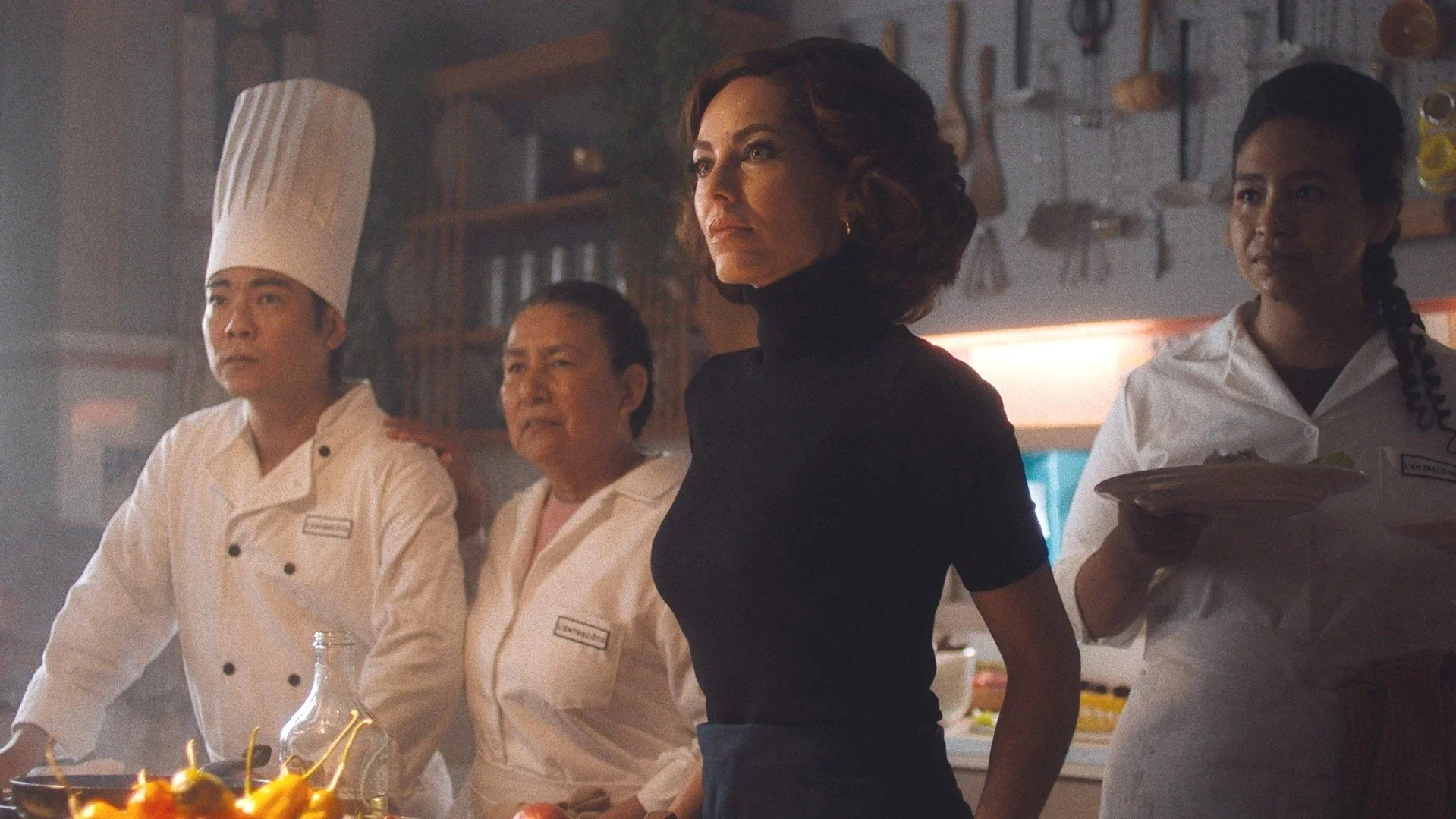
Image courtesy of Exposure.
by MANSEL STIMPSON
We see very few films from Peru which is both the country of origin and the setting of this film written and directed by Ricardo de Montreuil. Mistura (which we are told is a Peruvian word for a mixture) is the first release that I have come across from the UK distributor Exposure. It is in marked contrast to the bold choice earlier this year when Tributary released Better Go Mad in the Wild, a Czech documentary by a director unknown here as their initial offering. In fact, there are no famous names attached to Mistura either, but the nature of the material is such that its potentially wide appeal speaks for itself. However, in my own case at least, there is an ironical twist here in that I liked Better Go Mad in the Wild very much but on viewing Mistura regarded it as misjudged and much less attractive than it sounded.
In telling the story of Norma (Bárbara Mori) Ricardo de Montreuil is giving us one of those works that has come to be known as a foodie movie, a limited but memorable genre which includes such titles as Babette's Feast (1987), Big Night (1996), Chocolat (2000) and The Taste of Things (2023). In Mistura, Norma is a socialite living in Lima whose husband, Roberto (Christian Meier) takes up with a younger woman and walks out on his wife. He leaves with mortgage instalments unpaid and the bank threatens to foreclose and take her home away unless the money due is forthcoming within four months. Having had a father who had run a bistro in France and having loved cooking as a youngster (something left behind as the wife of an outwardly prosperous husband to whom she had been married for over twenty-five years), Norma unexpectedly falls back on this early love to earn money. She decides to turn part of the house into a stylish restaurant under her own supervision and finds a talented sous chef, Rául (Tomas Matsufuji), to help.
Some films of this type may feature food and its preparation rather more than Mistura does, but not least in a number of montage passages there is enough emphasis on this to please. While Norma’s efforts with her restaurant plan and the various setbacks that she faces are central to the film, there is also another plot thread which runs right through it and again sounds appealing. That lies in the help and advice that Norma gets from her devoted servant, Oscar (Cesar Ballumbrosio), whose duties include acting as her chauffeur. Norma can be tart and not the easiest of employers, but a real bond grows up between them with Oscar increasingly acting as her confidential advisor. Does their situation carry echoes for film fans? I would suggest that many viewers will be reminded of that great popular hit of 1989 Driving Miss Daisy and perhaps also of Green Book (2018).
With Mistura offering material akin to these past pieces that have played so well with the public, it may well be that it will indeed please the right audience regardless of the fact that its opening scenes feel too rushed to make for an engaging introduction to the characters and their situation. But for me the crucial drawback is that, since the film is concerned with Norma's endeavours, one needs her to be a sympathetic character if one is to feel truly engaged and that is not the case here. It is possible that Ricardo de Montreuil's screenplay wanted to show her as somebody from a privileged background who becomes more considerate and warmer in the course of the story. But, even if that was the intention, Norma is far too off-putting as drawn here. Bárbara Mori may be an able actress but she can do nothing to overcome this.
The film opens on New Year's Day in 1965 and Norma is presented as somebody required to fill her expected role as a perfect wife for her husband, one fitted to his place in society and to her family role too – they have a son who is now a young adult, Gerardo (Stefano Meier). Since we encounter Norma at the very time when she realises that she has been abandoned by her husband, there are good reasons why she should not be at her best. Nevertheless, what we get is the impression of a self-centred woman who is brusque and inconsiderate to those who work for her. As her chauffeur, Oscar himself is always at her beck and call and we soon observe how she turns on Rosa (Hermelinda Luján), her maid of many years standing, accusing her or her young grandson, Octavio (Josue Subáustue), of having stolen a valuable Swiss cheese that has gone missing. That she dismisses Rosa on the spot seems in character even if later she offers an apology which is not accepted. Subsequently when her son, Gerardo, arrives from Paris her immediate reaction on seeing him is to launch into an attack on his appearance.
Once the idea of a restaurant is mooted, we find that she wants it to be an exclusive, expensive establishment which adds to the sense that Norma is a snobbish class-conscious woman. From time to time, but without supplying any real detail, the film allows us to glimpse newspaper headlines suggesting that for many life in Peru is very different and later Norma's car is held up by street protesters who are demanding reforms. Her reaction is simply one of irritation at being delayed in this way.
By the time that the tale reaches its conclusion there have been other developments. In particular as part of the foodie theme Norma’s restaurant, which has not fared well initially, suddenly seeks to become an overnight success by changing its menu to emphasise Peruvian food. Ultimately, we find Norma recognising the contributions of Oscar, Rául and Rosa all of whom (yes, even the aggrieved, insulted Rosa) are now declaring how wonderful she is. That undermines credibility given what we have seen of Norma and there are instances too of dramatic contrivances used to fill out the film. At one point young Octavio's health is seriously endangered by an injury, but that is soon passed over; later Norma's husband returns seeking to be forgiven, but the role is one that is not fleshed out at all. The one real success in Mistura lies in the ideal casting of Cesar Ballumbrosio as Oscar. But even his splendidly sympathetic presence was not enough to make me warm to a film which in seeking to entertain offers a central character with whom one never wants to identify.
Cast: Bárbara Mori, Cesar Ballumbrosio, Hermelinda Luján, Christian Meier, Stefano Meier, Juan Pablo Olyslager, Tomas Matsufuji, Vanessa Saba, Josue Subáustue, Marco Zunino, Luciana Di Laura, Junior Bejar.
Dir Ricardo de Montreuil, Pro Ivan Orlic, Screenplay Ricardo de Montreuil, Ph Nicolás Wong, Pro Des Mario Frías, Ed Luis Colina and Ricardo de Montreuil, Music Tim Williams, Costumes Leslie Hinojosa Cortijo.
Seine Pictures/Unannounced Films-Exposure.
100 mins. Peru. 2024. US Rel: 24 April 2026. UK Rel: 16 October 2026. Cert. 12A.