
Mother Vera

A frequently unclear, disjointed and unsatisfactory documentary about a Belarusian nun inexplicably walked off with the Grierson Award at the London Film Festival. Why?
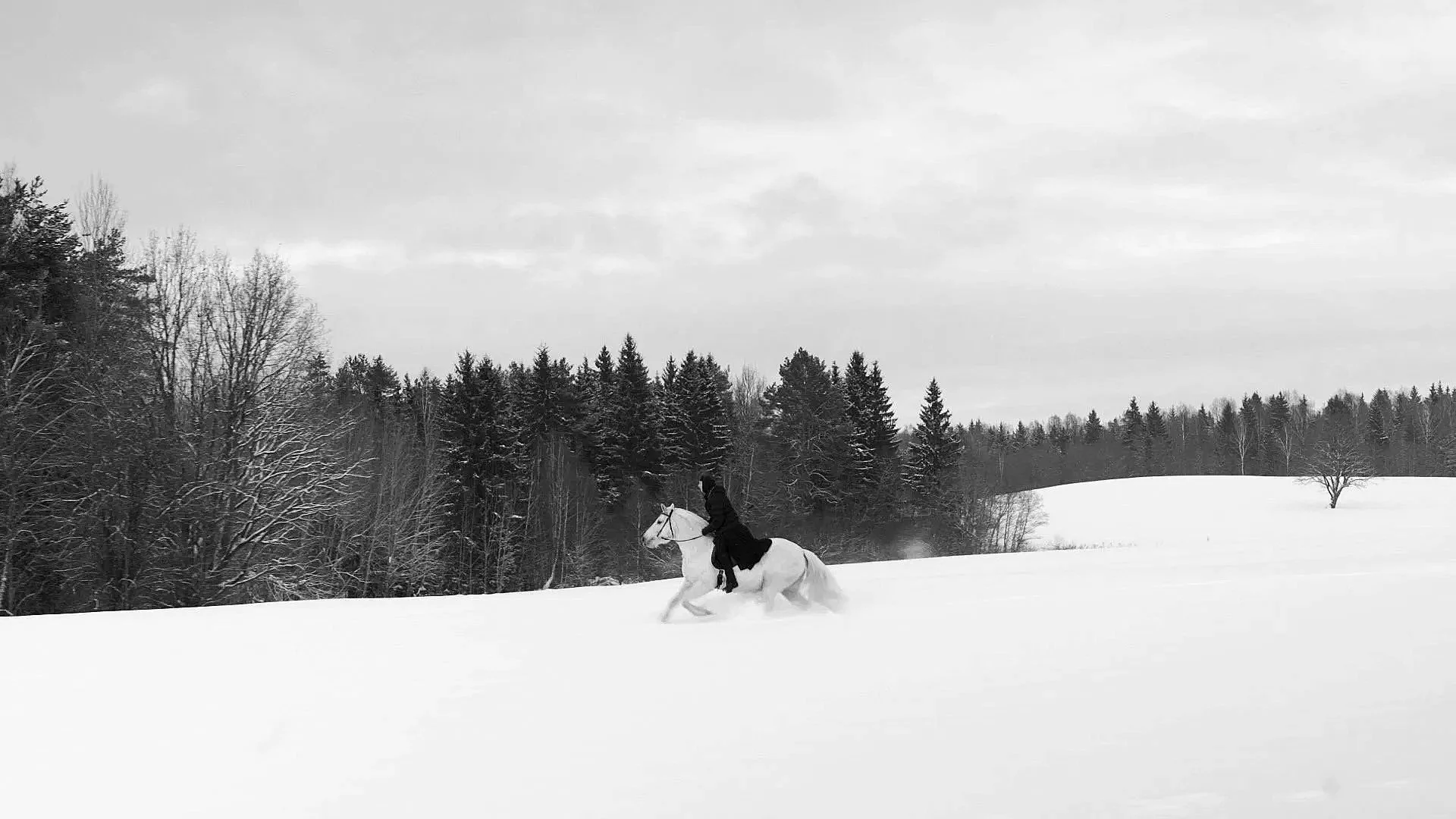
Image courtesy of She Makes Productions Ltd.
This is the film that won the prestigious Grierson Award for 2024 as the best documentary screened in that year’s London Film Festival. Its success must have delighted Cécile Embleton and Alys Tomlinson because this was their first feature film – indeed, while for Cécile a number of shorts had preceded it, Alys was new to the medium. As it happens, it was Mother Vera, an Orthodox nun from Belarus, who in a sense brought these two together. That's due to the fact that they first met when Tomlinson was working on a photographic project, a book entitled Ex-Voto, and Embleton was struck by Tomlinson's image of Mother Vera featured in it. This would lead to the idea of the two of them working together on a documentary about her although when they started filming at Minsk in the Saint Elizabeth Convent they had no idea that Mother Vera's life would soon take a dramatic turn which would change the character of their film.
It is indeed the case that Mother Vera, who as a child had been named Olga, has a very striking face and the location of her monastery in the forest of Belarus has the appeal of being unfamiliar to most viewers. These factors add to the potential appeal of the film, but in the event I am very surprised that Mother Vera should have become an award-winning work. I say that because this documentary contains three distinct elements which despite being interconnected fail to fuse into a satisfactory whole.
At the outset one gets the impression that this film will be an atmospheric study of the monastic life, something akin to Philip Gröning’s epic length work Into Great Silence made in 2005. The absence of any commentary, the quiet contemplative approach and the decision in this case to film in austere black-and-white seem to set what is an appropriate tone for just that. But then we find footage which shows men employed in the monastery and from their spoken comments we gather that at least some of them are ex-cons. Their presence is not something that one would expect in such a place and one comes to feel that what is called for is a wider view which clarifies the various facets of the monastery including the place of these men in it (some seem to have made their way there on their own but others have been sent to it by the police and whether or not this is just a source of labour or rehabilitation work is not clear). Such footage suggests that what is really required is something on the lines of those Frederick Wiseman documentaries which study institutions in detail so that all aspects of them are covered and fit into place. But as it proceeds Mother Vera moves back-and-forth between religious devotions, shots featuring horses with which Mother Vera shows a close rapport, scenes with the ex-cons and footage of Mother Vera visiting her family. These various episodes come up in no particular order and at times the lack of a commentary is unhelpful. For example, one does not expect a nun to be free to leave a convent to call on her mother but Mother Vera does so without any explanation of what the rules are.
Moreover, as Mother Vera continues, we come to realise that the most crucial aspect of the film resides in something else altogether – that is the story of how Olga became Mother Vera and just where this is leading her. It is a life story that could have been dramatised. But this being a documentary there are no flashbacks and the facts only emerge through what Mother Vera herself has to say in voice-over, the images remaining all the while those of the monastery even as what is said reveals something of her past history. This might have been an apt way to proceed, but it is done in bits and pieces that lack the clarity of being in chronological order and with much detail that we would like to know omitted. A key fact is that Olga was a rebellious teenager who at one stage overdosed on pills and who took up heroin for herself and for others and then reacted against it. She had a partner, Oleg, who went to prison and was himself a victim of HIV and infected her.
When we meet Mother Vera, she has been in the monastery for twenty years but just how she came to be there we don't learn. In talking about the appeal of heroin she gives the impression of seeking a kind of freedom through it and even refers to interacting with higher worlds. This may or may not indicate that her motives in turning to religion were much the same. But the limited context given makes it difficult to get a wholly clear picture. When she declares "I don't regret anything" it is not apparent what that ‘anything’ refers to. Later on, she does mention that she regrets the pain she inflicted on her mother and says "I must be from hell". Perhaps Olga has always been seeking some kind of liberation and in trying to understand her one ultimately has to take into account a decision that she reaches and which leads to the last section of the film being photographed not in black-and-white but in subdued colour. At this stage she declares that she has no physical home and refers to herself as standing internally on a rock but, just as a new location goes unidentified save for people speaking in French, it is difficult to get a really clear view of Olga and her conflicts.
Those who admire Mother Vera have referred to its visual appeal and the fact that so much of it is shot in black-and-white leads to some images that carry echoes of silent cinema. But, having by chance seen this film just after viewing The Ceremony, I felt that Robbie Bryant's work on that film illustrated the beauty of black-and-white photography in a way that totally overshadowed anything to be found here. However, my main complaint is that Embleton and Tomlinson have failed to find a structure that expresses the inner struggles of Mother Vera to full effect while also incorporating other elements that have turned their film into an unfortunate mishmash. That's a shame because the material they had to work on was far from uninteresting and their intentions were doubtless good. As it is, the strongest impression that you take away from this film is the one uncomplicated bond in Mother Vera's life: it is memorably captured in the film's best scene which expresses just how much ease she finds when caring for horses.
MANSEL STIMPSON
Featuring Mother Vera and members of her family: Vera, Natalia, Igor, Taras, Maksim and Max.
Dir Cécile Embleton and Alys Tomlinson, Pro Laura Shacham, Ph Cécile Embleton with Alys Tomlinson, Ed Romain Beck and Cécile Embleton.
She Makes Productions-She Makes Productions Ltd.
95 mins. UK 2024. UK Rel: 29 August 2025. Cert. 12A.
