
Young Mothers

Five teenage mothers struggle with their new responsibilities in the Dardenne brothers’ superlatively acted but woefully constructed drama.
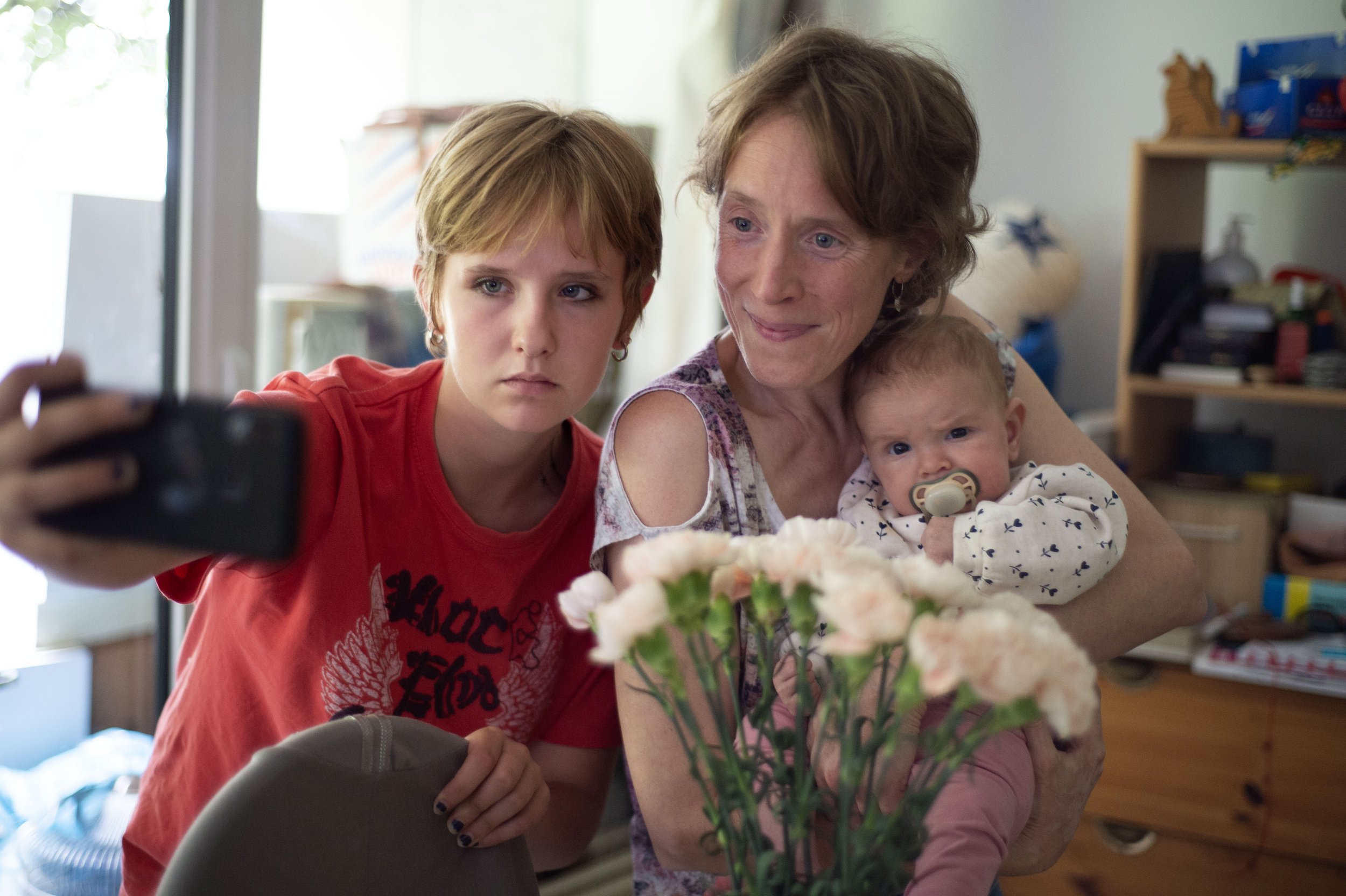
Image courtesy of Curzon.
The Dardenne brothers, Jean-Pierre and Luc, have been making films since 1978 and always together. For many years now they have had the right to be considered Belgium's most notable living film artists and in their time they have given us masterpieces – I would cite in particular The Son (2012) and Two Days, One Night (2014). The brothers also supply the screenplays for their films and the style that they adopt is comparable to the naturalism found in the work of Ken Loach. They may not be quite as politically overt as Loach so often is, but they do share his deep social concerns and, while on occasion working with name players, they often cast less familiar and even unknown faces.
The signature style cultivated by the Dardenne brothers ensures that their latest film, Young Mothers, contains a great deal to admire. It is set in Liège and is centred on a maternity home there and on four teenagers being looked after by this shelter. Both the film’s portrayal of the help given in this way through Belgium’s social services and its sympathetic treatment of the issues faced by pregnant teenagers are characteristic of the work of the Dardennes and of the kind of subject-matter which brings out the best in them. They have long since acquired the skill to express a warmth of feeling for their characters without ever falling into sentimentality and their ability to obtain wholly unforced natural performances from their players is remarkable.
The four characters specially featured here are Ariane (Janaina Halloy Fokan), Perla (Lucie Laruelle), Julie (Elsa Houben) and Jessica (Babette Verbeek). It is Jessica when we meet first and this is just before she gives birth. The other three already have young babies and in telling the interlocking stories of all four the film effortlessly raises issues for the audience to consider. Each mother will have her own outlook as she faces the question of bringing up her child or seeking a foster home for it. Depending on individual circumstances, to keep the baby might involve realising that one would be a single parent because the father wants nothing to do with his child or it might lead to a young couple facing the future together but struggling to find accommodation. In two cases here the young mothers are also influenced by the attitude of their own mothers: Ariane has a mother (Christelle Cornil) who wants to dominate and who, in encouraging her daughter to keep her child, really wants a granddaughter to fuss over and to give more meaning to her life; Jessica in contrast had herself grown up in a foster home and, on making contact for the first time with her birth mother (India Hair), finds that her own resentment at being given up is still affecting her (finding that she lacks maternal feeling she blames that on her own past history and is encouraged to believe that her daughter would be best off in a foster home because what she has inherited might well make her a bad mother herself).
In creating these characters, the Dardenne brothers bring all of them to life most convincingly and the film has three special virtues which add to its quality. One is the standard of the performances which are uniformly excellent (this is one of the rare occasions when it would be impossible to object should an acting award be given to be shared between the four main actresses). The second notable feature is the admirable work of the film’s photographer, Benoît Dervaux, a regular collaborator with the Dardenne brothers. The third great asset lies in the fact that the film gains by refusing to be didactic. As it illustrates the differing attitudes of the four teenage mothers, it enables one to see that there is no absolute right and wrong because circumstances make each case individual in a way which affects what is indeed the appropriate decision as to a child's future.
From the above it would be reasonable to assume that Young Mothers was good enough to be up there with the best work of the Dardenne brothers and that is indeed the view held by some (at the 2025 Cannes Film Festival the film won two awards, that for the Best Screenplay and the Ecumenical Jury Prize). However, when watching this film, I had the rare experience of finding that my huge admiration for so many things in it was seriously undermined by two major faults. The main point to be made is that the structure of the piece is horribly disruptive. Each of the four girls has a persuasive and involving story but by presenting them intermingled the film is constantly changing tack. I have seen many other films that merged story threads but I do not recall ever before feeling that I was being wrenched from one to another to this degree - and it keeps on happening.
The other flaw is in part connected to that. When you are in effect being offered four stories that you need to keep in mind throughout it makes it even more important that the storytelling should be clear and straightforward. But instead this prize-winning screenplay often delays in giving information that is needed. This is all too well illustrated in the very first scene which finds Jessica on the phone at a bus stop when expecting to meet her birth mother. Not only is there no mention of the maternity home to give the scene a clear context, but the early dialogue includes references to Isabelle without any indication of who she is (in fact the cast list confirms that she is a psychologist). When the mother fails to appear there is a cut to Jessica in a car being driven by somebody but only very much later do we learn this woman’s identity (the car is that of a social worker named Yasmine). Much further on in the film when Perla visits a woman unknown to us the scene plays out in full without naming her as Perla’s half-sister, Angèle. Since the tales of the four girls each bring in subsidiary characters one constantly feels under pressure to keep up and understand who is who – and, just when you think you know where you are, out of the blue the film suddenly has a scene in which a fifth girl (Samia Hilmi) is featured. She is about to move on and is thanking the shelter for their help. It is a good scene yet its unheralded inclusion is initially yet another distraction.
My final verdict on Young Mothers has to be that it would have worked far better if it had been shown, if necessary on television, as a four-part work with each episode devoted to one girl whose story could easily have been told more clearly and elaborated on to advantage. Ironically it is because in other respects there is so much to admire here that these failings add immensely to one's frustration and disappointment.
Original title: Jeunes mères.
MANSEL STIMPSON
Cast: Babette Verbeek, Elsa Houben, Janaina Halloy Fokan, Lucie Laruelle, Jef Jacobs, Christelle Cornil, India Hair, Günter Duret, Joely Mbundu, Adrienne D’Anna, Samia Hilmi, Dominique Swinnen.
Dir Jean-Pierre Dardenne and Luc Dardenne, Pro Jean-Pierre Dardenne, Luc Dardenne, Delphine Tomson and Denis Freyd, Screenplay Jean-Pierre Dardenne and Luc Dardenne, Ph Benoît Dervaux, Pro Des Igor Gabriel, Ed Marie-Hélène Dozo, Costumes Dorothee Guiraud.
Les Films du Fleuve/Archipel 35/The Reunion/France 2 Cinéma/BE TV & Orange/Proximus-Curzon.
106 mins. France/Belgium. 2025. UK Rel: 29 August 2025. Cert. 12A.
