
My Father’s Island

A father and son are reunited on an isolated Norwegian island in Vladimir de Fontenay’s misjudged tale of reconciliation.
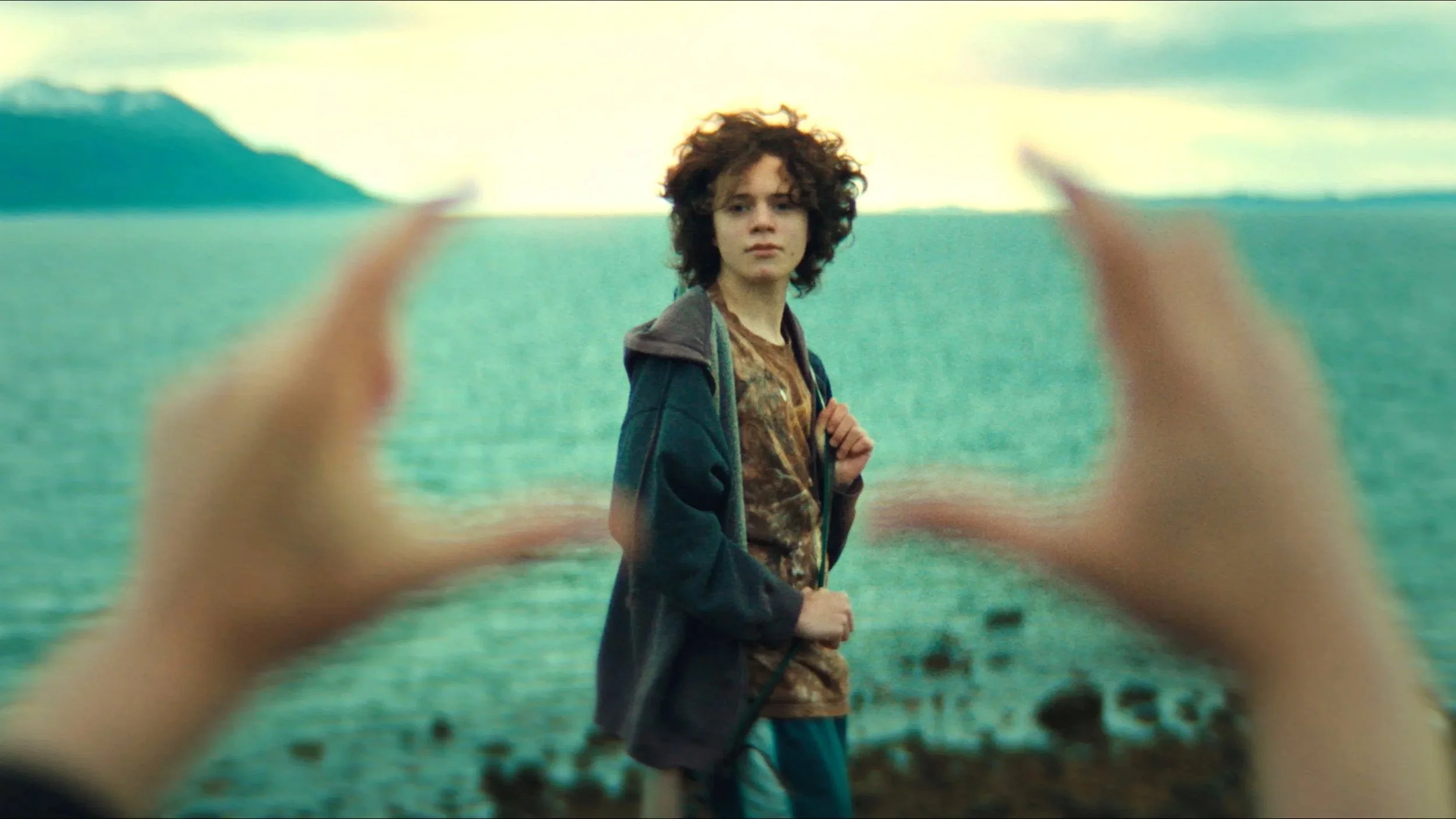
Image courtesy of Curzon Film Distributors.
by MANSEL STIMPSON
This film written and directed by Vladimir de Fontenay was formerly known as Sukkwan Island and that was indeed the title of the piece from which it derives. Most unusually the original was a novella which had a central position in a book by David Vann which also contained related short stories. This framework gave the novella its particular perspective by placing it in a meaningful context. I learnt this after seeing the film and it helps to explain what it was that Vann was seeking to do. At the same time, it enables one to understand just what a rash endeavour this adaptation was since, in seeking to find another way to shape this film version of the novella, Vladimir de Fontenay misjudges things badly.
This error of judgment is a great shame because My Father's Island has a lot of things going for it. Among them is Amine Berrada’s very fine colour photography which takes full advantage of the fact that most of the tale takes place on an isolated Norwegian island, a setting both unfamiliar and grandly impressive. It is here that Tom (Swann Arlaud) has chosen to make his home in the hope that his son, Roy (Woody Norman), will come to stay with him. The boy is living in London with Tom's ex-wife, Elizabeth (Tuppence Middleton), and the mother feels that Roy should get to know his father who had walked out on them. The invitation is for Roy to be based there for a year and, since he is thirteen, the idea of spending that time in the wilderness on an island which will only be inhabited by him and his father promises to be an exciting adventure.
When they arrive, the island is looking at its best and could be mistaken for a paradise. However, by winter everything will be drastically different. Furthermore, although there are no other humans present, the island is home to bears and one of them enters Tom's cabin and causes chaos in the absence of father and son. That means that their ability to contact the outside world has been cut off since the equipment for that has been damaged and it is no longer possible to speak to Elizabeth until it is working again. They do have periodic visits from a woman on the mainland, Anna (Alma Pöysti), who has her own plane but, because of the actions of that destructive bear, they cannot obtain her help until the next time that she chooses to fly over.
It must be admitted that a certain suspension of disbelief is required to accept the story since, even with the expectation of occasional returns to London, the notion of a mother entrusting her young teenage son to Tom for a whole year in these extreme conditions strikes one as more than a mite unlikely. Admittedly Tom's manner to her is friendly now but he had been involved with another woman and had chosen to leave home however much he may have come to regret it. Fortunately, one of the other great assets of the film is the quality of the acting. Swann Arlaud impressed in 2023’s Anatomy of a Fall and is extremely successful in capturing all aspects of Tom. With nothing overstated in the screenplay, there is nevertheless a sense that there is something needy about him when it comes to making a home with his son. Just how much he comes to care for the boy is undoubtedly conveyed, yet we recognise that his behaviour is at heart irresponsible. When tensions arise his reactions are such that we come to question his mental state ahead of the time when we subsequently find him fantasising that he is facing more menacing bears.
At times My Father's Island almost comes to play as a two-hander so it is fortunate that young Woody Norman should be as persuasive as Swann Arlaud. He had already proved his worth in 2021’s C’mon C’mon and here he is again ideally cast. Proof of his quality and evidence too of how good the screenplay is when it gets it right is made manifest in one scene in particular. This is when for plot purposes it is necessary that, although Roy has become sufficiently disenchanted and stressed out to decide that he should leave, he should change his mind. Norman shows us Roy’s sudden awareness that his father is vulnerable enough to need him and this makes us feel that he can do no other than decide to stay. What might have played as a contrived moment feels absolutely credible, Roy’s last-minute insight making it inevitable. The only other significant screen presence is that of Anna: it is a role which by comparison offers far fewer opportunities, but it is good to see again Alma Pöysti following her memorable lead role in Aki Kaurismäki’s Fallen Leaves(2023).
With a running length of close on two hours, My Father's Island does at times seem a little drawn out but, once we have accepted that Roy's mother would agree to it, the portrayal of Tom and Roy's time together provides an effective tale much aided by the quality of the actors. But then we come to the film’s final section and it is at this point that one is taken aback by the way in which Vladimir de Fontenay’s adaptation works. It is a recognised principle that a critic should not disclose how a story ultimately unfolds but, while avoiding any specifics, I can say that Roy’s sojourn on the island ends with what could be described as two plot twists. The first is an inherent part of the drama that we have been watching, but it is totally undermined by the fact that what we now see is inconsistent with the way in which the film had been set up at the start. The other twist is of a rather different kind but it is difficult to believe that it will not irritate most audiences who will feel aggravated at having been misled as to the nature of the tale that they have been following. Indeed, finding the right assessment for this film is far from easy. For much of its length and having regard to the excellence of the acting to rate it no higher than "good" may seem quite wrong. But, when one takes account of how in all probability the audience will feel at its conclusion that they have been cheated, then "good" may suddenly seem dangerously close to being an over-estimate.
Cast: Swann Arlaud, Woody Norman, Alma Pöysti, Ruaridh Mollica, Tuppence Middleton.
Dir Vladimir de Fontenay, Pro Carole Scotta, Elliott Khayat and Caroline Benjo, Screenplay Vladimir de Fontenay, based on Sukkwan Island from the book Legend of a Suicide by David Vann, Ph Amine Berrada, Pro Des Eve Martin, Ed Nicolas Chaudeurge, Music Florent Chronie-De Maria and Jeremy Villecourt, Costumes Sybille Langh.
Haut et Court/Maipo Film/VersusProduction/Good Chaos/Proximus/BeTV/RTBF-Curzon Film Distributors.
115 mins. France/Norway/UK/Belgium/Poland/Finland. 2025. UK Rel: 3 July 2026. Cert. 12A.
