
Shoot the People

Andy Mundy-Castle’s documentary looks at the British, Nigerian-born activist and photographer Misan Harriman and places his life in a wider historical context.
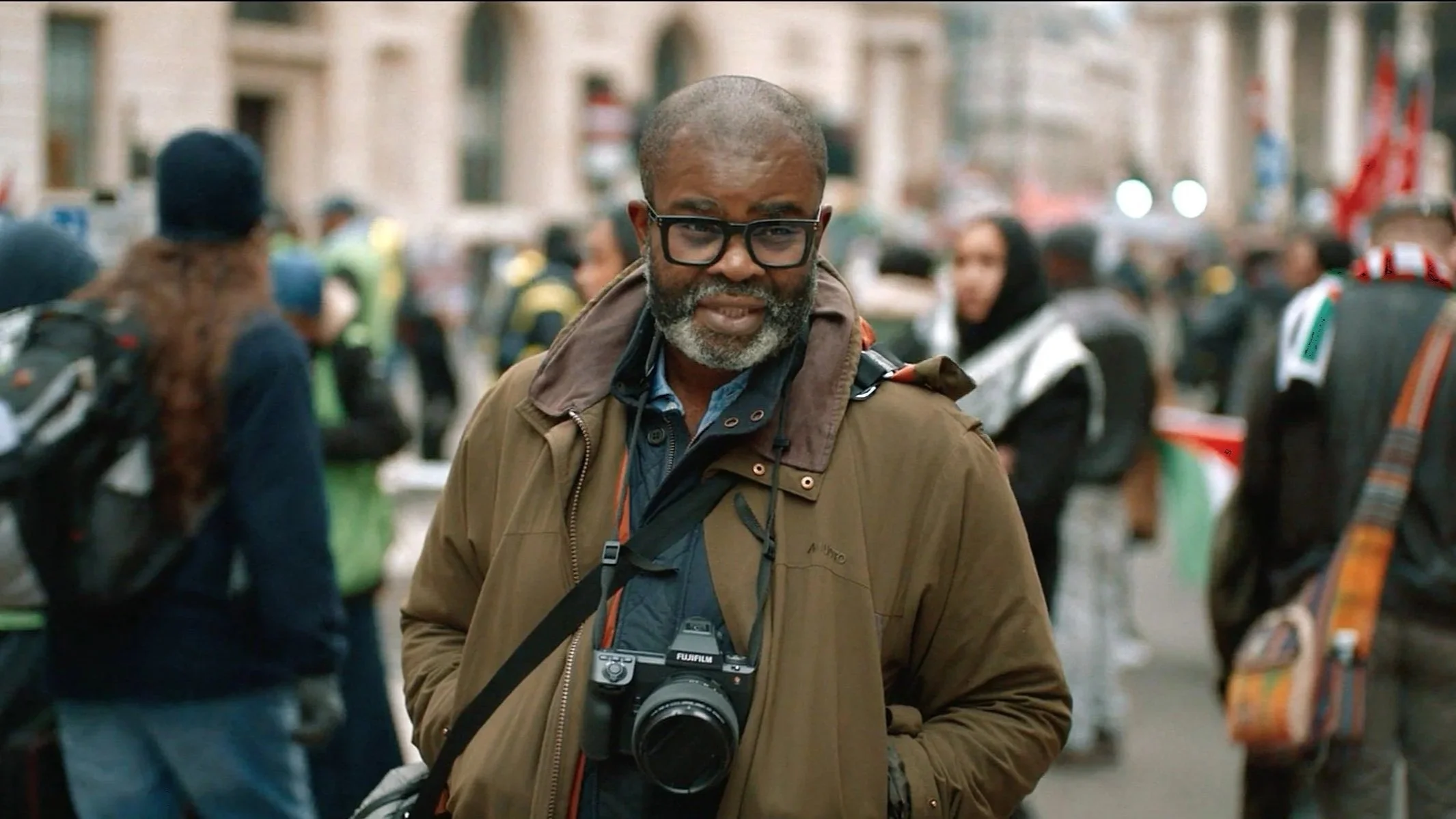
Image courtesy of Watermelon Pictures.
by MANSEL STIMPSON
More often than not an hour and a half or so is the appropriate running time for a documentary feature and Shoot the People is of a length which fits in with that. On this occasion, however, while the film is a striking one, it could well be that it would have benefited by being longer. When I read a description of it before viewing, I had the impression that it would be a film which had the potential to be unusually rich due to it bringing together three distinct elements. Centred on the photographer Misan Harriman, it seemed to offer a study of his work, a biography of the man and a thesis about the interconnection between the various protest movements that have come to the fore in the last sixty years or more. To achieve that fully, however, it needed more than 93 minutes so, good as it is, Shoot the People achieves rather less than it could have done.
Misan Harriman is Nigerian and was born in that country but grew up in Britain. Indeed, he would become the first black man to shoot the cover for British Vogue, but this film chooses rewardingly to focus on the photographs which link up with his own social activism. We are told in passing that his work has also included taking pictures of celebrities but that is not represented here. Similarly with his life. We learn that he has a privileged background but not that his father is a billionaire businessman. His wife, a sympathetic presence, does appear but we are told virtually nothing of her background (she is Swedish) and no comment is made on theirs being a mixed marriage. In other respects, too biographical details are skimmed (more on this later), but it could be argued that this film by Andy Mundy-Castle was always intended to spotlight the social concerns at the heart of Harriman’s activism rather than the man himself.
Shot in wide screen, Shoot the People is a documentary made with great competence and Harriman, acting as narrator and guide, engages us as he looks back. There are personal details (the lasting influence of having a father incapable of closeness to his son, the fact that Misan and Camilla have two children) but the key fact that emerges early on is the impact on him of the killing of George Floyd in Minneapolis in May 2020. It was this event that led Misan to concentrate on capturing images that spoke of social injustice. He embraced the Black Lives Matter movement since his sympathies were firmly in line with those of a woman protester seen bearing a placard which reads "Why is ending racism a debate?”
Films about protest movements are nothing new, but Harriman's take on them involves looking back as well as focusing on situations that have arisen recently. Thus we have footage of him interviewing Martin Luther King III the son of the great martyred activist who talks about his father and later in Johannesburg he visits custodian David Meyer-Gollam to discuss one of his heroes, Peter Magubane who died in 2024. He took great pictures which combined social concern and visual poetry and among them are images of the Soweto uprising in 1976. Magubane is described here as more than a male activist, a freedom fighter indeed, and also somebody who rejected all hatred even when it came to his own attitude to his enemies. This film is certainly a tribute to him and, if many of the great activists of the past failed to achieve as much as they hoped, Harriman sees their efforts as still being inspirational all these years later. Protests in the UK and in America whether by adults or students are approved as continuing the tradition and doing so in the same spirit as of old.
This wide view makes much of Shoot the People fascinating and it is followed by a middle section of a rather different kind as we see Harriman attending the Oscar ceremony in 2024, an occasion when he had been nominated for directing the live-action short film The After. Here Harriman is honest enough to speak of his discomfort in accepting a place on the red carpet when his real sympathies lay with the anti-capitalist and pro-Palestine protesters who were on the streets outside. After this interlude, the film returns to direct emphasis on activism but, regardless of a few other locations being touched on briefly, the emphasis is on Minneapolis where George Floyd Square is now the site of a memorial day each year. After the wider range of the film's first half this seems altogether more constricted.
In the recent documentary Planet Israel Gillian Mosely, a Jew who deplores what has happened in Gaza, is careful to make it clear that her deep concern over the suffering of Palestinians applies equally to Israeli victims of Hamas. Watching Shoot the People I did feel that the very brief references to the events of 7th October 2023 could well have been amplified given the amount of footage in the film devoted to protests about Netanyahu and Gaza. The Hollywood sequence does indeed incorporate Harriman’s endorsement of the celebrated Oscar speech by Jonathan Glazer when being in attendance for his award-winning film The Zone of Interest he deplored the actions of both sides in his acceptance speech. That fact together with the sense of humanity and intelligence found here in Misan Harriman himself made me feel that he did indeed share Mosely's views, but had slightly misjudged what needed to be said in this documentary. It was only some days after seeing the film that I realised that the man who had recently become controversial and is stepping down as chair of the Southbank Centre was Misan Harriman. No reference to that post is made in the film which was doubtless completed before the controversy arose. As is well known it became ignited by what some claimed to be antisemitic remarks by him on social media but which Harriman refused to accept as such. What we see in Shoot the People causes one to respect Harriman and, while views about this recent incident will inevitably differ, it is quite possible that relative ill-judgment rather than anything more is at the heart of the matter in both cases.
Featuring Misan Harriman, Martin Luther King III, Ilhan Omar, Camilla Harriman, David Meyer-Gollan, Sule Rimi, Corey Smith, Lesley Redmond, Shawn Allison, Chris Landsberg, Thabo Shabangu, Mari Mansfield.
Dir Andy Mundy-Castle, Pro Wyn Baptiste, Ph Johann Perry, Ed Maeve O’Boyle, Music Nik Ammar.
Doc Hearts-Watermelon Pictures.
95 mins. UK. 2025. US Rel: 19 June 2026. UK Rel: 10 July 2026. Cert. 12A.
