No Other Choice

An unemployed man resorts to desperate measures to land the perfect job in Park Chan-wook’s darkly comic satire.
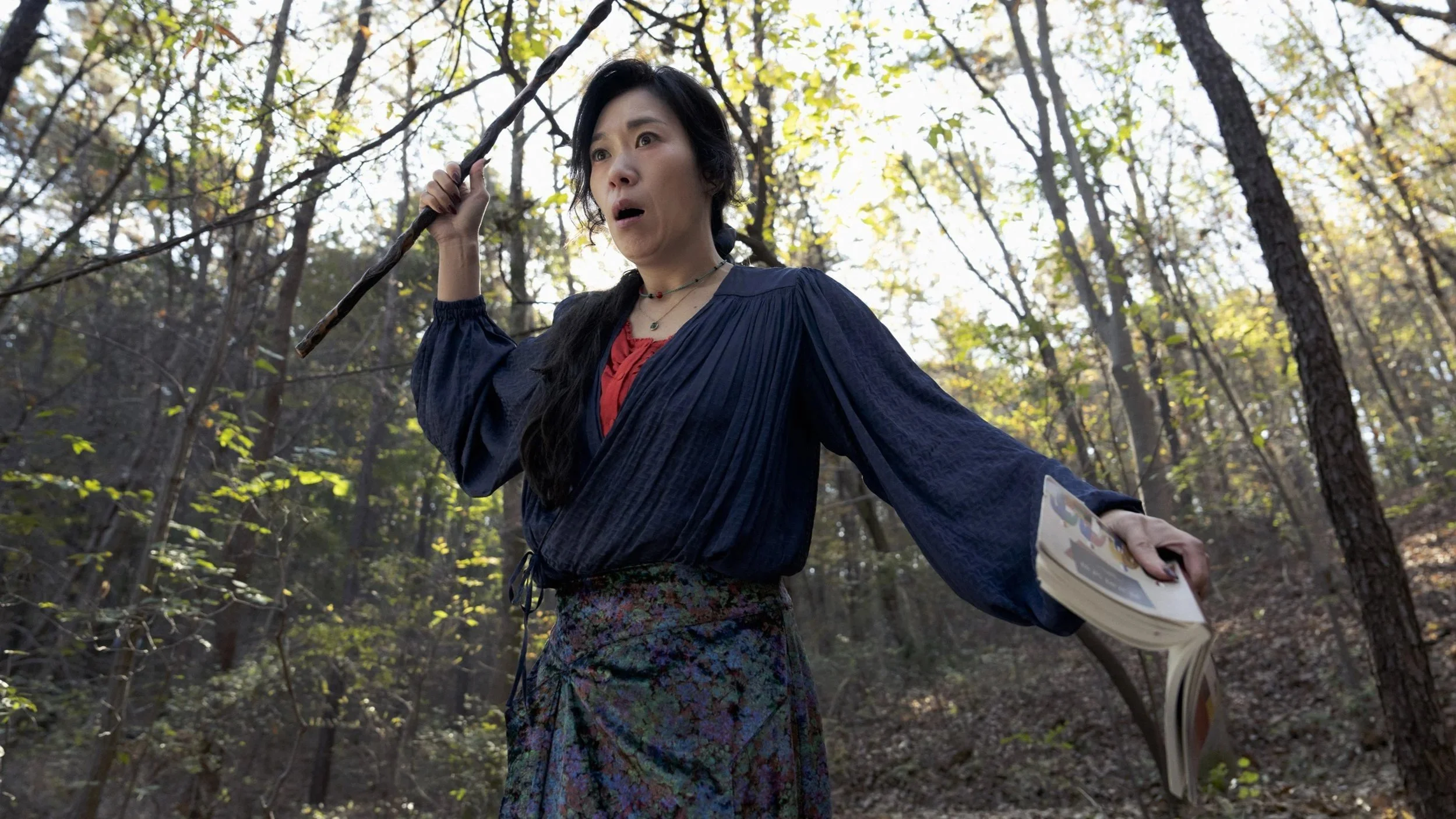
Yeom Hye-ran
Image courtesy of Mubi.
by MANSEL STIMPSON
Many critics have been surprised by the nature of this film made by the noted Korean filmmaker Park Chan-wook. That fact is in part a sign of the extent to which he is primarily associated even now with 2003’s Oldboy and its two companion titles which have come to be known as The Vengeance Trilogy. The strong violence for which they were noted is indeed absent here although the work on which No Other Choice is based – that being Donald E. Westlake's 1997 novel The Ax –has been promoted as a horror thriller. However, that book has also been described as satirical and Park's new film has understandably been compared with that classic murder comedy Kind Hearts and Coronets (1949). Robert Hamer’s very British tale certainly comes to mind here even though Park and his co-writers have in adapting Westlake's tale changed its American setting for one in South Korea. That is in line with what Park did in 2016 when he made The Handmaiden in which a novel by the Welsh writer Sarah Waters was reset in the Korea of the 1930s. Nevertheless, the humorous element conspicuous in No Other Choice makes the term "black comedy" seem an apt description and it is that central element which makes this new piece such a contrast to Park’s earlier work.
The central figure in No Other Choice is Man-su, a devoted husband who has for twenty-five years worked in the paper business thus keeping up a good lifestyle for his wife, Mi-si, and their two children, the teenager Si-one and his younger sister, Ri-one. The latter despite her age is already showing a marked skill for playing the cello. The opening scenes in Park’s film play up the sense of their prosperity to contrast it with what happens next. Changes in Man-su’s workplace mean that quite suddenly he is one of many employed there who are sacked and he soon realises that finding another job – especially one in the same line which is what he really wants – is far from easy. His wife can help by taking on work as a dental hygienist but without Man-su earning as well the family is in crisis. A mortgage debt could lead to foreclosure on the family home, the extra special cello lessons that Ri-one’s talent justifies cannot be afforded and, on top of that, they may no longer be able to continue to afford their Netflix account!
At this early stage that line about Netflix epitomises the film’s comic tone, but then the main storyline takes over. Man-su seeks a post with the one thriving paper concern, Moon Paper, of which Choi Sun-chul is a manager but there are strong rivals for the position in the form of Gu Bommo, another experienced applicant and Go Sijo, a younger man currently working as a shoe salesman. It is in these circumstances that Man-su decides that to guarantee his appointment he needs to kill his rivals. This is born of the desperation of the unfair situation in which he finds himself. Consequently, like the character played by Dennis Price in Kind Hearts and Coronets who sought to inherit by murdering relatives who had ill-used his mother, audience sympathy is with Man-su. That reaction is further encouraged by this role being taken by Lee Byung-hun. Like the rest of the cast, he rightly plays it straight and the actor has a sympathetic presence that invites one not to condemn Man-su. Thus, when the murder comedy gets going it comes over well. The stylish wit that marked Kind Hearts and Coronets may be lacking here but, by the time that Man-su attempts his first killing by dislodging a vast flower pot, the film appears to have found the right style (in fact this particular scene reminded me of another noted British comedy, 1988’s A Fish Called Wanda).
For forty-five minutes or so No Other Choice seems to be on track blending its black humour with an anger over the way that workers can be treated and at the system which allows it. But, as the film proceeds, it loses a clear-set tone. When we reach Man-su’s attempt to kill off Gu Bommo and find the latter's wife intervening we get a scene which visually plays more like a straight thriller but is nevertheless accompanied by a song on the soundtrack. This combination prevents it from working either as drama or as comedy and a few broader farcical touches that are then introduced conflict with the tone that has been set earlier. There is at this point still a long way to go and the film never really regains its sure footing. Furthermore, it lasts a full 139 minutes which feels overlong and involves sub-plots that are hardly necessary (one concerns Man-su’s son getting into trouble and another is an overplayed episode in which Man-su unaccountably suspects his wife of having an affair with the dentist who employs her).
The stylistic uncertainty exhibited is echoed in the film’s use of music which is notably varied: there is more than one song on the soundtrack but we also hear Alfred Brendel playing part of a Mozart Piano Concerto. Indeed, as the events get out of hand – Man-su is always something of a fumbling killer – the film loses most of its comic edge without really making it apparent what the film is actually aiming at ((the men targeted by Man-su prove to be arguably as much victims of the system as he is but to what extent Man-su is expected to forfeit our initial sympathy is not clear). It does help that in addition to the excellent central performance the other players should be so able and the ending of No Other Choice is undoubtedly effective. Here the film finds a new conclusion different from that in the novel for the simple reason that the book was written so long ago whereas the denouement of the film is very much linked to our own times. Nevertheless, these positive points failed to counter my impression that Park’s film lacks a consistent tone and it did so to such an extent that I found myself sitting it out rather than being able to respond pleasurably to a film that knew and conveyed what it was doing. Nevertheless, in many quarters No Other Choice has won high praise.
Original title: Eojjeo suga eobsda.
Cast: Lee Byung-hun, Son Yejin, Park Hee Soon, Lee Sung-min, Yeom Hye-ran, Cha Seung-won, Kim Woo-sung, Choi So-yul, Oh Dal-soo, Lee Suk-lyeong.
Dir Park Chan-wook, Pro Park Chan-wook, Back Jisun, Michèle Ray Gavras and Alexandre Gavras, Screenplay Park Chan-wook, Lee Kyoung-mi, Don McKellar and Jayhe Lee, from the novel The Ax by Donald E. Westlake, Ph Kim Woo-hyung, Pro Des Ryu Seong-hie, Ed Kim Sang-beom and Kim Ho-bin, Music Cho Yung-wuk, Costumes Cho Sang-kyung.
CJ ENM Co./CJ Entertainment/Moho Film-Mubi.
139 mins. South Korea/France/Cayman Islands. 2025. UK Rel: 23 January 2026. Cert. 15.