Saipan

Steve Coogan and Éanna Hardwicke star as Mick McCarthy and Roy Keane in a fictionalized version of football’s famous public barney.
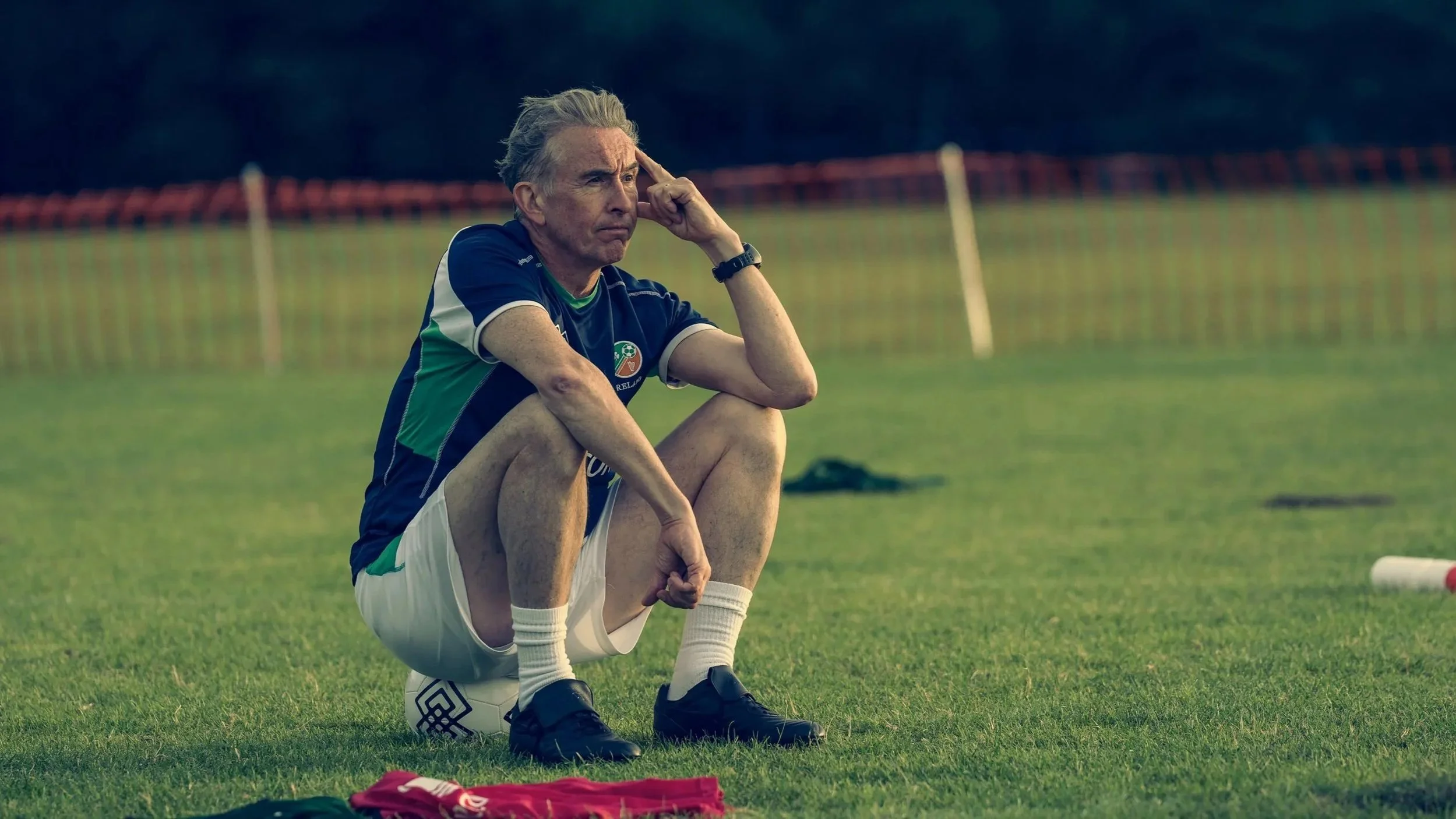
Steve Coogan as Mick McCarthy
Image courtesy of Vertigo Releasing.
by MANSEL STIMPSON
The Irish filmmakers Liza Barros D’Sa and Glenn Leyburn always work as co-directors and are indeed a married couple. In 2019 they gave us their masterpiece: Ordinary Love was their third feature and, aided by great performances by Lesley Manville and Liam Neeson, it avoided all the sentimentality that might seem unavoidable in a film about a loved one dying of cancer. Yet another side to their talent had been revealed in their two earlier features, the somewhat undervalued Cherrybomb (2009) and the acclaimed Good Vibrations (2012). The former was a contemporary study of adolescence and its problems while the latter centred on a real-life record store and portrayed the punk rock scene in Belfast against the political tensions of its time. In both cases I approached those films feeling that the material might not be attuned to what would appeal to me personally and yet the enthusiasm of the filmmakers and their ability to draw fine performances from their players won me over in both cases.
Given that track record, I approached Saipan with high hopes despite the fact that I do not have any interest in sport. Football enthusiasts will probably know from the film’s title that it is all about what became known as the Saipan Incident which arose when the Republic of Ireland was about to participate in the FIFA World Cup in 2002. In my own case, however, it was only when I read about the film that I realised that it told a tale about a national team preparing for a football match. As for screenplay credits, each of the four features made by D’Sa and Leyburn has a different writer attached, but the one here is by Paul Fraser who co-wrote with director Shane Meadows one of his best films, that being 1999’s A Room for Romeo Brass. In view of all this, I was hoping that Saipan would be another example of a film from this source so adroitly made that I would be caught up in its world despite the potentially limited appeal that its material had for me.
That really did seem a genuine probability, one aided by the fact that the focus in Saipan is less on the actual game of football and more on the tensions that arose between Mick McCarthy, the team’s manager, and its key player and captain, Roy Keane. With Steve Coogan as McCarthy and Éanna Hardwicke as Keane we have skilled actors and both are well cast. Furthermore, early screenings of Saipan have largely led to positive reviews. But in the event, I was sadly disappointed. Sports enthusiasts who remember both what happened in 2002 and just how great the headlines about it were may well find themselves embracing Saipan yet my own impression was that the material was too thin to warrant it becoming the basis of a feature film, even one with the modest length of 90 minutes.
Rather unusually, January 2026 has seen the release of three British films featuring sport, the other two being Heavyweight and Giant. Those two were centred on boxing, but Giant is nevertheless akin to Saipan in that it too has at its centre a relationship that became a troubled one. In Giant, it was between the boxer Prince Naseem Hamed and his trainer Brendan Ingle and responses to that film have shown mixed reactions over how the two men should be seen. Here again – and perhaps to a greater degree – it is possible to argue over which man to support. The central issue in 2002 was the inadequate facilities that existed when the Irish team spent seven days on the island of Saipan where they were sent for training ahead of the World Cup that would take place in Tokyo. Not only was the accommodation poor, the food bad and the pitch decidedly imperfect but at the outset there were even no footballs on the island! Keane became very angry about this and threatened to walk out and his stand can readily be justified. Blaming McCarthy for this debacle despite his ardent apologies may well have been apt. However, Keane's hostile attitude to the manager seems to have been aggravated by the fact that, although McCarthy was Irish and had himself once played for the national team, he had actually been born in England and spent most of his life there. But in any case, it could be argued that Keane, who was noted for failing to control his tongue, should not have spoken out publicly and that he was letting down his team in allowing his criticisms to be reported in the press and by being ready to weaken Ireland's chances by walking out only a few days before the tournament would start.
The conflict between the two men comes to a head in the last third of the film when they confront each other directly. But, if there is drama at this point, the first hour of the film is no more than mildly engaging. The screenplay introduces their wives, a woman reporter, a representative of the Football Association of Ireland and various members of the team. Yet none of these figures is developed sufficiently to play a meaningful part in the story. Ironically, this is so despite a wider than usual version of the declaration that regularly precedes most films based on fact. This one states that all the events in the film are fictionalised, modified or composited for dramatic purposes. Indeed, there are signs that D’Sa and Leyburn may themselves have felt that the piece was dramatically thin because they seem keen to compensate for that by adding flourishes which in the event do not help at all. The frequent snatches of pop songs of the period which are heard on the soundtrack may please some more than others. But in addition one has to put up with evocations of life in 2002 and in Keane's childhood years which feel misjudged. They incorporate archive footage into enacted scenes in a way that is rushed and off-putting. Even more distractingly frequent changes in the film ratio used become a feature and split screen images appear too as though at any cost the film must be made more lively. But this time the approach taken by the directors only serves to suggest a desperate manoeuvre and thus it fails.
At least the latter stages of the film become more effective and the two lead actors give performances that can be relied on. Even so, at the end of the day and in contrast to Cherrybomb and Good Vibrations, it is only possible to recommend Saipan to audiences drawn in by the material, people who in this instance can't wait to see the Saipan Incident portrayed on screen.
Cast: Éanna Hardwicke, Steve Coogan, Jamie Beamish, Aoife Hinds, Peter McDonald, Alice Lowe, Harriet Cains, Oliver Coopersmith, Jack Hickey, Miles Paloma, Zachary Murdiff.
Dir Lisa Barros D’Sa and Glenn Leyburn, Pro Macdara Kelleher, John Neville, Trevor Birney and Oliver Butler, Screenplay Paul Fraser, Ph Piers McGrail, Pro Des John Leslie, Ed John Murphy and Gavin Buckley, Music David Holmes and Brian Irvine, Costumes Lara Campbell.
Wild Atlantic Pictures/Screen Ireland/Fine Point Films/Bankside Films/Atomic 80 Productions/Yellowmoon-Vertigo Releasing.
90 mins. Ireland/UK. 2025. UK Rel: 23 January 2026. Cert. 15.