
László Nemes’ observational historical drama set after the Hungarian uprising of 1956 is intriguing if not entirely satisfying.
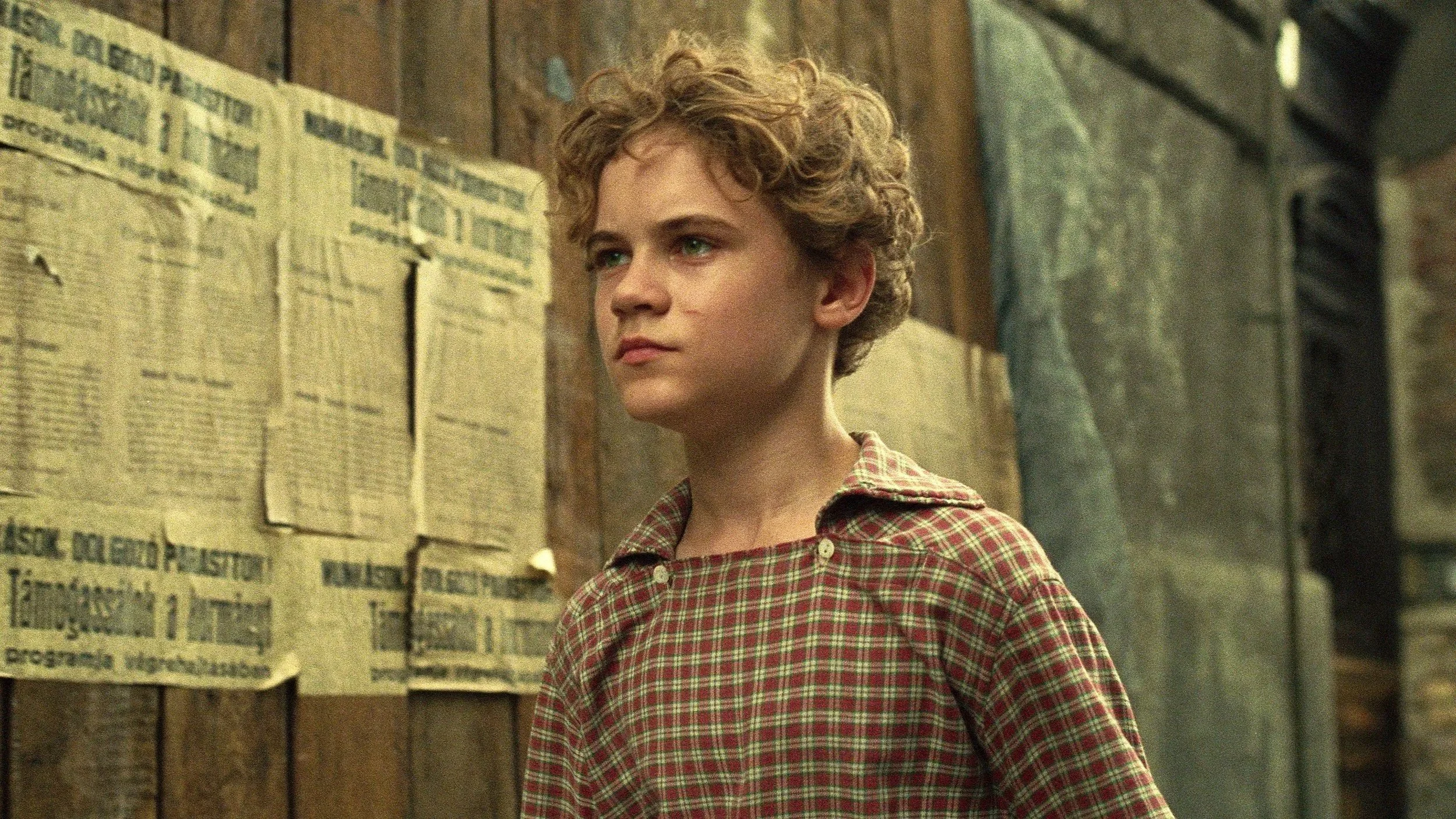
Image courtesy of Mubi.
by MANSEL STIMPSON
The fact that we get to see relatively few films from Hungary these days gives Orphan a certain novelty value and adding to that is the fact that this latest work by László Nemes takes us back to an era which rarely features in films today. Following a brief scene set in 1949, Orphan takes place in Budapest in 1957 after the failed uprising against communist control. This is the third feature from Nemes who earned instant international fame with his highly effective 2015 film about the Holocaust, Son of Saul. Its successor followed in 2018 and, while it received a more mixed reception, Sunset also gained distribution in the UK. Orphan has won an award for its photographer Mátyás Erdéli who has shot all three of the features made by Nemes but early reviews suggest that the film itself is somewhat dividing opinion. Nevertheless, it says much for Nemes that all three of his features have had a wide release and when viewing Orphan it is always clear that this is a film that bears a truly personal signature.
The central character here is a boy named Andor Hirsch played by Bojtorján Barabás. We meet him first in the prologue when he is reunited with his mother, Klára (Andrea Waskovics), who in the late stages of the war had left him in an orphanage. We learn that his father had been taken to a concentration camp in 1944 and has not been seen since. While Klára accepts that her husband is almost certainly dead, Andor dotes on the father he never knew and persuades himself that he will return. When on his own and unobserved he even addresses his father as though in prayer. What follows is portrayed throughout from Andor’s viewpoint and that means that Orphan gives us a vivid picture of life in Budapest at this deeply difficult time. The bleak atmosphere is admirably caught and the period sense could not be better.
The film shows Klára working in a grocery where Andor sometimes helps her out. He finds a friend in Sári (Elíz Szabó) a girl of his own age and discovers that her older brother, Tamás (Soma Sándor), remains in hiding from the authorities having been involved in the uprising. Andor visits an entertainer, Géza (Marcin Czarnik), who had known his father and becomes aware too of the Jewish community to which his father had belonged. But life under the Soviets is drab and often menacing. In capturing all this Orphan brings to mind the world of immediate post-war Berlin as portrayed in Roberto Rossellini's classic Germany Year Zero. Unsettling too for Andor is the fact that he becomes aware of a mysterious man on a motorbike, a stranger who visits Klára. When he starts to question his mother, she says that this man is a butcher from out of town named Berend Mihály (Grégory Gadebois). She describes him as somebody who had taken her in and had looked after her following her husband being taken away to a camp. When he meets and talks with Berend, the boy regards him as a somewhat sinister figure, but he is even more disturbed when Berend claims that he is in fact Andor’s father.
Orphan can in part be thought of as a portrayal of Hungary in these times, a world of tension which makes it likely that a gun that is dug up early in the film will come to play a significant role. When the climax comes, it will take place on a Ferris wheel, a setting that evokes Carol Reed’s film The Third Man which also seemed to have an influence on the earlier Nemes film Sunset. But, before that point is reached, we observe how Andor seeks to find out more about Berend even stealing money to cover a train fare to take him to the butcher's hometown. This journey leads to him discovering that Berend has had a wife and a child of his own. One might expect that as the story develops we would get a clearer picture of this man yet what emerges tends to be ambiguous. Andor’s hostility certainly grows but we realise that, even if Berend had helped Klára in return for sex, he may not be quite the monster that Andor supposes. He now talks of proposing to Klára and it could be that he has a genuine fondness for the boy who is his son.
If responses to Orphan prove somewhat mixed, that would hardly be surprising. The story it tells is an unusual one and that adds to its interest, but whether it really called out for a film lasting 133 minutes is questionable. It seems likely that most viewers will admire the leading adult actors: Waskovics is well cast as Klára and Gadebois is very adroit in making Berend at one and the same time a disturbing figure yet somebody who may justify a more sympathetic reading of his character. More divisive is young Bojtorján Barabás: he is certainly a competent child actor and some have strongly acclaimed his performance. Nevertheless, I did not see him as being one of the great child actors regarding him as more able when it comes to looking the part than in capturing from the inside the deep feelings that drive Andor. On occasion when there is an emotional scene Nemes chooses to shoot it from a distance as though not wanting to strain his young actor with a close-up. However, it should also be recognised that the director’s style in this film albeit displaying a real sense of cinematic mastery is one that is essentially observational. His film looks at the world which Andor inhabits and does so richly (as witness the admirable production design and the well-judged music score by the Galperine brothers) but it views it from a distance. This may also be relevant to the fact that the story leaves us somewhat uncertain as to its theme: what is our final assessment of Berend and what significance is there in Andor being a boy with a supposed father who is Jewish and an apparent one who is not? Indeed, there may even be disagreement as to whether the resolution of the piece is indeed positive or on another level to some extent negative. All of this makes Orphan an interesting film even if it is not always a fully satisfying one.
Original title: Árva.
Cast: Bojtorján Barabás, Andrea Waskovics, Grégory Gadebois, Elíz Szabó, Soma Sándor, Marcin Czarnik, Gábor Iványi, Konrád Quintus, Hermina Fátyol, Loppert Martin Tibor, Szabolcs Ruszina.
Dir László Némes, Pro Ildiko Kemény, Mike Goodridge, Alexander Rodnyansky, László Nemes, Ferenc Szale, Gregory Jankilevitsch and Alexander Bazarov, Screenplay László Némes and Clara Royer, Ph Matyas Erdély Pro Des Márton Ágh, Ed Péter Politzer, Music Evgueni Galperine and Sacha Galperine, Costumes Andrea Flesch.
Pioneer Pictures/Good Chaos/Lumen Films/AR Content/Mid March Media/Arte France Cinéma-Mubi.
133 mins. Hungary/UK/France/Germany. 2025. UK Rel: 15 May 2026. Cert. 15.