
Orwell: 2+2=5

Raoul Peck’s misguided, congested documentary examines the prophetic vision of George Orwell.
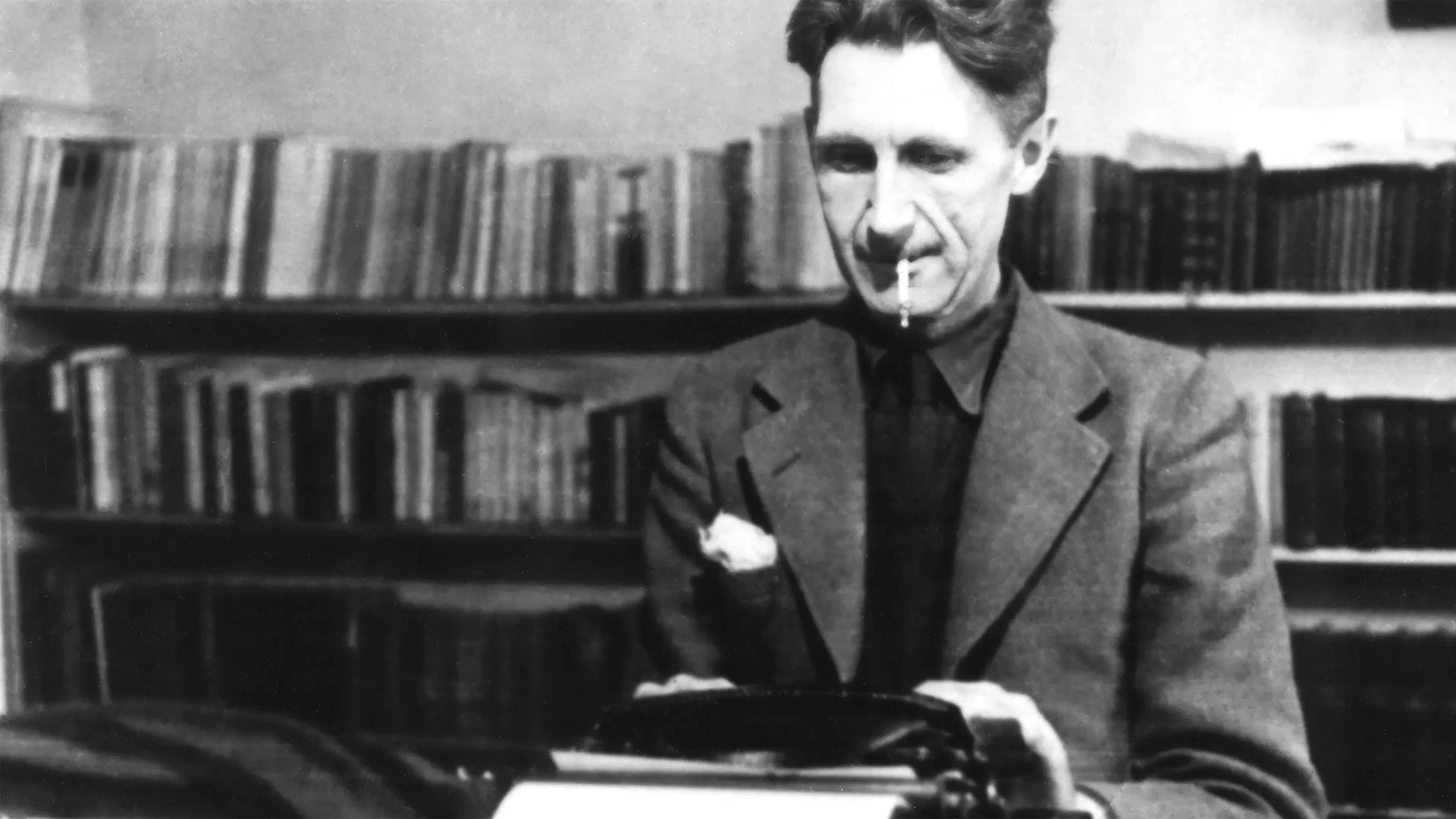
George Orwell
Photo courtesy of Altitude Film Distribution.
by MANSEL STIMPSON
Heartfelt though it is, this latest film by Raoul Peck strikes me as totally misguided. On paper it sounded immensely promising. Not only does the author George Orwell who died at the age of forty-six in 1950 remain a notable and all too relevant prophet but to make a film using the words of Orwell himself as its text suggests that this could be a companion piece to Peck’s outstanding 2016 documentary I Am Not Your Negro which was centred on James Baldwin. Although the latter featured narration by Samuel L. Jackson and was made almost thirty years after Baldwin's death, there was considerable archive material available for it to feature footage in which Baldwin, himself a great speaker, was heard at length. The Orwell film too uses much past footage but in contrast to the earlier film it has to rely on the actor Damian Lewis to speak the words of George Orwell. Lewis is a good choice for this since his delivery is never overdramatised and makes one appreciate how well Orwell expressed himself.
Ironically, the quality of Orwell’s writing, be it in published works or taken from letters and essays, is part of the problem here. Peck is anxious to illustrate the extent to which Orwell’s warnings about the future have proved to be so valid in the years since his death and indeed so very applicable to the state of our world today. In order to prove it his film understandably enough narrows its focus. Although it sketches in various details of Orwell's life, it largely plays down his relationships as examined with a decidedly critical eye in the book Wifedom by Anna Funder and sidelines his own books other than Animal Farm and 1984. Admittedly the earlier four novels have a somewhat lesser standing, but Orwell's non-fiction publications include such classics as Down and Out in London and Paris and The Road to Wigan Pier which are ignored here.
These omissions are fair enough given the particular focus of the film. Indeed, its very title by indirectly referencing 1984 (the notion that two and two make five is famously part of the indoctrination under torture imposed by an authoritarian state in that novel) pinpoints the aspect of Orwell’s work with which Peck is most concerned. In a film made up mainly of pre-existing material, the only new footage is of the Isle of Jura in Scotland where Orwell was living when he wrote 1984 in 1948 and Peck is intent on bringing out the extent that the future as envisaged by Orwell back then is so widely echoed in the world of the 2020s. The film does also reference events which influenced Orwell himself with scenes from Germany in 1933 and of the massacre of Jews at Babi Yar by the Nazis in 1941. But then, by way of the likes of Pinochet and Marcos, we move on to such figures as Putin, Orbán, Marine Le Pen, Netanyahu and Trump, the latter's most memorable appearance in this film following on immediately from a clip in which Winston Smith makes obeisance to Big Brother.
However, Orwell: 2+2 = 5 suffers from not one but two fatal weaknesses. One lies in the simple fact that the relevance of Orwell’s views to our present age is something that most of us have come to recognise already so that Peck’s film has nothing new to say. I would contrast that with an underrated film which appeared just over a year ago, Asif Kapadia’s 2073. Although his film featured actors and like 1984 was set in a future year, Kapadia was warning us about the dangers in today's world. But in his case, he was bringing together a range of factors – modern technology, climate change, wars, far-right politics, autocracy – and making us recognise how they all interlink and threaten catastrophe. Kapadia made us look at these things from a fresh angle but Peck’s film contains nothing equivalent to that.
An even more serious problem stems from Orwell’s words being so powerful in their own right that they do not call for the bombardment of images that we are asked to take in at the same time. To emphasise the actual modern day parallels we get images here from such places as Ukraine, Myanmar, India, the West Bank, El Salvador and Honduras. Each one is named and dated so that we have extra words and pictures to take in on top of the quotes from Orwell. When it comes to political issues and the power of the media there is comparable overkill with quick references to Rupert Murdoch, Jeff Bezos, Silvio Burlesconi and the murder of Jamal Khashoggi, all of which come up at speed. Whenever there is an absence of appropriate actuality footage Peck chooses to insert a large number of movie clips to represent that reality. Thus we get extracts from a number of Ken Loach films, three scenes from the Bill Douglas feature My Way Home, documentary moments from Generation Wealth and American Factory, a brief segment from Out of Africa, one from Brazil, another from the 2005 War of the Worlds and even the sight of the great Falconetti in Dreyer’s silent classic The Passion of Joan of Arc.
Theoretically a more natural use of pre-existing material is to be found in raiding TV programmes about Orwell and using extensive extracts from screen versions of Animal Farm and 1984. Particularly in the case of the latter, I had no idea that so many treatments existed and in the later stages of his film Peck can't resist intercutting from one to another of them and back again. But even here viewing bits and pieces from different versions of 1984 is often more of a distraction than an extra insight. Peck continues to pack his film full in this way right up to the final moments where he touches on Alexei Navalny, Black Lives Matter and George Floyd but, while an interview with Milan Kundera stands out for being unfamiliar and unexpected (he takes back some earlier criticisms of Orwell), for most of the time the approach here seems plain wrong. Comparison with I Am Not Your Negro in which the power of James Baldwin's words exist in a context in which they speak afresh for themselves underlines to a cruel extent what works and what doesn't. That at least is how I see it, but I should acknowledge that Orwell: 2+2 = 5 has won awards.
Featuring Damian Lewis as the voice of George Orwell.
Dir Raoul Peck, Pro Alex Gibney, Raoul Peck, George Chignell and Nick Shumaker, Text by George Orwell, Ph Julian Schwanitz, Ben Bloodwell, Stuart Luck, Aera, Maung Nadi and Roman T., Ed Alexandra Strauss, Music Alexei Aigui.
Jigsaw Productions/Velvet Film/Anonymous Content/Closer Media/Neon-Altitude Film Distribution.
119 mins. France/USA. 2025. US Rel: 3 October 2025. UK Rel: 27 March 2026. Cert. 15.
