
Underland

The scientific and the poetic are combined in Rob Petit’s study of three researchers who explore what lies beneath our feet.
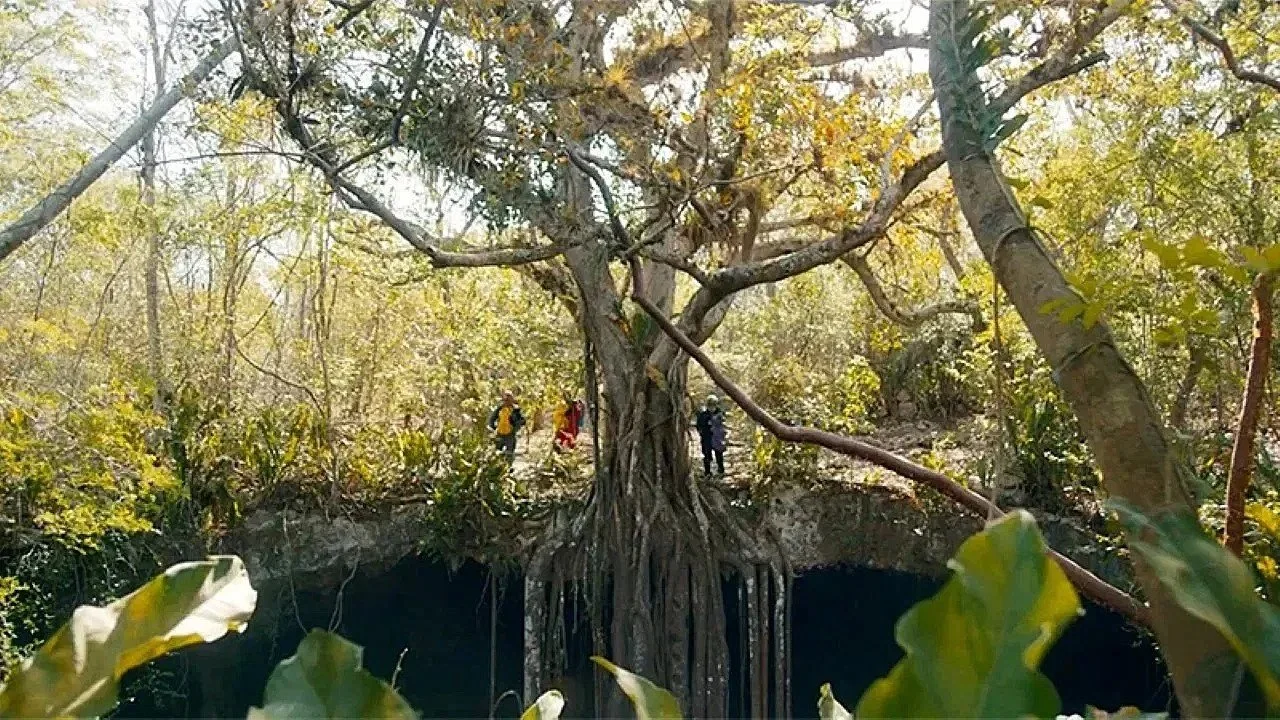
Image courtesy of Dogwoof Releasing.
by MANSEL STIMPSON
This strikingly unusual documentary finds the acclaimed writer Robert Macfarlane collaborating with filmmaker Rob Petit who seeks in this film to give us a cinematic take on Macfarlane's acclaimed book Underland: A Deep Time Journey. They had previously linked up in 2019 for a short film, Upstream, which followed the course of the River Dee in Scotland but this new work, Petit’s first feature, was a much more challenging undertaking since what is portrayed in it takes place underground. It's an endeavour which attracted the attention of Darren Aronofsky who came on board as one of its producers and the film, which comprises six titled chapters, is centred on three individuals described in the film’s publicity as astronauts of the underworld. They are the archaeologist Fátima Tec Pool, the urban explorer, photographer and author Bradley Garrett and the physicist Mariangela Lisanti.
Although each of them is deeply concerned with exploring what lies beneath the earth’s surface, they are found in contrasted locations and focused on their own distinctively individual concerns. Fátima Tec Pool who is seen first is of Mayan ancestry and is committed to exploring caves in Yucatán that reveal traces of Mayan roots including those to be found in flooded burial chambers. Garrett is an American whose work at this particular time is centred on what can be uncovered in the storm drains of Las Vegas. A very different underground world is that inhabited by Mariangela Lisanti. Her work below ground is inside a Canadian laboratory located there. The research work in progress consists of continuing efforts to find and understand the nature of dark matter that underpins the visible universe.
These three central figures seen going about their researches seek to explain their aims and how much the work means to them. All three appear in the first segment of Underland which is entitled ‘The Beckoning Void’ and thereafter the film seeks variety by continually moving back-and-forth between them. What they have in common however is not only their extreme dedication but the respect which each of them earns from the filmmakers. Although the laboratory is one that takes its workers away from everyday life, the caves and sewers are clearly even more challenging and not environments that many would choose to put at the centre of their lives. In creating a film which invites the viewer to share something of the experiences of each of the chosen three, Petit has found an approach which blends the scientific and the poetic. The latter is exemplified by the camera eye of Ruben Woodin Dechamps and by the tone of the narrative passages incorporated and spoken in English by Sandra Hüller. A further contribution relevant to the film's tone is provided by the music score of Hannah Peel.
Underland is a film charged by huge respect – one might even say awe – for the dedicated work being done and it is presented in images which turn watching this film into something that is genuinely felt by the viewer to amount to what can only be called an experience. It makes perfectly good sense that the publicity for the film advises viewers to see it on as big a screen as possible. These qualities are unusual and made me feel that this might be a documentary masterpiece. If ultimately it fell short of that for me, it may be a failing on my own part that is responsible.
I am not scientifically minded and consequently there were times when my lack of closer and more detailed understanding of the work to which these three devoted themselves became a drawback. We recognise their integrity and want to admire them but for that to feel right we need to appreciate the value of their work. In the case of Fátima Tec Pool we do at least witness her coming across ancient markings and designs which evidence early Mayan existence and in the case of Bradley Garrett discoveries are made that relate to issues around toxic waste and the like. But in the case of Mariangela Lisanti far from there being any breakthrough she ultimately explains how identifying dark matter is so difficult that most experiments end in failure. Furthermore, rather than it just being a case of her trying again and again, she declares that it would not be surprising if there were to be no successful attempt in her own lifetime. Consequently, in her case especially I was ultimately left with the sense that there was an element of folly in letting her life be circumscribed by this cause. It may be so important that she deserves nothing but commendation for her commitment, but this is where for somebody like myself the film fails to communicate how crucial it is and that ultimately undermines the impact of this film. But for those with greater understanding of the value of the forms of research portrayed in Underland it is likely that they will want to applaud Petit’s film. After all it is in so many ways a memorable artistic achievement in its own right.
Featuring Fátima Tec Pool, Bradley Garrett, Mariangela Lisanti, Susan Schuppli, Jerónimo Avilés Olguín Sergovia, and the voice of Sandra Hüller as narrator.
Dir Rob Petit, Pro Darren Aronofsky, Lauren Greenwood, Ari Handel and Jessica Harrop, Screenplay Robert Macfarlane and Rob Petit, from Robert Macfarlane’s book Underland: a Deep Time Journey, Ph Ruben Woodin Dechamps, Ed David G. Hill, Anna Price, Andy R. Warboys and Julian Quantrill, Music Hannah Peel.
Sandbox/Protozoa Pictures Films-Dogwoof Releasing.
79 mins. USA/UK. 2025. UK Rel: 27 March 2026. Cert. 12A.
