
Oslo Stories Trilogy: Dreams

Dag Johan Haugerud’s admirably acted account of a teenage girl’s deep crush on her teacher is a clever blend of seriousness and humour, the first of a three-part offering.
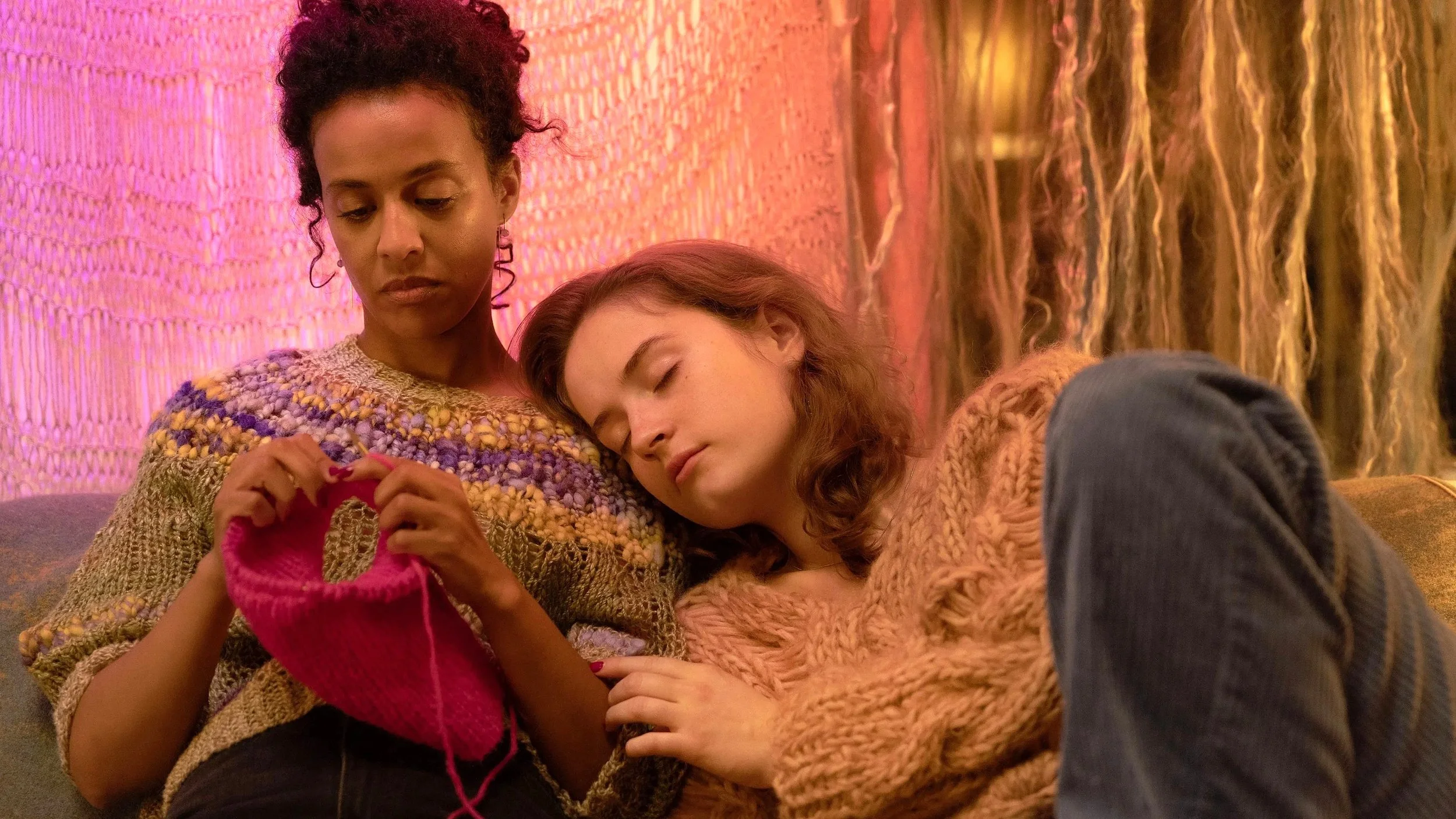
Selome Emnetu and Ella Øverbye
Image courtesy of Mubi.
The Norwegian filmmaker Dag Johan Haugerud is not a newcomer and his early career was far from being unsuccessful. In addition to making a number of short films and TV pieces he wrote and directed two award-winning features namely I Belong (2012) and Barn (2019). But, if that made him a recognised figure at film festivals, it did not lead to widespread releases for those films. However, he is now achieving that through the eye-catching device of working on three feature films during 2024 which are now being presented as The Oslo Stories Trilogy. Although promoted as a three-part package, the films, which are individually titled Dreams, Love and Sex, are not dependent on one another and can be viewed as distinct items. Indeed, while releasing them in close proximity adds to the publicity, it is even the case that the actual sequence in which they have appeared has not been consistent. In the UK, it is Oslo Stories Trilogy: Dreams which is the first to be released to be followed later in the month by Love and Sex. As it happens, starting with Dreams involves timing which quite accidentally can be seen as ideal. After all, this is a film concerned with a 17-year-old girl who writes about her sudden feelings for a teacher and then finds a publisher for it and this leads into a sequence of events which involve questions about whether or not her account is in part a work of fantasy. For a book to be questioned in that way is a theme which could hardly be more topical this summer.
The central figure here is Johanne, a teenager who falls in love for the first time when she becomes besotted with a new teacher who by chance has a name very similar to her own, Johanna. The student is played by Ella Øverbye and the teacher a woman probably in her thirties or early forties by Selome Emnetu. The casting of these roles and of the other leading figures – Johanne’s single mother Kristin (Ane Dahl Torp) and her grandmother Karin (Anne Marit Jacobsen) who lives with them – is ideal. That said, it is Ella Øverbye’s Johanne who dominates the film and does so not only through being screen centre throughout but by being the storyteller whose voice-over is a major feature. This is especially the case in the first quarter of the film as Johanne narrates how her feelings for her teacher developed.
Compelling as this is, it does raise an issue for viewers outside Norway who will find that reading this spate of subtitles – Johnanne’s comments come at us in a flow that feels seamless – makes it difficult to concentrate as much as one would wish on the visuals (in fact the colour photography by Cecilie Semec is one of the film’s great assets along with the quality of the acting). We are certainly aware in these early scenes of the adroit and sensitive way in which Haugerud and Øverbye capture Johanne's obsessive emotional focus on her teacher but at the same time the words dominate in a way that can make one question whether or not this is right when cinema is the chosen medium. Fortunately Dreams follows this initial section with scenes in which the voice-over is no longer omnipresent. Time passes and, while Johanne's feelings for Johanna remain a central element, related issues develop in a significant way. Early on Johanne is telling us of her secret written descriptions of her deep feelings but in time she confides in her grandmother, herself a poet, who reads what Johanne has set down and is impressed by her writing talent. This leads on to the possibility of publication and concerns over the advisability of making the private public. But there's another worry too in that what Johanne has written apparently contains material that is sexually explicit. Consequently, when Kristin too reads it, her reaction finds her concerned as to whether or not the teacher has taken advantage of Johanne and should therefore be exposed.
Being the writer as well as the director here, Haugerud is the one who sets the tone for the film and he has pulled off a clever balancing acting in more ways than one. When Johanne is telling us about herself early on it becomes clear that she reads a lot and she claims that in doing so her purpose is to find herself. She refers to one novel in particular, Janine Boissard’s L’Esprit de famille, about a girl of her own age who falls in love with an uncle who is forty and married. The situation described by Boissard leads to their becoming lovers and we can see how she could have been influenced by this and how she could have incorporated this into her account of her relationship with Johanna. We see how their rapport, that of a caring and considerate teacher who is drawn to her most intelligent pupil and agrees to give her knitting lessons, is emotionally charged for Johanne but nothing that we see in the film’s visualisation of what she is describing involves actual sex. So, what Johanne is telling us is all about her dreams which may include her fantasies.
One aspect of Haugerud’s skill lies in the way that what we see of the key relationship is presented so much from Johanne's viewpoint that it blends the realism of her emotions with the possibility that we may be viewing her own made-up version of events. There is another balance involved too in that Dreams is inherently a serious work about adolescent feelings but at the same time a work which contains much ironic humour (that element is particularly to the fore in its portrayal of Kristin and Karin trying to live up to their own decidedly liberal views about sex despite having underlying fears that Johanne may have been used). All of this is so good that Dreams is well worth seeing, but even so the film runs aground. It opts unnecessarily for a running time of 111 minutes and reaches that by including a final segment following publication of Johanne's writing in book form. Here the piece becomes more stylised (the film freezes at one point for a voice-over comment to be made) and raises questions about the teacher’s motivation without making them properly effective. There is also a scene in which Johanne sees a psychologist (Lars Jacob Helm) but there is an indeterminate sense about this which carries over into the film's final scene while the inclusion of a song on the soundtrack is out of character with what has gone before. Dreams undoubtedly leaves one keen to discover what the rest of the Oslo Stories Trilogy will provide but hoping that the other pieces will be more surefooted in their concluding stages.
Original title: Drømmer.
MANSEL STIMPSON
Cast: Ella Øverbye, Selome Emnetu, Ane Dahl Torp, Anne Marit Jacobsen, Andrine Sæther, Ingrid Giæver, Lars Jacob Holm, Nadia Bonnevie, Ella Bothner-By, Valdemar Dørmænen Irgens.
Dir Dag Johan Haugerud, Pro Yngve Sæther and Hege Hauff Hvattum, Screenplay Dag Johan Haugerud, Ph Cecilie Semec, Pro Des Tuva Hølmebakk, Ed Jens Christian Fodstad, Music Anna Berg, Costumes Ida Toft.
Motlys/Viaplay Group/Oslo Film Fund-Mubi.
110 mins. Norway. 2024. UK Rel: 1 August 2025. US Rel: 12 September 2025. Cert. 12A.
