
Once again Leonie Benesch is terrific, this time as a nurse facing crisis point in Petra Volpe’s deeply felt Swiss drama.
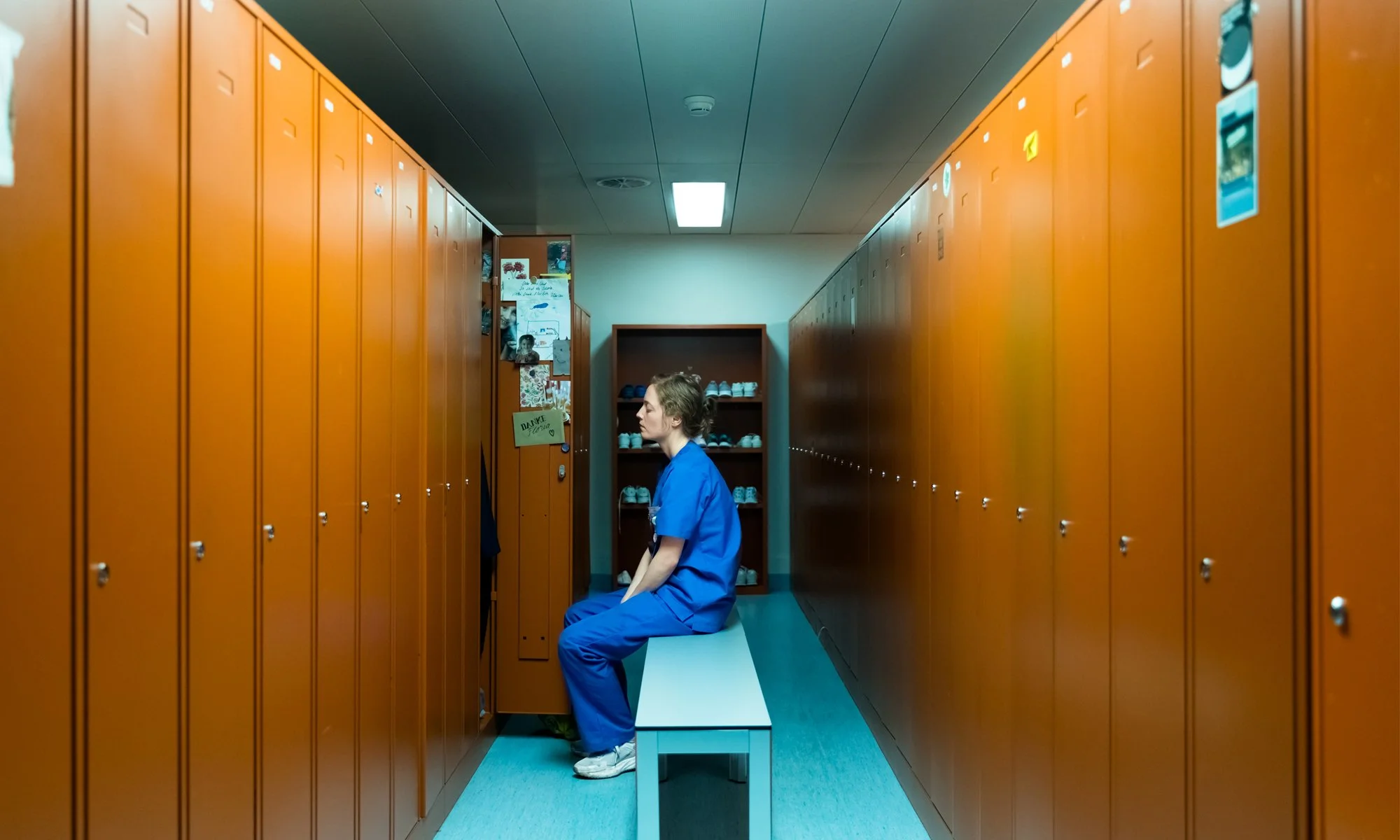
Leonie Benesch
Image courtesy of Vertigo Releasing.
Petra Volpe’s film, shot in Zürich and Basel, is a tribute to hospital nurses so many of whom are overworked. Its key focus is on one particular nurse, Floria Lind, played by the German actress Leonie Benesch, and what we see is limited to the events of a single day presented in a style which, despite the intensity conveyed, is close to that of a documentary. Virtually the whole film is set in the hospital where Floria works and at the outset we learn that her ward on the third floor is that day lacking one nurse who is unavailable. This means that the ward is dependent on just two of them, namely Floria and her colleague Bea (Sonja Riesen). That a student nurse, Amelie (Selma Aldin), is also present makes for another pair of hands but also puts further pressure on Floria.
Despite its large cast Late Shift is a small-scale film but one which comes over as a compellingly relatable drama. Most hospital tales offer a cast of characters who are developed in such a way that the varied stories of certain staff members and patients are combined to create a series of plot lines which are threaded throughout. More daringly and with total success Volpe’s film, for which she provided the screenplay as well as directing, simply shows us the patients from Floria’s viewpoint as she goes about her duties. Adroit casting ensures that even if they appear only briefly these figures come to life. That’s so whether they are people close to death or victims of dementia or in the hospital to be operated on. We learn a little about them but not so much that their individual stories take over in any way. It is similar with those who are seen on duty. We become aware of all of them as part of the overall picture of life in a crowded and understaffed hospital.
A comparable approach applies in the case of Floria herself. In the course of the film, we do learn a few details about her – she has a young daughter at school and has been involved in a relationship that has ended badly – but for the most part the focus is on her actual work, her commitment to it, her care for the patients and her practised efficiency. That what we see of her is so completely persuasive is largely down to the casting of the film’s main role. It was in 2024 that I first became aware of Leonie Benesch through her exceptional performance when playing the leading role in the German drama The Teachers’ Lounge. I missed her subsequent appearance in a supporting role in September 5, but here she is again the pivotal figure and is quite superb. She captures totally Floria’s professional skill but also conveys the extent to which the pressure which she is under could lead to a mistake or to a sudden uncontrolled outburst of exasperation.
Volpe's direction backs up Benesch in exactly the right way by capturing so realistically the hectic nature of Floria’s work which finds her always on the move and trying to fit in more than the time really allows. The camerawork by Judith Kaufmann and the editing by Hansjörg Weißbrich contribute hugely to the sense that Late Shift is showing us with absolute authenticity a situation that exists in many hospitals today. By refusing to elaborate on personal dramas built around its characters the film stands as a statement of generalised social concern and that gives it extra weight.
It seemed likely that this uncluttered approach would yield a film which on its chosen direct level would, however modestly, be perfectly realised. But quite unexpectedly the film loses its way in its concluding scenes. Late on Volpe’s screenplay opts for a dramatic development in which a wealthy private patient (Jürg Plüss) plays a significant part. Plüss enacts the role well enough and the man's presence in the ward is quite in keeping with the tone of the film. But then the storyline takes on a contrived note with a valuable watch playing a key part at which point both the events that occur and the behaviour of the characters come to seem decidedly fictional. For that matter it seems quite wrong that a film that has an almost documentary realism at its centre should feature a soundtrack song during its closing shots. This falling away is a great shame. Even so it doesn't invalidate what's gone before because when one considers the skill of the filmmaking up to that late point, the quality of the acting (Benesch in particular) and the passionate sympathy for the nursing profession so potently conveyed here they are quite enough to render this a film to see regardless of its eventual misjudgments.
MANSEL STIMPSON
Cast: Leonie Benesch, Jürg Plüss, Urs Bihler, Eva Fredholm, Urbain Guiguemdé, Sonja Riesen, Selma Aldin, Margherita Schoch, Jeremia Chung, Dominique Lendi, Ridvan Murati, Elisabeth Rolli, Albana Agaj.
Dir Petra Volpe, Pro Reto Schaerli and Lukas Hobi, Screenplay Petra Volpe, Ph Judith Kaufmann, Pro Des Beatrice Schultz, Ed Hansjörg Weißbrich, Music Emilie Levienaise-Farrouch, Costumes Linda Harper.
Zodiac Pictures/MMC Zodine/Schweizer Radio und Fernsehen (SRF)/SRG -SSR-Vertigo Releasing.
91 mins. Switzerland/Germany. 2025. UK Rel: 1 August 2025. Cert. 12A.