
Parthenope

Paolo Sorrentino’s beautiful coming-of-age fantasy, bathed in the Mediterranean sunlight, is a slender thing.
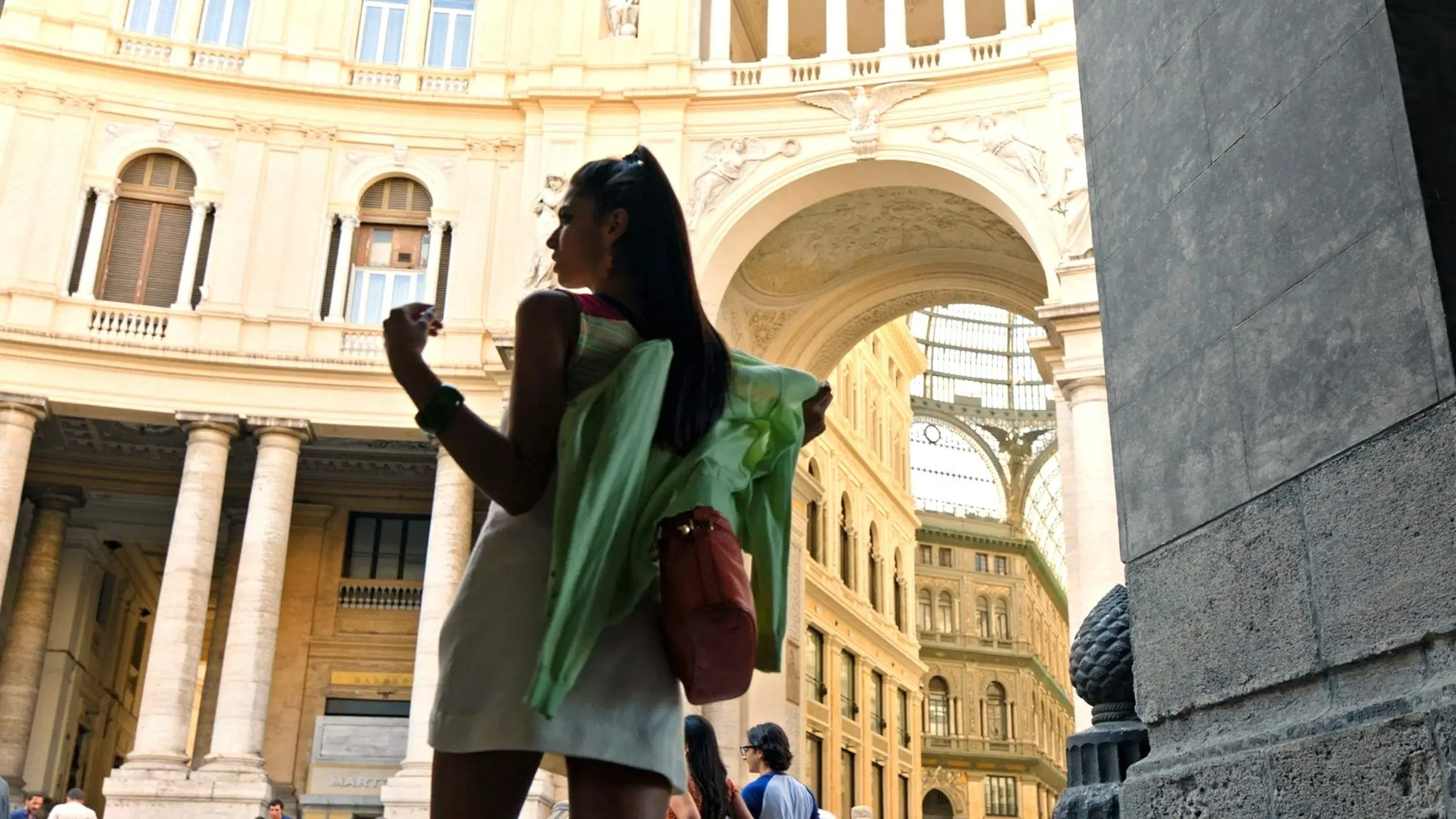
Image courtesy of Picturehouse Entertainment.
Paolo Sorrentino's latest film has won two awards: unsurprisingly its photographer Daria D’Antonio carried off a prize at Cannes last year while not unreasonably Peppe Lanzettta playing a cardinal who is monstrous in every sense of the term was acclaimed breakout actor at Capri, Hollywood. The film itself, however, has fared far less well and many critics regard it as inflated and empty. For the first hour or so it is possible to feel that it has been misjudged for we are reminded once again of just how beguiling a filmmaker Sorrentino can be, but as Parthenope continues for another hour and a quarter one comes to understand those verdicts. Even so, the film is always beautiful to look at.
The film’s title is the name of its central character played by Celeste Dalla Porta, someone who is born to wealthy parents living in Naples in 1950. However, it represents more than that since I am told that Parthenope is also a figure in ancient Italian myths. In one she is a siren unsuccessful in seducing Ulysses and in another a human being who falls in love with a centaur, but in both cases her fate links her with Naples in such a way that she comes to represent the city. In other words, the title of this film is telling us that, as with its 2021 predecessor The Hand of God, Sorrentino is offering us a work about the city in which he was born. That earlier piece was not without some autobiographical echoes but here for once Sorrentino places a female character screen centre and her story, expressive of a love/hate relationship in which the love wins out, is also a representation of what the filmmaker wants to say about Naples itself.
Although the film begins with the birth of Parthenope in the sea it quickly moves on to show her emerging out of the water as a stunningly beautiful 18-year-old who is described as a goddess. At no point does the film develop a strong plot, but its first third or more concentrates on the way in which Parthenope flirts with two men close to her, one being her own older brother, Raimondo (Daniele Rienzo), and the other Sandrino (Dario Aita) who is the son of the family's housekeeper. It is also established that Parthenope is intelligent since she sets out to study anthropology, is encouraged by a professor, Marotta (Silvio Orlando), and eventually graduates with honours. At the same time, it is established early on that her looks draw many men to her which may suggest that even a clever woman will only be sought after for her appearance. However, a chance encounter with the American author John Cheever (a cameo role for Gary Oldman) leads to a sense of rapport perhaps helped by the fact that he is gay and in addition she looks up to Marotta as a mentor whom she can respect.
These scenes and especially those involving the young trio, Parthenope, Sandrino and Raimondo, find Sorrentino on top form. Now well into middle age, Sorrentino, born in 1970, observes Parthenope and her companions with a sensual eye matched by the glorious widescreen photography of Naples (D’Antonio’s work quite the equal of that of Lucas Bigazzi who shot many earlier films for Sorrentino) and by the luscious music score by Lele Marchitelli. In more recent times both The Hand of God and especially Lora (2018) led to criticism of Sorrentino for indulging the male gaze in an uncomfortable way. Here, however, nudity is largely held back (it is mainly indulged later on in a scene about a couple uniting two Neapolitan families who are required to prove themselves by having their sexual consummation in public) and the sensuality featured earlier is romantic at heart. Furthermore, it blends perfectly with the flowing images which illustrate what a fine filmmaker Sorrentino can be.
But, that said (and it is admittedly a lot), we are dealing here with a filmmaker who is often overindulgent in the length of his films (this one lasts 137 minutes) and sustaining a narrative is far from being his greatest gift. Here we end up with what is undoubtedly a film of episodes which may give a critical insight into the ‘dolce vita’ indulged in in Naples (echoes of Fellini abound in Sorrentino's films) but don't build up the sense of narrative that a long film requires. Scenes linked to the possibility that Parthenope’s looks might lead to an acting career bring in a former star actress who hates Naples (Luisa Ranieri) and a scarred, mask-wearing elderly coach (Isabella Ferrari) and these sequences carry hints of Billy Wilder’s Sunset Boulevard (1950). As time passes – until a short contemporary coda the film is set between 1968 and 1975 – we observe too Parthenope's involvement with men including a popular local official (Marlon Joubert) and the aforesaid cardinal played by Peppe Lanzetta. More puzzling in terms of what we are meant to make of them are the aforesaid sex scene and a calculated, delayed revelation near the close about the condition of Marotta’s son who is sick.
The real inadequacy of this as a storyline lies in the fact that, while making Parthenope his main character, Sorrentino can only view her from the outside and never gets to grips with what is actually going on in her own mind. More than one phrase in the dialogue recurs but the main one which always refers to Parthenope herself is "What are you thinking about?" and that is never answered. She may want to avoid being a beauty whose looks make her into an actress but how are we to regard the intellectual side of her life? How seriously can we take her pronouncement that “Desire is a mystery and sex is its funeral"? Do we respect her professor when he suggests that she should take as a subject "The cultural frontiers of the miraculous" or does this suggest a candidate for pseuds corner? And, if Parthenope reveres him, why does she then ignore his warning about the devilish cardinal? But, just as Sorrentino’s screenplay plays down the two dramatic incidents that might have given the story some extra strength, it also seeks to be elusive to the very end when Parthenope concludes that “Love as a means of survival has been a failure – or maybe not”.
The longer this film runs the less satisfying it becomes and the less appropriate it is to refrain from giving it a low rating. Nevertheless, Celeste Dalla Porta is a real beauty and for all its inadequacies Parthenope does contain plenty of sequences which confirm that Sorrentino’s cinematic sense remains as acute as ever even if his weak skills as a screenwriter render the film as a whole a failure.
MANSEL STIMPSON
Cast: Celeste Dalla Porta, Stefania Sandrelli, Gary Oldman, Silvio Orlando, Luisa Ranieri, Peppe Lanzetta, Isabella Ferrari, Dario Aita, Daniele Rienzo, Marlon Joubert, Francesco Ferrante, Margherita Aresti, Liliane Bottone.
Dir Paolo Sorrentino, Pro Lorenzo Mieli, Anthony Vaccarello, Paolo Sorrentino and Ardavan Safaee, Screenplay Paolo Sorrentino, Ph Daria D’Antonio, Pro Des Carmine Guarino, Ed Cristiano Travaglioli, Music Lele Marchitelli, Costumes Carlo Poggioli.
Fremantle Film/The Apartment/Pathé/Numero 10/PiperFilm/Saint Laurent/Logical Content Ventures/Canal+/Ciné+-Picturehouse Entertainment.
137 mins. Italy/France. 2024. US Rel: 7 February 2025. UK Rel: 2 May 2025. Cert. 15.
