
Planet Israel

Gillian Mosely’s outstanding documentary puts the case for the Jewish people horrified by Israel’s actions in Gaza.
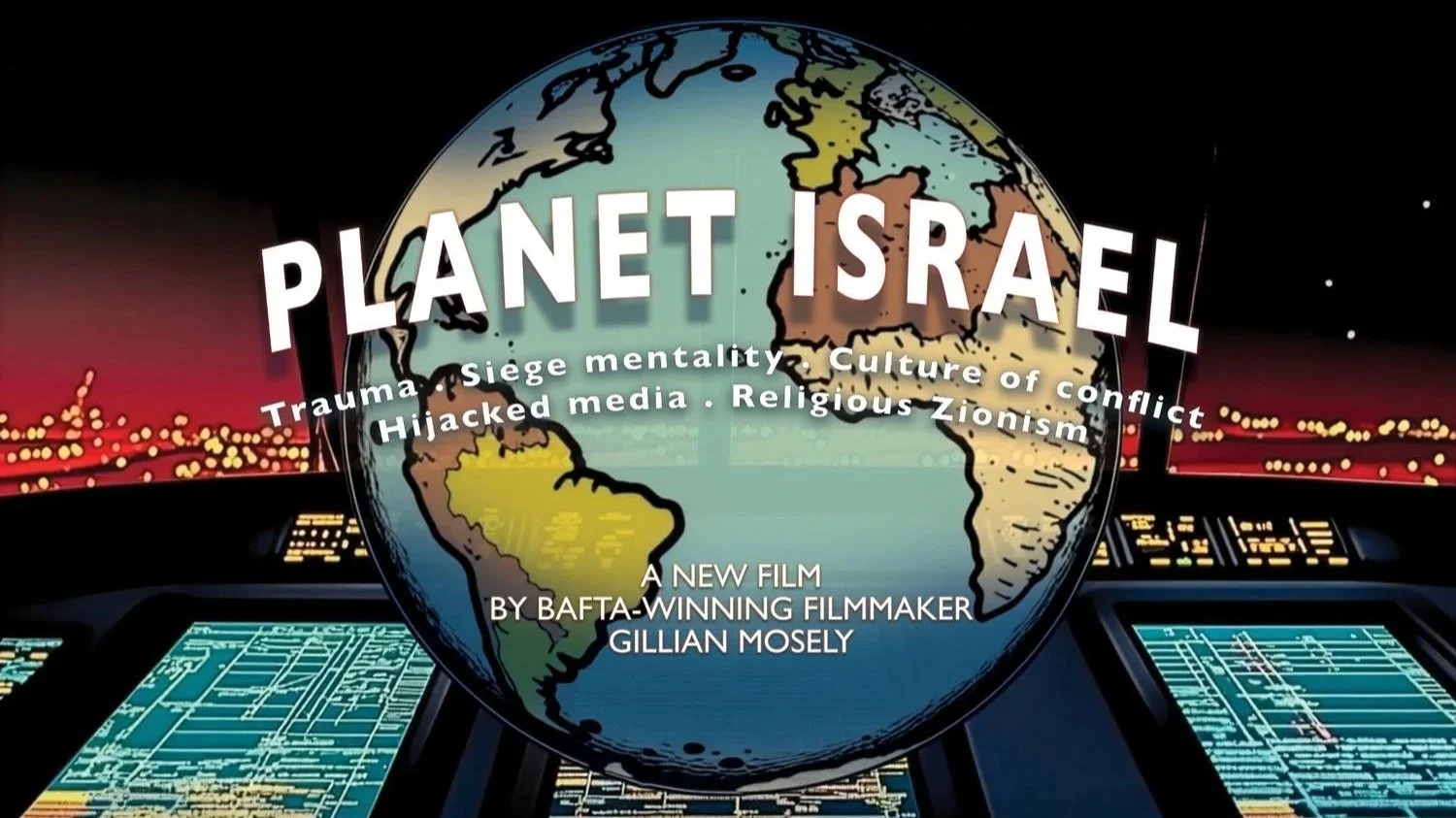
Image courtesy of Dartmouth Films.
by MANSEL STIMPSON
Back in 2022 I praised The Tinderbox, a film made by Gillian Mosely which I described as a work in which she poured her heart out. I explained that she was a secular diaspora Jew, part British and part American, who, in responding to the conflict between the Israelis and the Palestinians, had come to have total compassion for both sides. To express that view which meant so much to her, she turned director for the first time (she had previously been a producer) and The Tinderbox was a very successful debut. Now she brings us a second feature-length documentary which has the same viewpoint but is heightened by her horror over the Hamas attack on Israel on 7th October 2023 and by what Israel has done to Gaza in response. Planet Israel is even better than The Tinderbox and it could well prove to be the best documentary released in 2026.
The experience which I had when watching Planet Israel was akin to attending a lecture which had sounded interesting but which proved to be far richer and wide-ranging than expected. It is a personal statement in which Gillian Mosely shares her own thoughts and researches while incorporating the views of a range of people. They include academics, a historian, a rabbi and in Dr. Julia Chiatin somebody who is a social psychologist, a researcher, a peace activist and a teacher all in one. But the route taken by the film is that set down by Gillian Mosely herself and its starting point is her dismay that such a large proportion of Jewish Israelis were supportive of Israel's robust response to the Hamas attack (research in May 2024 put the figure at 73%). It is not, of course, a case of Mosely underestimating the horror of what was done on 7th October (an early section of her film is concerned with that event and its aftermath). However, Israel’s retaliation turned out to be of a kind which made her ask what it is that makes a people turn a blind eye to wide-scale atrocities committed in their name. She speaks as a Jew who believes that Gaza now stands as evidence that Israel has lost its moral compass.
In pursuing this view and seeking also to explain the attitude of those who support Israel’s actions, her film goes deep. In its early stages we hear conflicting viewpoints on the part of the public while the extremism that arose is illustrated by archive footage of Yoav Gallant, the Israeli Defence Minister, declaring that the aim was that Gaza would have no electricity, no food, no water and no fuel which was entirely appropriate since Israel was fighting human animals. But, having established that, Planet Israel looks back on earlier history and on the trauma that Israel has suffered in consequence. It even goes back to early Zionism leading on to the revisionist form of it set up by Jabotinsky in 1923 which was favoured by Benjamin Netanyahu’s father and is now embraced by his son. References to the historical background also emphasise events such as the Balfour Declaration and Britain's disturbing actions when governing prior to partition in 1947, an event which led to the mass displacement of Palestinians from what had become the State of Israel.
However, it is after this section that the film branches out in more surprising ways making it even more rewarding. A section headed ‘Trauma’ considers the extent to which Israel has a mental health crisis largely born of the Holocaust which causes so many Jews to see themselves as victims. It is suggested that it has induced an understandable fear in people which can result in blindness to their own aggression. Mosely’s investigations next lead into a study of five key steps which are described as a "Handbook for Authoritarian Rulers". They include utilising unaddressed trauma, encouraging militarisation by distorting the way that history is taught, bringing extreme views into the mainstream, taking over the media while also attacking opponents and twisting religious precepts to support ultranationalism.
Taking each of these tactics in turn, Mosely’s film illustrates how these steps are all present in what has been done by Benjamin Netanyahu and his far-right ministers Ben Gvir and Smotrich and here parallels with what has been happening in Trump's America speak for themselves. In the Israeli context what stands out is the control of the media which, together with reporters not being allowed into Gaza independently, involves those who live in Israel being virtually prevented from seeing any images of what conditions in Gaza have become. This surely helps to explain why, despite 40% of British Jews being found to be critical of Israel, 82% of Israelis would expel Palestinians from Gaza and 56% would expel Palestinians who are Israeli citizens. Another aspect specific to Israel is the disconcerting fact that some rabbis have become radicals taking a supportive view which Mosely regards as a betrayal of Judaism.
There is no doubt at all that Gillian Mosely believes that it is immoral to hold back on this issue. At the conclusion of her film, she describes Israel's actions in Gaza as a crime and does not hesitate to call it genocide. In reaching that conclusion she is answering the question "Have the abused become the abusers?" and in doing so she is seeing the answer as a tragedy as much for the Israelis as for the Palestinians. Even so, supporters of Netanyahu will doubtless see her as biased and misguided and may even regard her as a Jewess who deserves to be called a traitor. But, for anyone with eyes to see, her belief in common humanity shines out, the epitome of decency. Planet Israel expresses her beliefs profoundly and also asks that others should speak out in the same way. Indeed, there is a quote at the close of the film from John Stuart Mill to the effect that "Bad men need nothing more to compass their end than good men should look on and do nothing". This is an admirably constructed film providing much food for thought and adventurously getting away from talking heads from time to time by incorporating AI animation to illustrate what is being described. Personal testimonies from Palestinians end the film in a way that is most moving due to its simple directness. But, over and above everything else, there is the fact that, since we live in an age when antisemitism is on the rise once again, to have a film like this which evidences the fact that many Jews are as appalled as anybody else by the cruel devastation of Gaza and its citizens is absolutely invaluable.
Featuring Daniel Bar-Tal, Avi Dabush, Avi Shlaim, Ayala Panievsky, Esti Gallili-Weisstub, Julia Chiatin, Lawrence Freedman, Israel Medad, Patty Abozalo and Gillian Mosely.
Dir Gillian Mosely, Pro Gillian Mosely, Screenplay Gillian Mosely, Ph Lucy Lyon, Ed Althea Lindsay.
Medialab-Dartmouth Films.
96 mins. UK. 2025. UK Rel: 5 June 2026. Cert. 15.