
Savage House

Richard E. Grant plays a social climber of grotesque proportions in a flamboyant and deadly dour black farce.
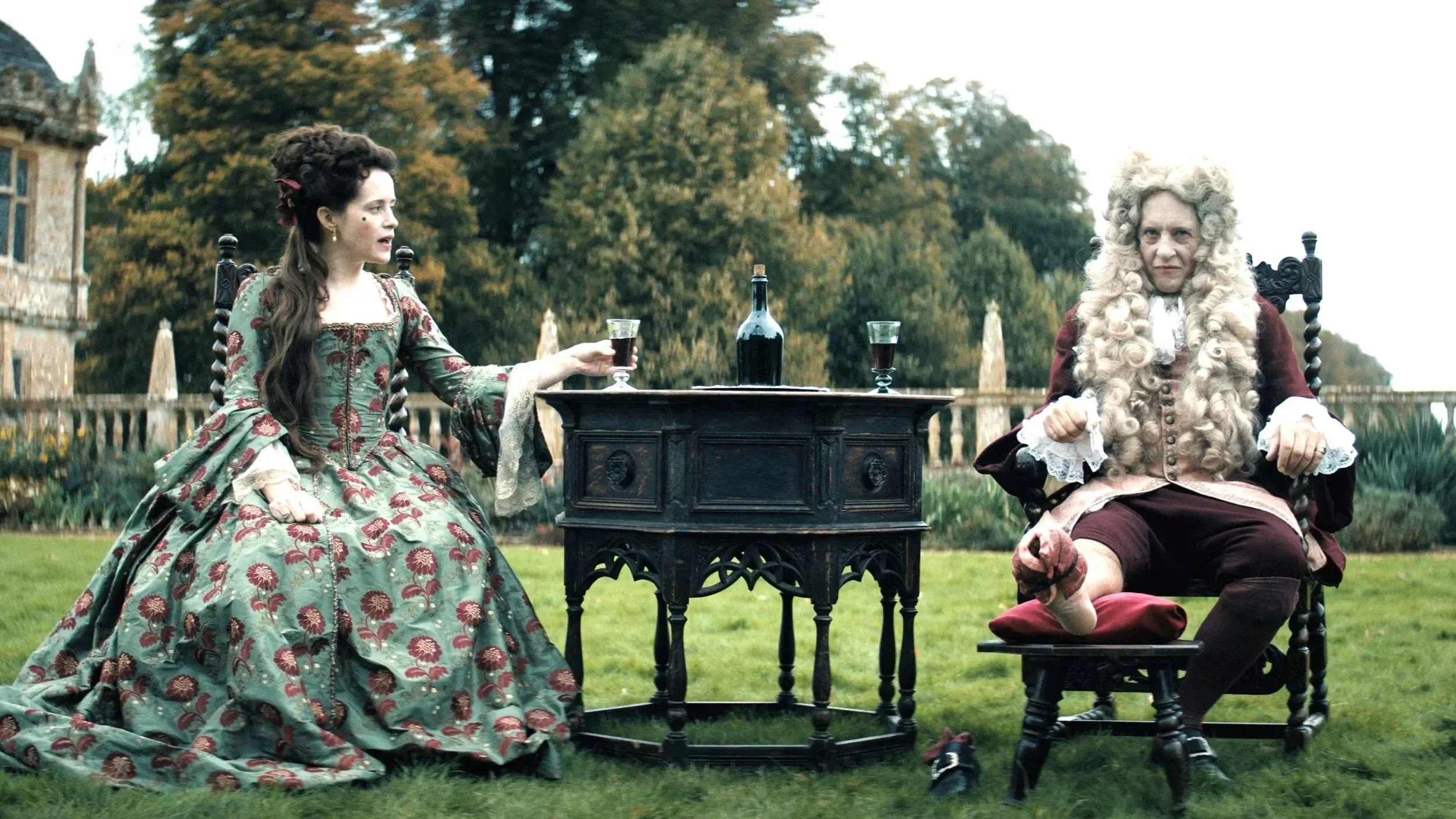
The rake’s progress: Claire Foy and Richard E. Grant
Image courtesy of Paramount Pictures.
by JAMES CAMERON-WILSON
It’s an appropriate title. In spite of his airs and graces, enormous house, ample grounds, staff, lavish wardrobe and appetites, Chauncey Savage (Richard E. Grant) is a savage both by name and by nature. Even his loyal valet, Reginald Halifax (Jack Farthing), dares to whisper in his master’s ear, “you are an acquired taste, Sir.” Chauncey was born in lowly circumstances and has been clawing at the rungs of the aristocracy ever since, by cheating, embezzlement and marriage to the noble Lady Savage (a plucky Claire Foy). But his extravagant lifestyle, taste for gambling and consumption of only the finest wines and cuisine has had a devastating effect on his ill-gotten gains. One local visitor, the pompous and supercilious Humphrey Bennett (Richard McCabe) comments to his wife that the visibility of only two servants at the House amounts to “the barbaric.”
The film, written, directed, edited and co-produced by Peter Glanz, is described as a black comedy, although the accent is more on the black than the comedy, with Richard E. Grant hamming it up as if he’s centre stage in an outrageous farce, channelling the excesses of Vivian Withnail with cherries on top. As his long-suffering wife, Claire Foy lands a few laughs, but even these are sparse. Chauncey is a monster whose cruelty and bad manners are grotesque in the extreme, alienating everybody within earshot and sniffing distance of his malodorous corporality. Such are his social aspirations, that when the Duke and Duchess of Devonshire invite themselves to dinner, he pulls out all the stops to prepare for the grand visit, squandering what remains of his wife’s inheritance. No expense is spared, from the acquisition of new furniture and paintings and an array of talented entertainers to prepare for what he sees as a chance to ingratiate himself with the nobility.
One might label the film a Jacobean romantic tragedy, as there is a glimmer of genuine affection amongst the grotesquerie, even as Lady Savage says to her daughter Fanny (Kila Lord Cassidy), “you’re a disturbed child, but I love you.” The dialogue does have its moments, such as when Humphrey asks, “you can’t be serious?” – to which Chauncey replies, “I’ve been accused of many things, but seriousness is not one of them.” The photography, production design and costumes are all top-of-the-class, recalling the cinematic aesthetic of the great Peter Greenaway, but there’s a bleakness and unpleasantness that deadens any sense of fun. And it’ll take a strong stomach to endure some of the more gruesome moments, most of which Chauncey invites upon himself. All this may have taken place 311 years ago, but the outbreak of the pox, displeasure with the monarchy and the division of the rich and the poor still have a certain resonance today, which may have been the point. Perhaps.
Cast: Richard E. Grant, Claire Foy, Jack Farthing, Bel Powley, Kila Lord Cassidy, Vicki Pepperdine, Richard McCabe, Pip Torrens, Tony Way, Tom Godwin, Roger Ashton-Griffiths, Nicholas Woodeson, Miles Jupp, and the voice of Robert Bathurst (narrator).
Dir Peter Glanz, Pro Peter Glanz, Oliver Roskill, Mark Hopkins, Dylan Maranda and Phillip Thomas, Screenplay Peter Glanz, Ph Adriano Goldman, Pro Des Gary Williamson, Ed Peter Glanz, Music Peter Glanz and Laurence Love Greed, Costumes Alex Bovaird, Sound Saoirse Christopherson and Andy Kennedy, Dialect coaches Helen Jane Simmons and Brett Tyne.
Record Player Films/Deluge Pictures-Paramount Pictures.
113 mins. UK. 2024. UK Rel: 5 June 2026. Cert. 15.