
Redoubt

In John Skoog’s real-life drama, a Swedish farmhand converts his house into a bunker to prepare for a Soviet invasion.
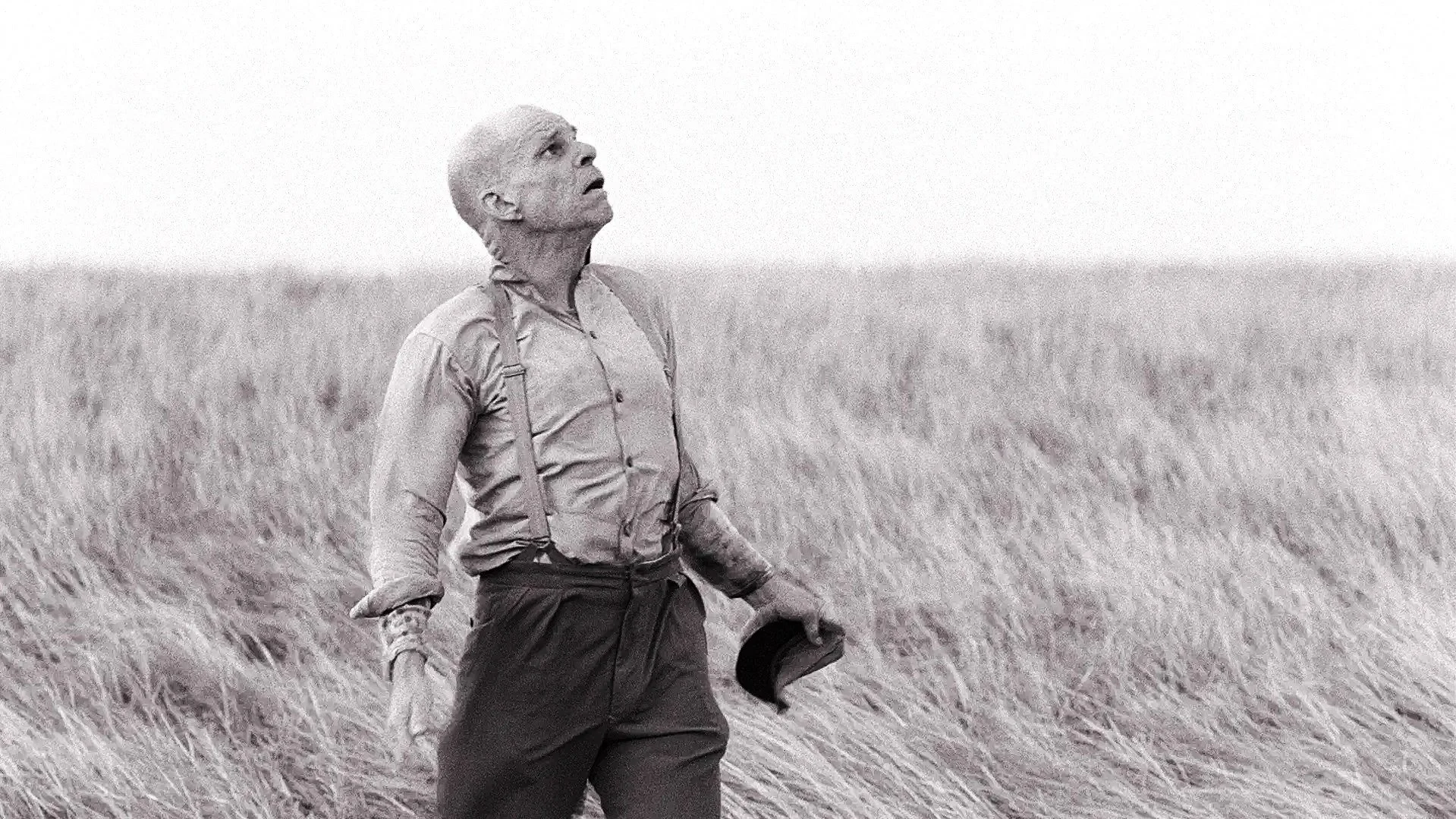
Denis Lavant
Image courtesy of Sovereign Film Distribution.
by MANSEL STIMPSON
This is a film that exists on its own terms. That is to say that it is patently a work made by an artist who is not in any way tailoring what he does in order to give it popular appeal. That man is John Skoog who was born in Malmö, Sweden, in 1985 and, in addition to directing this film, he shares the writing credit not for the first time with Kettil Kasang. Redoubt is his second cinema feature following on from his experimental documentary Ridge made in 2019 and it is centred on a real person. His name was Karl-Göran Persson who lived from 1894 to 1975 and who worked as a farmhand just outside the Swedish village of Hörby in Skåne. That this man is remembered to this day is due to the fact that being an eccentric loner he devoted his life to converting his rural farmhouse into a fortress that would protect himself and others should war come. In fact, despite being a two-storey building above ground, it was conceived as a fortified bunker and is now known as the Söderto Fortress. Over thirty years he scavenged material for it ranging from bed frames to milk churns, from bicycle parts to railroad tracks that had been decommissioned. Persson may now be dead but the building still exists and is visited.
Although John Skoog would later make Copenhagen his base, he grew up in this area and was consequently aware of this piece of local history. His filmmaking began with a series of short films and one of them, Reduit made in 2014, was actually centred on Persson. Yet he felt that he had more to say about this man and that has led not only to this feature film but also to an exhibition at Moderna Musset in Malmö featuring the fabricated duplication of Persson’s redoubt which was made for filming (installations are a further feature of Skoog’s artistic range and photography is too although for most of his films including this one he has regularly called on the services of Ita Zbroňiec-Zajt).
It would theoretically have been possible to approach Persson’s life as a biopic even if it would have been necessary to find some way of incorporating memories of this loner to build a wider picture. But Skoog is more interested in contemplating the extent to which Persson’s obsession dominated his life (a passing reference to a sister who went to live in Philadelphia is the only detail we get about his family). What we are given at the outset are illustrations from a pamphlet entitled ‘If War Comes’ which was indeed sent out to all households by the Swedish government in 1943 and advised on steps to be taken in the event of a Soviet invasion. Apparently, its production only ceased in 1991 and would be resumed once more in 2018. What we see of it together with some opening written statements about Persson make it clear that the creation of a fallout shelter was largely encouraged by this pamphlet but taken to exceptional lengths. It was not, however, a self-centred endeavour since Persson regarded his bunker as a place where other local people would take shelter with him and even envisaged the possibility of a room in it housing the Swedish King should he be nearby when an attack occurred.
Karl-Göran Persson is portrayed here as a man who is understandably viewed as an oddity by his community. Despite being seen among the congregation in the local church and attending social events such as a New Year's Eve party, he is often on his own (and all the more so after barricading the windows of his house and shutting himself away). Nevertheless, in addition to incorporating scenes with locals who are prepared to help him, the film is also at pains to add voice-over remarks by children from this community who treat him as a friendly figure ready to join in their games. With so little elaboration of surrounding characters, Redoubt relies heavily on the casting of this key role and, possibly aided by the fact that Persson is not a great one with words and rarely talks at length, the French actor Denis Lavant took this on including the need to speak Swedish. He is an ideal choice, as distinctive a presence as the late Klaus Kinski but one readily able to suggest the underlying tenderness that co-exists with the undeviating drive which is a mark of Persson’s obsession. That the film was photographed on 35 mm. and in black-and-white adds to its strength and individuality.
Given the nature of this material and the limited amount of dramatic development, Skoog was wise not to overextend the piece (81 minutes is an apt length). The care taken over the quality of the images and over the aptness of Amina Hocine’s music score further ensure that Redoubt emerges as a well-judged film. But, regardless of the quality of the filmmaking, this inevitably comes across as a work of somewhat specialist appeal. Persson while basically sympathetic is a strange figure who clearly meant well but could be seen as becoming his own worst enemy since his actions increasingly caused his whole life to be taken over by the notion that war was coming. I was not bored by Redoubt as some might well be, but equally and despite it being well done I felt that this portrait was somewhat limited in its dramatic satisfaction given that there are no discoveries to explain what made Persson the man that he was. To respond in this way may in part be a matter of taste. In particular I would guess that anyone who greatly admired the two films which Ben Rivers made about the Scottish hermit Jake Williams – Two Years at Sea (2011) and Bogancloch (2024) – will find Redoubt very much to their liking. Yet even those who found those works hard going may find Redoubt a more approachable film despite its unconventional character. It is certainly good of its kind.
Original title: Värn.
Cast: Denis Lavant, Agnieszka Podsiadlik, Aron Skoog, Livia Millhagen, Michalis Koutsogiannakis, Sol Roach, Tilda Nilsson, Linnea Kralj, Maya Peterson, Liam Friberg.
Dir John Skoog, Pro Erik Hemmendorff and Caroline Drab, Screenplay Kettil Kasang and John Skoog, Ph Ita Zbroňiec-Zajt, Pro Des Søren Schwartzberg, Ed Jussi Rautaniemi and John Skoog, Music Amina Hocine, Costumes Fianna Robijn.
Plattform Produktion/Bord Cadre Films/Film i Skåne/Lemming Film/Paloma Productions-Sovereign Film Distribution.
80 mins. Netherlands/Denmark/Sweden/Finland/Poland. 2025. UK Rel: 27 March 2026. Cert. 12A.
