
Savages

In Claude Barras’s visually impressive stop motion cartoon, an 11-year-old girl and her cousin combine forces to protest against the deforestation of their Borneo home.
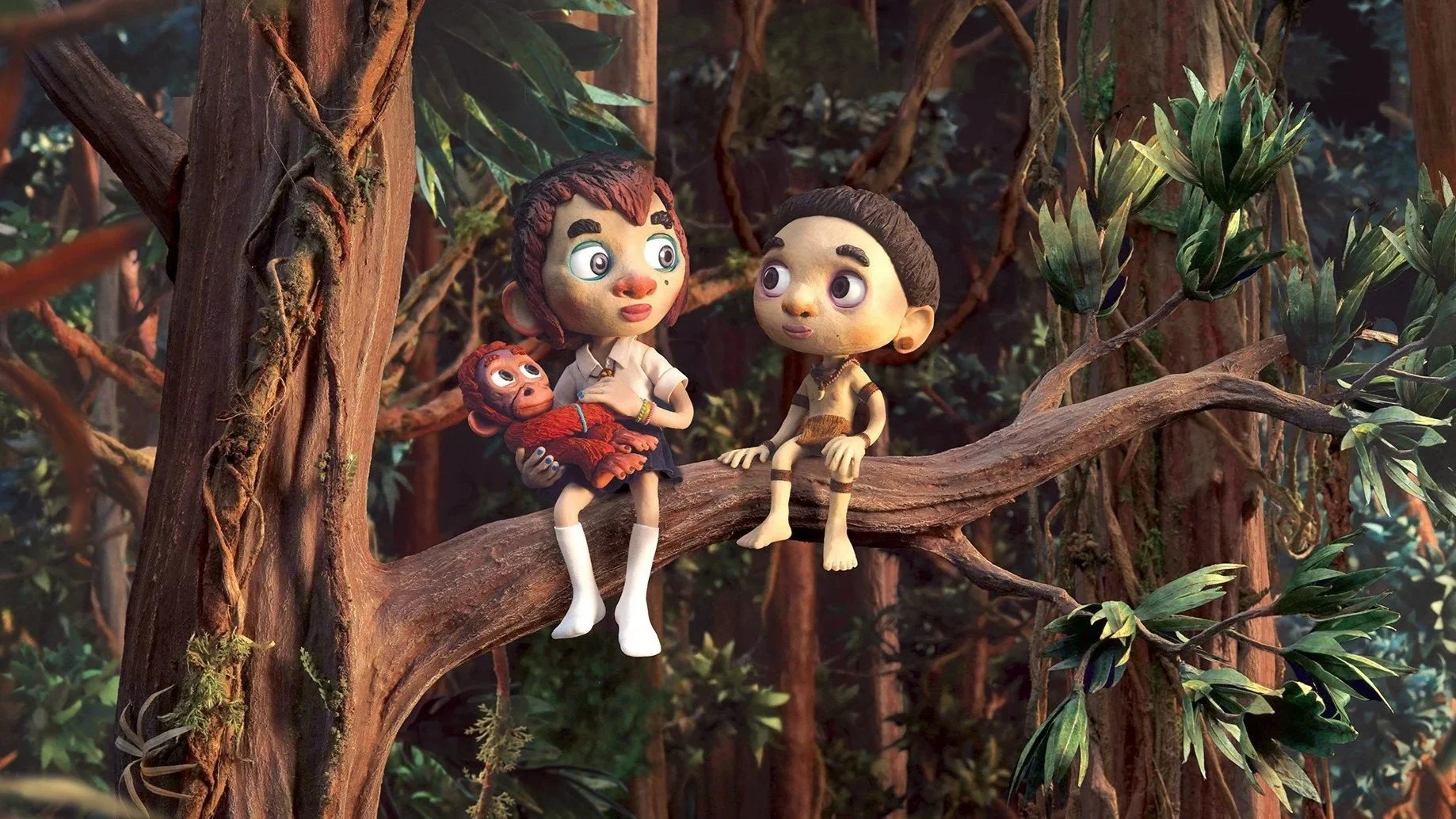
Image courtesy of Metfilm.
The distinguished Swiss animator Claude Barras became devoted to stop-motion as his method of filming in 2007 from then on using it for all his short films and for his first feature My Life as a Courgette released in 2016. It's a form of animation which takes up an enormous amount of time when it comes to making a feature so it is hardly surprising that only now are we seeing Savages which retains that form. It again bears the filmmaker's personal stamp visually since the characters in the story are clay sculpted figures with large heads and intensely expressive eyes. That might suggest a degree of stylisation which would distance them from the viewer but, as proven by My Life as a Courgette which contained a directly comparable look, Barras had the skill to make viewers think of them as real people and to feel their emotions accordingly.
Although My Life as a Courgette also contained lighter elements, its greatest distinction lay in its ability to tell so movingly in animated form the story of a nine-year-old boy who, following the death of his alcoholic mother, found himself bullied when put in a children's home – all of this being captured in its full emotional depth. A very different but comparably serious theme lies at the heart of Savages. Barras has turned to a real-life situation in the Sarawak region of the island of Borneo, that part of Southeast Asia which is home to the indigenous Penan people. Logging operators in that region became an issue fifty or more years ago but in the 1980s and subsequently deforestation became even more widespread. It is the major concern behind the story told in Savages since what is happening deals with both environmental issues and a failure to respect indigenous rights.
There is no doubt at all but that the quality of the animation in Savages measures up to that in My Life as a Courgette, but this time around the tone of the piece is less consistent. Although not divided into distinct sections, there is a sense that Savages is a film in three parts. The central character throughout is an eleven-year-old girl named Kéria whose mother has died and who lives with her father, Mutang, who works for a logging company cutting down trees for a palm oil plantation but who nevertheless has decent feelings. Early on both father and daughter witness the killing of an orangutan by loggers and Mutang steps in to save the life of its baby. Kéria looks after the little primate becoming in effect a surrogate mother and it is at this time that her grandfather deposits Kéria's cousin Selaï with them, a boy about the same age as her. Through her late mother Kéria has Penan blood, but in Selaï’s case that is much more obvious and it results in abuse being directed at both of them by Kéria’s schoolmates. Because of this Selaï chooses to run away into the forest where the Penan people live and the orangutan, which the girl has now named Oshi, follows him. This leads to Kéria pursuing them and in time they do manage to meet up although they have lost their way.
This opening section certainly begins dramatically and the killing of Oshi’s mother puts one in mind of the death scene in the Disney classic Bambi. Nevertheless, despite that and the wider issues that are hinted at, the first third of Savages while moving at an admirable pace does portray the adventures of the cousins and of Oshi in the forest in a way that suggests a children's tale. Even if dangers can be encountered, there are jokey references here as Kéria and Selaï slowly overcome their doubts about each other.
The middle section of Savages finds the cousins linking up with the Penan people whose native traditions save Oshi when the orangutan has been bitten by a snake. However, other native beliefs are presented in ways that seem decidedly primitive rather than representing a belief in animism that can readily be respected. It is also the case that this segment largely loses sight of the deforestation theme even if it does introduce an ecologist living with the Penan who knows Mutang. In this context fresh information comes to light regarding the death of Kéria's mother although subsequently her actual fate will emerge in a totally different way.
The final third of Savages does bring back the question of how best to challenge deforestation but incorporates scenes that come to verge on melodrama, a tone that has not been present earlier. Consequently, Savages comes across as a work which changes its character from time to time rather disconcertingly. If My Life as a Courgette was readily recommendable to adult viewers as well as to older children, there are times when this film’s appeal seems more attuned to children's tastes despite the strong social comment which should make it ideal for the audience who loved its predecessor. The fact is that My Life as a Courgette was so good that it overshadows Savages and underlines its lack of unity. However, to stress that too much is probably unfair to Savages which is visually impressive throughout and has its heart in the right place (in theory its title could be taken to refer to the Penan people but the film takes pains to make it absolutely clear that it is the loggers who are the savages). I viewed the film in a subtitled version but, since it contains much likely to appeal to younger viewers sympathetic to its stance, it is good to know that a dubbed version will also be on release in the UK. In that connection it is worth noting too that in 2021 the Locarno Film Festival set up what is known as the Locarno Kids Award la Mobiliaire and in 2024 the winner of that award which recognises someone capable of bringing cinema to younger viewers was Claude Barras for Savages.
Original title: Sauvages.
MANSEL STIMPSON
Original voices of Babette De Coster, Martin Verset, Benoît Poelvoorde, Laetitia Dosch, Pierre-Isaïe Duc, Nelly Tungang, Gaël Faye Hannah Boudreau, Nessa Staes, Sailyvia Paysan, Komeok Joe.
Dir Claude Barras, Pro Nicolas Burlet, Screenplay Catherine Paillé and Claude Barras with Nancy Huston and Morgan Navarro, Ph Simon Filliot, Pro Des Jean-Marc Ogier, Ed Anne-Laure Guégan and Claude Barras, Music Charles de Ville and Nelly Tungang, Lead Animator Antony Elworthy, Costumes Anna Deschamps.
Nadasdy Film/Haut et Court/Panique!/Hélium Film/Beast Animation/France 3 Cinéma/Proximus-Metfilm.
86 mins. Switzerland/France/Belgium. 2024. UK Rel: 1 August 2025. Cert. PG.
