Scarlet

It’s Hamlet rehashed in anime director Mamoru Hosoda’s messy morality tale.
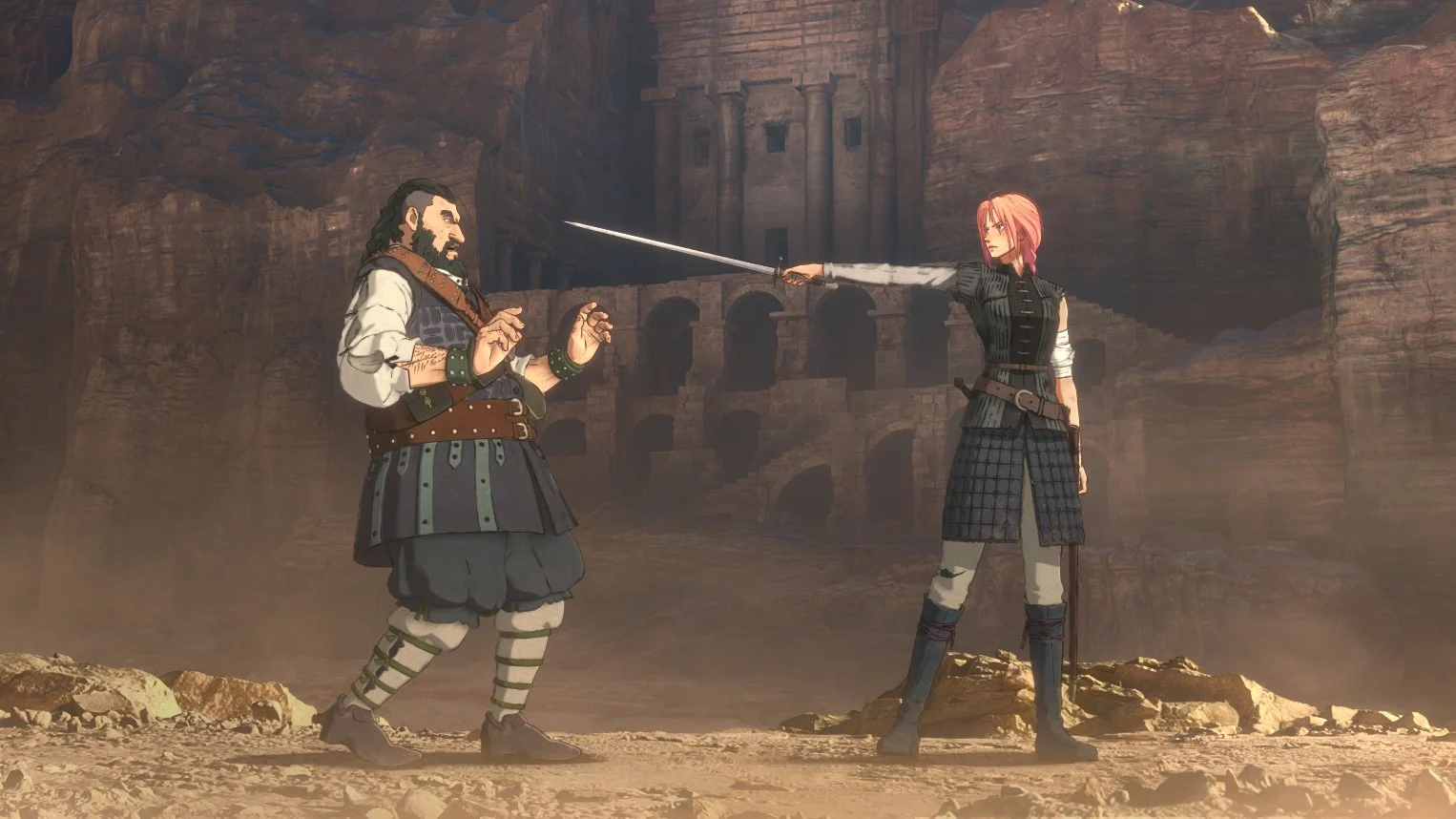
2D or Not 2D: Scarlet seeks revenge.
Image courtesy of Sony Pictures Classics.
by CHAD KENNERK
From Riz Ahmed’s recent turn as the tortured prince to the central plot of a certain Best Picture contender, William Shakespeare and his masterworks continue to occupy centre stage in our collective consciousness. Widely considered one of the great anime directors, Mamoru Hosoda — the Oscar-nominated filmmaker behind Mirai, The Girl Who Leapt Through Time, Wolf Children, and Belle — now turns to late-16th-century Denmark for a gender-flipped revision of the Bard. Set in the waning years of the 16th century, Scarlet follows a sword-wielding, pink-haired princess bent on avenging her father’s murder. In Hosoda’s version of Hamlet, the princess fails to catch the conscience of the King…and dies. In the liminal ‘Otherworld’, where the sky is an endless ocean, a Godzilla-like dragon bristling with thousands of swords strikes down wrathful bolts of blue lightning. As she journeys across the hopeless wasteland seeking vengeance, Scarlet encounters Hijiri (as in ‘holy person’ or ‘sage’ in Japanese), a present-day paramedic who tends to her wounds and suggests she puts an end to her eternal rage.
Hosoda’s most beloved films were collaborations with screenwriter Satoko Okudera, and since their parting, fans have been less enthusiastic about his work. In recent years, Hosoda has increasingly incorporated 3D-driven CGI into his traditionally 2D style, with Scarlet marking his most significant blend of the two. In some cases that blend works particularly well; in others, it creates a jarring distancing effect. Hosoda’s animation remains striking, yielding remarkable images and sequences, but even with the tragedy of Hamlet as a foundation, Hosoda delivers an uncharacteristically bland narrative of lament and rage in limbo. Shakespeare’s characters are stripped down to nothing more than names and general motives. Bill’s words and wit are gone too, though the infamous “Get thee to a monastery” surfaces for no discernible reason. It’s a heavy-handed morality tale about forgiveness that should have stuck to Shakespeare.
Hosoda seems hellbent on shoving a ‘choose love’ theme down the audience’s throat, rather than trusting them to absorb it. In one particularly bewildering sequence, Scarlet experiences an orgasmic, hallucinatory vision of a utopian future, where she dances in the streets with Hijiri to the relentlessly chipper J-pop anthem ‘Shukusai no Uta’ (‘A Song of Celebration’), which pleads, “Teach me about love, oh please let me know, the miracle that’s inside of you.” For all its visual imagination, Hosoda’s worthy sentiments land with a heavy thud. Like the juxtaposition of 2D and 3D, Scarlet feels like a hodgepodge of influences rather than a cohesive vision. For a filmmaker known for capturing humanity in a fantastical premise, this journey to the afterlife is oddly earthbound.
Original title: Hateshinaki Sukāretto (Endless Scarlet)
Voices of: Mana Ashida, Masaki Okada, Koji Yakusho, Kōtarō Yoshida, Yutaka Matsushige, Kazuhiro Yamaji, Tokio Emoto, Munetaka Aoki, Shota Sometani, Yuki Saito, Masachika Ichimura, Kayoko Shiraishi, Noa Shiroyama.
Dir Mamoru Hosoda, Pro Nozomu Takahashi, Yuichiro Saito, Toshimi Tanio, Screenplay Mamoru Hosoda, Ed Shigeru Nishiyama, Music Taisei Iwasaki, Sound Kevin Gundlach.
Studio Chizu/Nippon Television/Columbia Pictures-Toho Co., Ltd./Sony Pictures Entertainment.
111 mins. Japan. 2025. US Rel: 13 February 2026, UK Rel: 13 March 2026. Cert. PG-13 (US), 15 (UK).