
The Choral

Alan Bennett returns with his eighth screenplay, a touching, funny, compassionate and surprising period drama set in his native Yorkshire.
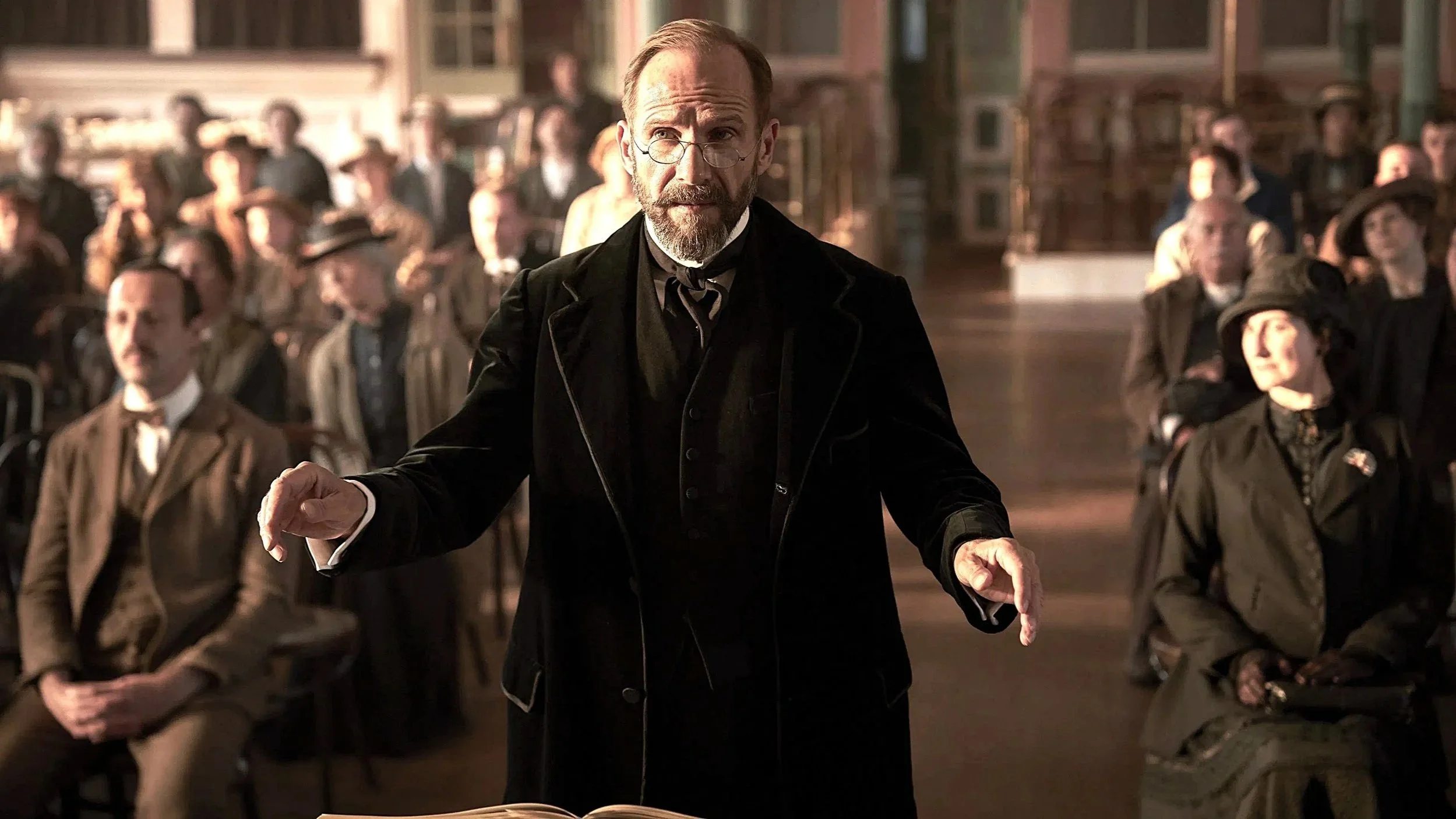
War requiem: Ralph Fiennes
Image courtesy of Sony Pictures.
It’s funny how a film set in 1916 can feel so pertinent today. If the world is still here in a hundred years, let’s hope there will be no need for antiwar cinema. While the Great War is very much at the forefront of Alan Bennett’s drama set in the fictional Yorkshire town of Ramsden, it is but one contentious issue that the writer deals with so adroitly. At one point the conflict is described as a great leveller, as the war machine is hungry for souls of every stripe. For Duxbury (Roger Allam), the mill owner who runs the local choral society, his needs may seem more mundane, as the trenches monopolise the male voices he needs to fill out the ensemble for Bach’s St Matthew Passion. Then things go from bad to worse when the chorus master decides to do his patriotic duty and sign up for the slaughter, and so the choral – and the oratorio – are left wanting. There is a possible replacement, but he – Dr Henry Guthrie (Ralph Fiennes) – comes with misgivings. Not only has he spent some time in Nuremberg, but he’s a considerable devotee of German music and has even had the privilege of meeting Brahms. He believes that art should transcend cultural barriers and that music should rise above the social order. He even quotes Goethe to put across his point, which doesn’t really go down well.
The Choral sits in that comfortable drawer of British cinema that comprises Brassed Off, Song for Marion and Military Wives, but at 91 years of age Alan Bennett has lost none of his acerbic wit nor lightness of touch. Even as the streets of Ramsden (filmed in Saltaire) look like they’ve been teleported out of a Christmas card, the underlying baleful fabric of the “social order” is more than subliminally present. At one point, Guthrie is pelted by rocks by a gaggle of young children, but is this because he has spent time in Nuremberg or because of the “other things” that Duxbury alludes to? Nothing is overstated and should one be unaware of the issues that the film deals with – including its sexual marginalia – one might be none the wiser. As Bennett has the ability to make you laugh as he breaks your heart, he will squeeze out a comic note at the most unexpected moments. As Guthrie and his pianist Horner (Robert Emms) discuss matters of an unspeakable affection, they do so in front of the Queens Hotel.
Behind the camera is none other than Sir Nicholas Hytner, who has done great service to Bennett’s other screenplays The Madness of King George, The History Boys and The Lady in the Van. The film has barely started when we can appreciate that we are in the hands of filmmakers of the finest calibre. The legend ‘1916’ stands alone on the screen, followed by a hilltop in which solitary figures slowly appear over the horizon. As we are braced to taste the cordite of war, it is revealed that these men are actually part of a beating line on a pheasant shoot and we are introduced to two of our central characters, Lofty (Oliver Briscombe) and Ellis (Taylor Uttley), who are still too young to fight. Nonetheless, the shot has already imprinted an ominous note, underlined when we realise that Lofty’s job as a postman is to deliver telegrams to the newly widowed, which Ellis sees as a romantic opportunity.
As Guthrie struggles to assemble his oratorio under increasingly oppositional forces, this disparate bunch of people find themselves united in a greater cause than themselves. If Bach is off the table, then maybe Elgar can come to the rescue with his oratorio The Dream of Gerontius, if only Guthrie can find a suitable Gerontius. Fiennes has turned the reaction shot into an art form and here he presents a tortured and noble presence, with several uncomfortable secrets under his waistcoat. Meanwhile, a roster of familiar British faces do credit to Bennett’s writing, running the gamut from A to A (Allam, Addy and Armstrong), while Simon Russell Beale steps in for an unforgettable cameo. Amara Okereke is sensational as Mary, a Salvation Army officer with the voice of an angel, while pretty much everybody is note-perfect. There is a significant elephant in the room (several, actually), and it is to Bennett and Hytner’s credit that they refuse to over-egg the chickens in their coop. It’s not often one is treated to a film that makes one truly thankful to sit in a cinema – and grateful to be English.
JAMES CAMERON-WILSON
Cast: Ralph Fiennes, Roger Allam, Mark Addy, Alun Armstrong, Robert Emms, Lyndsey Marshal, Ron Cook, Amara Okereke, Emily Fairn, Shaun Thomas, Jacob Dudman, Oliver Briscombe, Taylor Uttley, Simon Russell Beale, Angela Curran, Reuben Bainbridge, Christopher Dean.
Dir Nicholas Hytner, Pro Kevin Loader, Nicholas Hytner and Damian Jones, Screenplay Alan Bennett, Ph Mike Eley, Pro Des Peter Francis, Ed Tariq Anwar, Music George Fenton, Costumes Jenny Beavan, Sound Rob Turner.
Head Gear Films/Metrol Technology-Sony Pictures.
112 mins. UK. 2025. UK Rel: 7 November 2025. US Rel: 25 December 2025. Cert. 12A.