
The Ice Tower

The enchantment of cinema blends with the lure of the fairy tale in Lucile Hadžihalilović’s disappointing fantasy drama.
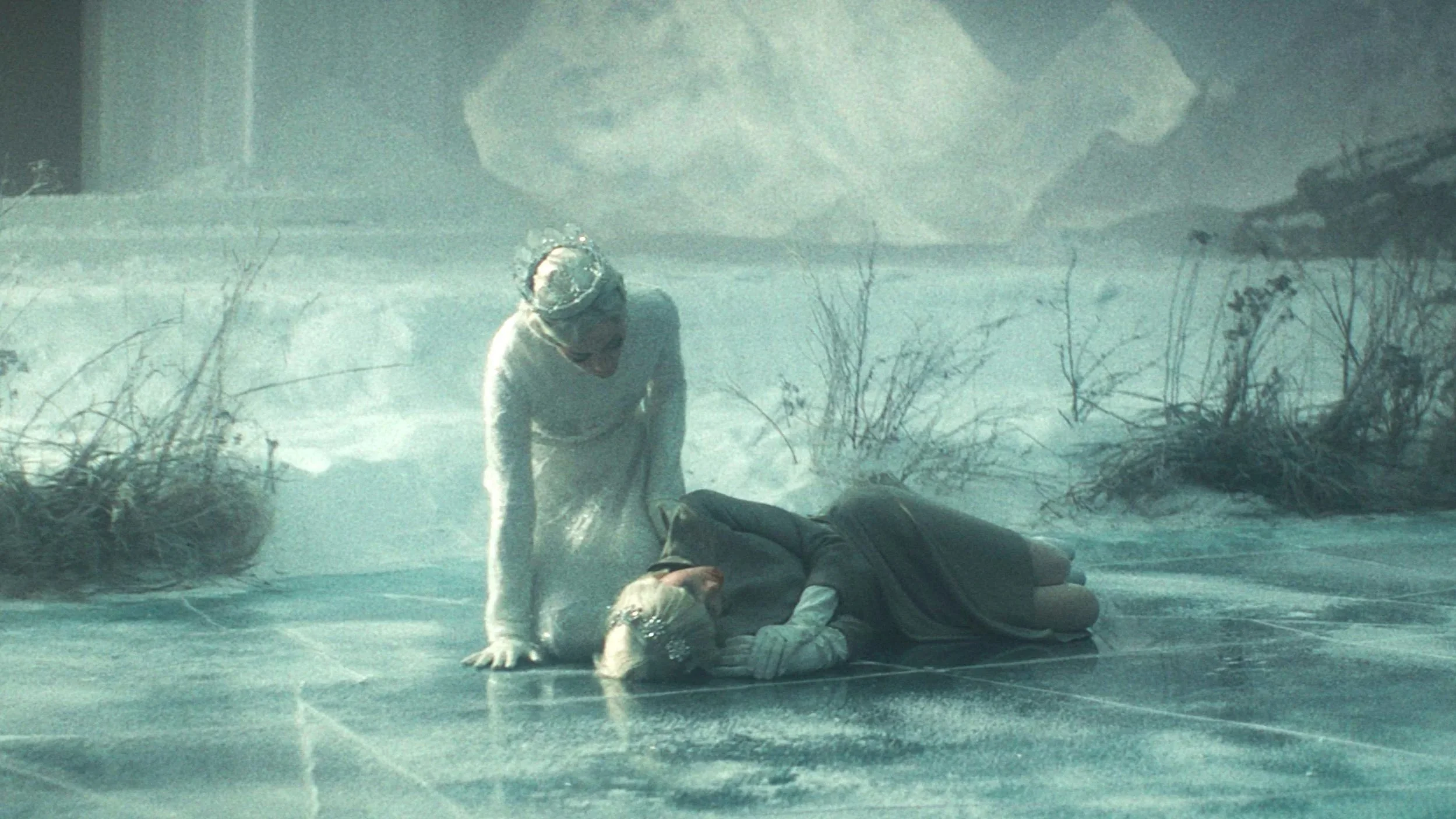
Image courtesy of British Film Institute.
For admirers of the work of the French filmmaker Lucile Hadžihalilović what they need to know about her fourth feature, The Ice Tower, can summed up in a single word: it is characteristic. Some directors, especially those who write their own screenplays, create films which are so close in style and character that there is a strong likelihood that if you like one you will also appreciate the others. It was in 2004 that Hadžihalilović made her first feature, Innocence. It drew on a novella by Frank Wedekind but in retrospect it fully establishes the tone that feels uniquely her own and is consequently also present in Evolution (2015) and Earwig (2021). That applies no less to The Ice Tower since, although it references in special ways the fairy tale The Snow Queen written by Hans Christian Andersen, it is not an adaptation of it but a film that can be considered a screen original. As with its two immediate predecessors, the writing credit is shared by the director and Geoff Cox in collaboration with Alante Kavaite.
Given the similarities within these works, it is no surprise that I can say of The Ice Tower exactly what I said of Innocence, namely that it is a film composed as a work of art with great attention to images and sound (the latter involving both music featured and the considered use of silence). But, if these elements are all positives, another constant aspect is to be found too, a delight in things that are stylised and mysterious. Some viewers may welcome the amount of interpretation that is left up to them, but many will come to find that tiresome in a film like this that lasts for virtually two hours. When talking about The Ice Tower, the filmmaker has made a statement which in itself suggests that it will appeal much more to some than to others. What she said was that it is “about emotions rather than meaning”.
The key presence in this piece is a 15-year-old girl named Jeanne played by Clara Pacini in her first significant role. She is a foster child who had been only six years old when her mother died. She reads the Andersen tale to a younger girl in the same house (Cassandre Louis Urbain) and her own imagination is fired by the story and by the figure of the snow queen herself. But Jeanne is so unhappy that she runs away and finds herself in a nearby town (this is in France in the 1970s). Seeking shelter for the night she breaks into premises where by chance a film is being shot. This movie is based on The Snow Queen and the star playing the title role is Cristina van der Berg (Marion Cotillard). When Jeanne is seen there the next morning, she justifies her presence by pretending to be an extra. The diva can be difficult but seems to take an interest in the teenager who in due course finds herself promoted to taking over a supporting role when the actress in that part, Chloé (Lilas-Rose Gilberti), fails to satisfy. Jeanne is fascinated not only by the figure of the snow queen but by Cristina herself and her rise in Cristina's world creates a distant echo of Eve Harrington’s climb in All About Eve (1950) although what happens to Jeanne is not through her conniving but very much by chance. In any case the central concern here is not on this ascent but on what Jeanne and Cristina each respectively represents for the other and with the added complication that Jeanne is drawn to a person who is in a sense both the actress and the snow queen she is playing.
Whatever one’s view if this kind of tale, the first third of The Ice Tower is notably successful. The initial focus is very much on Jeanne and, while Cotillard is thoroughly adept as Cristina both as the actress herself and when performing her film role, it is the newcomer, Clara Pacini, who rivets one. She catches perfectly Jeanne’s youthful vulnerability but also her strength and curiosity as she enters Cristina's world. There is a finely judged balance between the realistic characterisation of this teenager and the fairy tale world of Andersen’s story. The snowy setting in which we see Jeanne blends with the evocation of the icy queen as expressed partly through costume design but also quite wonderfully by the music used (Hadžihalilović has a special skill for finding the right existing music as illustrated here by her featuring pieces by Messiaen which prove wonderfully atmospheric but no less so when it comes to a brief skating sequence at an ice rink for which she uses a pop number by Aphrodite’s Child).
However, in my own case it was paradoxically the appeal of these early scenes, genuinely poetic and arresting as they are, that led me to feel let down when it became increasingly difficult to see what the filmmaker was getting it as the film proceeded. She is certainly moving to a conclusion that is miles away from Andersen's conventional happy ending, but what are we to make of the central relationship? In time Cristina and Jeanne will kiss but not in a way that suggests a lesbian theme. But, just as Andersen’s queen is evil, there is something of the vampire in Cristina. Make of that what you will since this is not a horror film.
Young people play a strong central role in all of Hadžihalilović’s films and one could see Cristina as representing for Jeanne what it means to be a successful adult. It definitely becomes apparent that if the diva seems to be somebody to admire, she is in reality an unhappy woman and not a person to emulate. However, certain details emerge which indicate that Cristina and Jeanne have certain experiences in common and, while Cristina's motives remain an open question, from her point of view she may see in Jeanne her own younger self before disillusionment set in. Such possibilities are interesting and pondering them - or indeed any other ideas that come to mind - may satisfy some. But, after an additional hour or more in which the meaning seemed ever further away, I was frustrated by the fact that the promise of the early scenes led on to nothing that was in any way clear-cut. Arguably it all comes down to a matter of taste and those fully on Hadźihalilović’s wavelength are unlikely to share the disappointment that I felt.
Original title: La tour de glace.
MANSEL STIMPSON
Cast: Marion Cotillard, Clara Pacini, August Diehl, Marine Gesbert, Lilas-Rose Gilberti, Gaspar Noé, Cassandre Louis Urbain, Valentina Vezzoso, Dounia Sichov, Raphael Reboul, Carmen Haidacher, and the voice of Aurélia Petit as narrator.
Dir Lucile Hadžihalilović, Pro Muriel Merlin, Screenplay Lucile Hadžihalilović and Geoff Cox with Alante Kavaite, Ph Jonathan Ricquebourg, Pro Des Julia Irribarria, Ed Nassim Gordji-Tehrani, Costumes Laurence Bendit.
3B Productions/Sutor Kolonko/Davis Film/Arte France Cinéma/Canal+/CineOCS-British Film Institute.
118 mins. France/Germany/Italy. 2025. US Rel: 3 October 2025. UK Rel: 21 November 2025. Cert. 15.
