The Thing with Feathers

Benedict Cumberbatch is once again on outstanding form, playing a grieving father in Dylan Southern’s daring, fascinating adaptation of Max Porter’s novella.
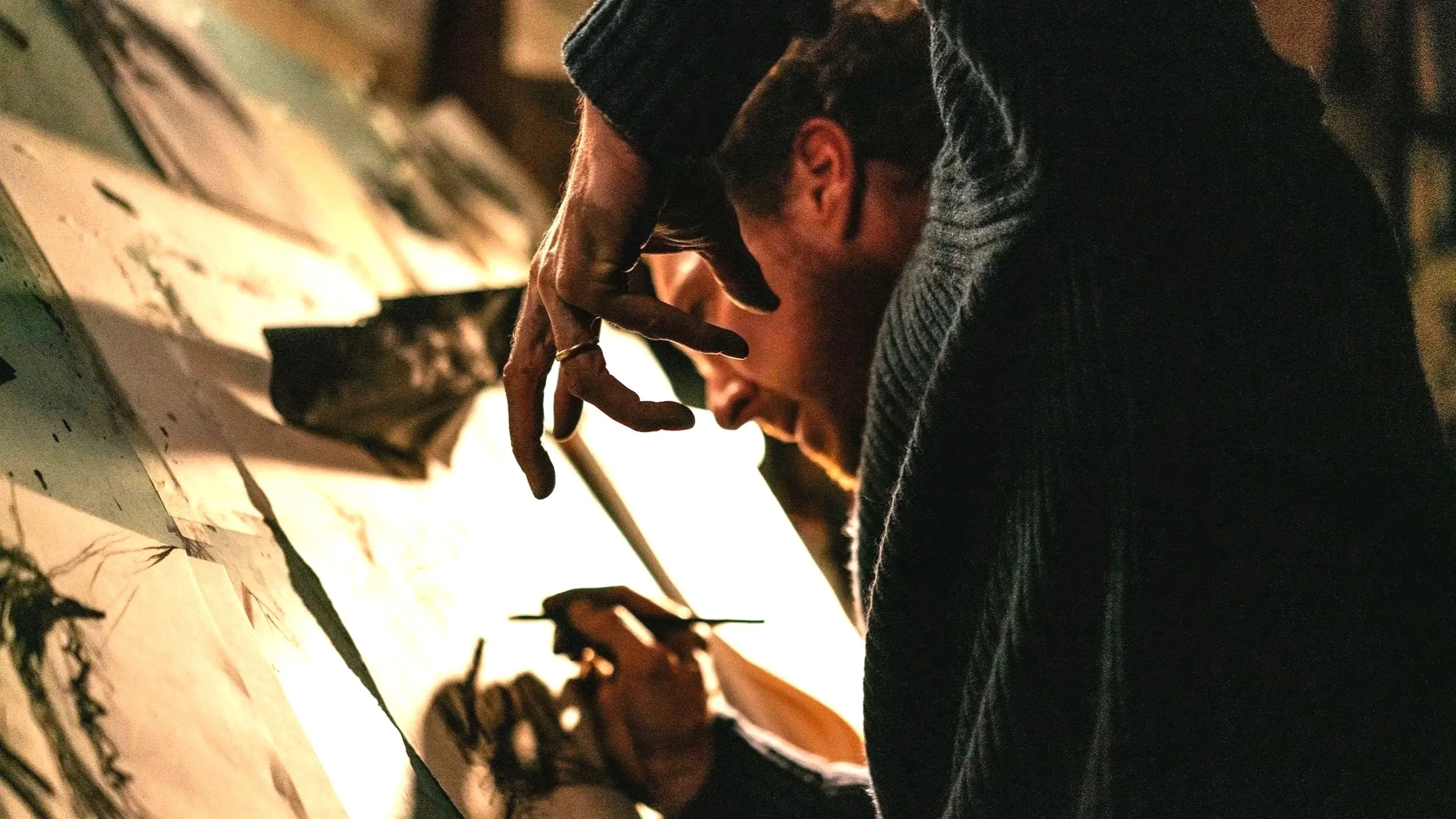
The brilliant Benedict Cumberbatch
Image courtesy of Vue Lumière.
This is the year when the work of the author Max Porter is reaching our screens. Recently we had Steve which featured an outstanding performance by Cillian Murphy and was an adaptation – or more correctly a reworking – by Porter himself of his recent novella Shy. Now it is the turn of an earlier novella, the one which appeared in 2015 and which made Porter's name, its full title then being Grief Is the Thing with Feathers. Once again, the film version contains brilliant acting by its leading player and here it is Benedict Cumberbatch. Hardly less striking is the skill shown by the film’s director Dylan Southern whose previous work, often undertaken in conjunction with Will Loveless, has consisted mainly of documentaries and music videos. The Thing with Feathers is his first feature-length acted drama and illustrates his bravery as well as his directorial talent. Knowing that such a debut can make or break a director, it may indeed be thought that he was being foolhardy in his choice of material since Porter's novella is not easily turned into cinema. Descriptions of it indicate its adventurous and offbeat nature, a blend of prose and poetry, and its central conceit is not one easily transposed to film. However, the fact that the film’s screenplay is by Southern himself must mean that the book is one that he loves.
The film’s title being slightly shorter than the original is also more cryptic and could be taken as hinting at a horror movie. Far clearer an indication of what is at the heart of it, Grief Is the Thing with Feathers immediately underlines the theme of grieving as being a central issue even though it also suggests something decidedly unusual in the depiction of it. Told in four chapters, the film begins on the day of a funeral. The central character, known to us only as dad, has lost his wife who has died suddenly. He is a writer of graphic novels who assures his publisher that he would find getting on with his latest work a helpful distraction in these tragic circumstances. Nevertheless, he had been so dependent on his wife that coping with everyday life after her death is itself a huge challenge. And that is all the more so because he now has two young sons to bring up alone (they are played by two real-life brothers Richard and Henry Boxall who give splendidly natural performances).
Southern’s approach is to draw us right in from the start. In addition to making a feature of close-up shots he uses the old confined Academy ratio. The emotional intensity that Cumberbatch brings to the role of the bereaved father touches one immediately: in expressing it to the full, he avoids any sense of this being a meaty acting role and instead makes everything feel deeply authentic. In the course of the first chapter entitled ‘Dad’ we see him taking the boys to and from school, talking to his brother (Sam Spruell) and his agent (Tim Plester) and busying away in his workroom. The sense of reality is so acute that we are persuaded that what we subsequently see and hear reflects what is in the father's head: sudden imaginings in which he seems to hear words being spoken, memories of his wife's death and a deep disquiet increasingly linked to the sudden sounds and appearances of a bird.
The second chapter is indeed called ‘Crow’ and dad is now confronted by a giant crow, no longer a normal bird but a figure which speaks to him. One understands well enough that this figure, an echo of the creature that dad is drawing for his latest graphic novel, is a representation, a visual metaphor indeed, of his sense of despair and loss. This is combined with the guilt that he feels over not having done enough to be able to act as a fully capable parent now that the mother is no longer there to contribute. The often-taunting comments that the crow makes are tellingly spoken by David Thewlis. The strength of the film in the lead up to these scenes encourages one to accept this extreme stylisation but it is a huge leap to take all the same. Nor does the film always seem to follow its own logic. The third chapter, ‘Boys’, is from the children's point of view and includes their comments on how they can hardly recognise their father in the man that he has become. However, although the crow exists only in dad’s mind, it remains a presence here and the supposed change of viewpoint consequently comes to feel bogus. However, there are times when the realism of the opening scenes is regained including an effective Christmas scene in which dad and the boys visit the mother's parents (Garry Cooper and Lesley Moloney).
The Thing with Feathers never reaches the point at which the elements reminiscent of a horror film take over and prevent it from functioning as a portrayal of a man’s mindset in the emotional months that follow an unexpected bereavement. Even so, the final chapter, ‘The Demon’, does move closer into the realm of supernatural drama before dad realises the need to challenge despair and self-pity. This leads ultimately to a beach scene in which the mother's ashes are scattered and there is a sense that life is now going forward.
Certain viewers may take to the visually stylised concept more readily than others, but many will find it difficult to accept it wholeheartedly. Nevertheless, this is a fascinating work which at its best reveals Dylan Southern to be a very confident director. Furthermore, it shows Benedict Cumberbatch on something like his very best form. Despite being complementary about his acting, many early reviews of the film have not been very favourable and it seems quite possible that The Thing with Feathers will not draw large audiences. On such occasions it is not to be expected that an actor appearing in it, however distinguished the performance, will win an award for it – and certainly not an Oscar. Cumberbatch is too well established for this to affect him unduly, but there is irony in the fact that at least two of his best performances seem set to share this situation. It happened when he played Julian Assange in the 2013 film The Fifth Estate and it is doubtless due to happen again with The Thing with Feathers. But he is so good in this film that, however likely such an outcome may be, it feels distinctly unjust.
MANSEL STIMPSON
Cast: Benedict Cumberbatch, Richard Boxall, Henry Boxall. Vinette Robinson, Sam Spruell, Garry Cooper, Lesley Molony, Tim Plester, Leo Bill, Lizzie Clarke, Eric Lampaert, and the voice of David Thewlis.
Dir Dylan Southern, Pro Adam Ackland, Andrea Cornwell and Leah Clarke, Screenplay Dylan Southern, from a novella by Max Porter, Ph Ben Fordesman, Pro Des Suzie Davies, Ed George Cragg, Music Zebedee C. Budworth, Costumes Sophie O’Neill.
Film 4/LOBO Films/SunnyMarch/Align/Film i Väst-Vue Lumière .
98 mins. UK. 2025. UK Rel: 21 November 2025. US Rel: 28 November 2025. Cert. 15.