
The Last Bath

In David Bonneville’s unsatisfyingly elusive drama, a nun is obliged to adopt her errant 15-year-old nephew.
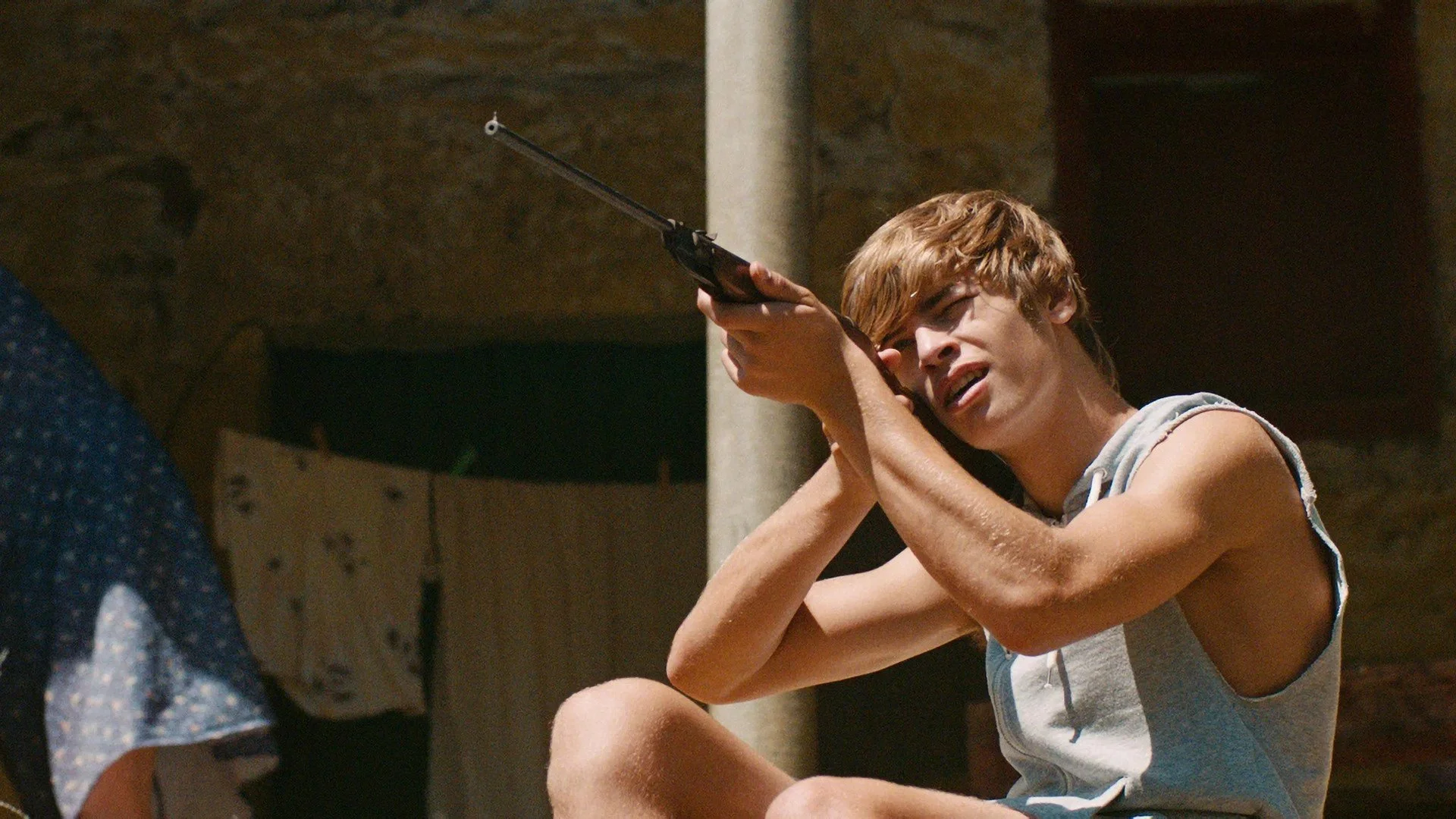
Martim Canavarro
Image courtesy of NQV Media.
by MANSEL STIMPSON
Had The Last Bath obtained a release in the UK some three years ago, it would not have been all that surprising despite the fact that this Portuguese film has no international names attached that would help to sell it. The filmmaker who is both the director and the co-writer of the screenplay is David Bonneville who, despite being of French and British descent, was born in Portugal. His early career there found him working as an assistant to that country's most notable cinema auteur Manoel de Oliveira who died in 2015 at the age of 106. But when Bonneville made The Last Bath in 2020 it was his first feature so his name was not a draw and, although the film had roles for the twin sisters Anabela and Margarida Moreira, they were not famed abroad despite being well established in Portugal. But what could have led to distribution here then was the fact that The Last Bath won a phenomenal number of awards in 2021 and 2022, no less than forty-three of them in total. It is the case that a large number of them were on home ground but others came from further afield including Casablanca, Trieste and even the UK (the latter giving a best actress prize to Anabela Moreira when it was shown in the Liverpool Film Festival). But in the event it was as recently as December 2025 that the film got an internet release in the USA while only now in September 2026 is it available in the UK on streaming platforms.
In the light of all those awards one might assume that for UK viewers its appearance is an example of delayed justice. I was certainly expecting to see an impressive film, but instead I found it to be a work which was exceptionally elusive as to just what the story told was meant to achieve. What confuses is not the plot line itself but what we are meant to make of it. The central figure is Josefina, that being Anabela Moreira's role. She is first seen in a convent and we learn that at the age of forty this novice is preparing to take perpetual vows. However, just before that happens she receives the news that her father has died at his home in the Douro Valley and that something needs to be done about her fifteen-year-old nephew, Alexandre (Martim Canavarro), the latter being the child of an unknown father. Ever since the boy's mother had deserted him and disappeared, he had been looked after by Josefina's father and since she is the only other close relative there is now a call of duty on her to look after him in the family home. If this were to be taken on long-term, it would inevitably conflict with her religious calling, but it might be the Christian thing to do.
If that is the situation set up at the start, it soon becomes apparent that Bonneville’s film is intent on suggesting that, when it comes to keeping Alexandre clean and giving him a bath, the intimacy of that could readily take on a sensual charge and bring out feelings in Josefina that she has suppressed. Josefina may be in denial about this but, while choosing not to be in any way overt about what she is actually feeling, the film opts to emphasise images of flesh (Josefina’s legs and thighs, Alexandre’s upper body) and these are presented in a way which conveys erotic potential. Later on, Josefina's sister, Àngela (Margarida Moreira), surprises everybody by suddenly turning up. She now has a husband (Ângelo Torres) and is seemingly keen to take back her son. In contrast to the quietly dressed Josefina, Àngela's make-up and her bright red dress suggest a sensual woman even when she embraces her son. What is now apparent is that Josefina wants to prevent her sister from re-entering Alexandre's life. Meanwhile, the boy himself seems to have a girlfriend, Cláudia (Maria Costa), who attends the same school.
Just recently I praised a film entitled Songs of Forgotten Trees which was centred on showing us the lives of its two central characters. It invited the viewer to speculate on their motivation and their feelings but in doing so wanted to emphasise just how difficult it is to know clearly what the truth is about other people. In that film one felt close to the characters and wanted to understand them, but Bonneville's film doesn't achieve that degree of involvement. He seems to be consciously holding back over any real insights into what the characters are feeling while often showing them as figures dwarfed by the landscape (the film is shot in widescreen). We can only guess to what extent Josefina rather than being in denial is conscious of being sexually attracted to Alexandre since the indications of sensuality all come from the images consciously inserted by the director. As for what Alexandre feels about Cláudia, there is virtually no indication although it would be far more likely that he would be attracted by her than by Josefina. If much here is left enigmatic, so too are the later scenes between Àngela and her husband, which fail to provide clear insights into her desires and her state of mind.
It could be argued that the film is actually about people who are struggling to understand both themselves and their true desires and that the enigmatic nature of the piece reflects that. But it is unsatisfactory that the longer that the film goes on the less clear it becomes about what its themes really are. Is it a film that regards the celibate life of a nun as unnatural? Regardless of the fact that in many countries a relationship between an aunt and a nephew would count as incest and despite the big age difference here adding extra concern, is it a work which nevertheless wants us to approve of the idea of their becoming a couple? If Bonneville fails to make evident his thoughts on issues such as these, is that an artistic choice (misjudged in my opinion) or is it fear of censorship had he been clearer?
Such questions prevented me from finding The Last Bath a film which worked and the last scenes left me even more uncertain what conclusions one was meant to draw - although I did like the unexpected but decidedly telling last shot of all. It was only after my viewing and quite by chance that I learnt that the film exists in two versions both approved by Bonneville. It would seem that the version which won the prizes lasted longer continuing the story with a major development in it creating a more tragic outcome which, however belatedly, may have answered some of my questions. Either way the acting, especially that of the Moreira sisters, is persuasive and Vasco Viana's colour photography makes its mark. Yet the fact that Bonneville has allowed his film to exist in two such contrasted versions only adds to my conviction that the narrative called for a more evident sense of purpose in its telling than this international version of it ever achieves.
Original title: O Último Banho.
Cast: Anabela Moreira, Martim Canavarro, Margarida Moreira, Ângelo Torres, Maria Costa, Nuno Fernandes, Afonso Santos, José Manuel Mendes, Filomena Gigante, Lourenço Mimoso, Paulo Calatré.
Dir David Bonneville, Pro Joana Ferreira and Isabel Machado, Screenplay David Bonneville and Diego Rocha, Ph Vasco Viana, Pro Des Bruno Duarte, Ed Nicolas Desmaison, Music José Alberto Gomes and Jonatan Blati, Costumes Patrícia Dória.
Bocalupo Films/C.R.I.M. Produções-NQV Media.
95 mins. Portugal/France. 2020. US Rel: 10 December 2025. UK Rel: 14 September 2026. No Cert.
