
The Lost Children of Tuam

Monica Dolan triumphs in a further dramatisation exposing the scandal of Ireland’s Mother and Baby Homes.
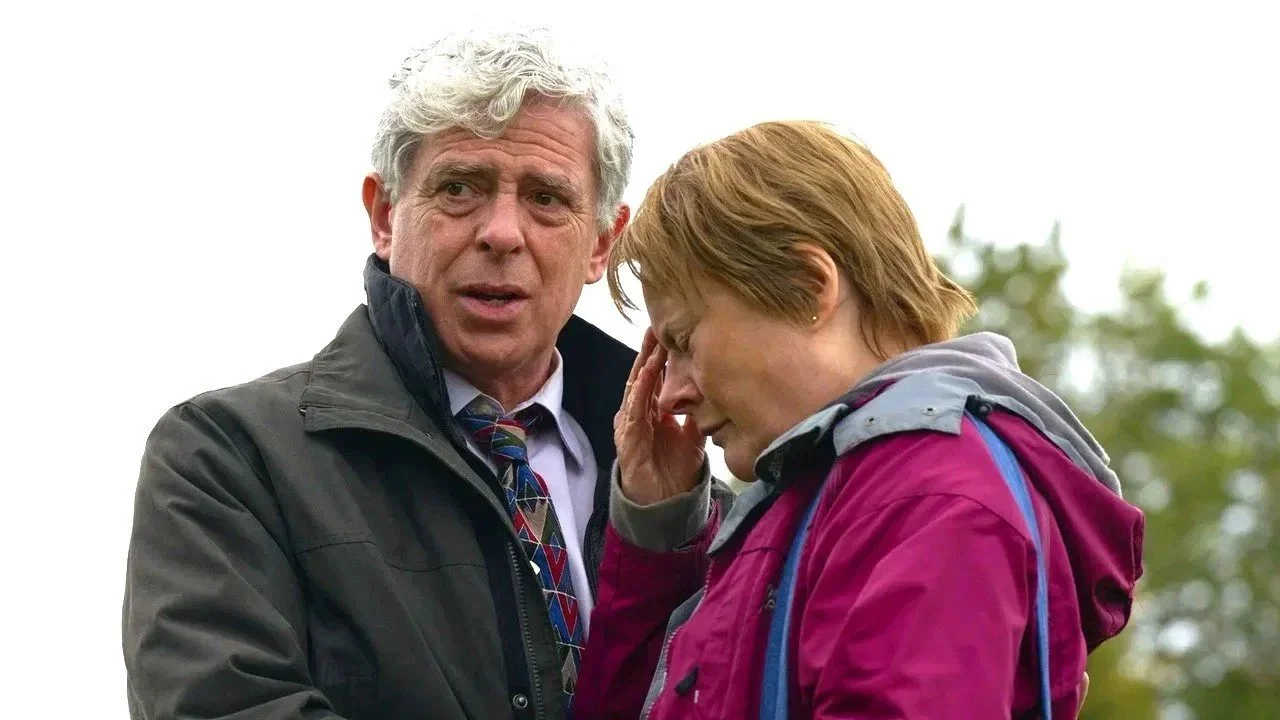
Andrew Bennett and Monica Dolan
Image courtesy of Picturehouse Entertainment.
by MANSEL STIMPSON
I first came across the work of the Irish filmmaker Frank Berry when I saw his 2017 film Michael Inside. It was in fact the second feature which he had made with actors and it left a strong impression. He followed it up with Aisha in 2022 and now we have this new piece The Lost Children of Tuam. All three titles evidence his consistency not only in terms of his ability but as regards the kind of subject matter that appeals to him and the tone that he likes to adopt. All three films deal with issues of social concern expressed through dramatised works which eschew melodrama. When reviewing Michael Inside I referred to its unforced even subdued naturalism and that was also present in Aisha. It now marks his approach to The Lost Children of Tuam. But there is a difference this time in that, although its two immediate predecessors dealt with real-life concerns (the impact of prison life on young offenders and the situation of asylum seekers were their respective subjects), they were told through tales that were realistic but fictional. In contrast – and as its title indicates – The Lost Children of Tuam is a direct recreation of the events which led to the revelation that some 796 bodies of children who died in County Galway in Tuam’s Mother and Baby Home, St Mary's, had been buried in unmarked graves. The home which had opened in 1925 had been run until its closure in 1961 by the Catholic order known as the Bon Secours.
A special feature of Aisha was the outstanding performance in the leading role by Letitia Wright and no less exceptional is the one given here by that splendid actress Monica Dolan. She is central to The Lost Children of Tuam because the approach adopted in this film is to show us step-by-step the role-played by a Tuam housewife, Catherine Corless, in uncovering what had happened (it’s a role in which Dolan is perfectly cast). In 2010 she attended a local history society and it was there that she recalled seeing in her childhood inmates from the St Mary's home and chose it as a subject to look into and to write up. Her researches soon led her to feel that facts were being hidden and indeed she came across evidence of death certificates for numerous children who did not have any record of a cemetery burial. Back in the 1970s bones had been found in a sewage tank located in the grounds of St Mary’s but they had been thought to relate to an earlier period when the site had been a workhouse. The realisation that the sewage tank had not existed in those days spurred on Corless to persist in her endeavours to uncover the truth. This would be done despite it becoming a strain on her health and would lead also to hostility from those in Tuam who did not want it to become known for such a scandal.
Berry’s film gives us an insight into the home life of Catherine Corless and Andrew Bennett appears as her husband, Aidan. This element is welcome but very much yields pride of place to her long struggle to get at the truth, to publicise it through the press and eventually to create enough pressure for a test excavation to be done. Official reports would subsequently follow. As a statement at the end of the film indicates, the truth that emerged was far from being confined to Tuam and it transpired that nine thousand children from eighteen such homes had died between 1922 and 1998.
The casting of Monica Dolan is key here because her ability to just be the person she is playing (any signs of acting wondrously lost to sight) is exactly what Berry’s quietly realistic approach requires. The other lead actor, Andrew Bennett, also fits in with this style, as indeed do the large cast of supporting players. These individual roles are not given prominence but effectively play their part in ensuring that the focus is on the long persistent enquiries by Catherine Corless and on what in consequence was eventually exposed (on more than one occasion Berry uses a montage of faces which speak volumes).
These qualities all ensure that The Lost Children of Tuam works well and it could be said that the finished product entirely justifies the belief in the project held by one of its co-producers, Liam Neeson (I understand that he played a major role in advocating for this film to be made having been moved by Don Barry's article in the New York Times which is acknowledged as a source for it). However, I must confess to being surprised by this due to the fact that a number of earlier films exist which have dealt with the scandals in Ireland's Mother and Baby Homes. Three of these were dramas, namely The Magdalene Sisters (2002), Philomena (2013) and Small Things Like These (2024). The first two were notable successes and I appear to have been in a minority in viewing the 2024 adaptation of Claire Keegan's acclaimed novella as a relative failure despite its good intentions (Berry’s film is much more successful at blending the exposé with a story built around an individual’s realisation and response).
But, while it may be less well known, Margo Harkin’s documentary Stolen (2023) is to my mind the most moving and most effective film that there has been on this subject to date. Its range is wide but within that it covers the events in Tuam and Catherine Corless herself is one of the contributors (so too indeed is the journalist Alison O'Reilly played here by Lynn Rafferty). Because The Lost Children of Tuam makes its appearance in this context one is prevented from describing it as an essential film and all the more so given that the piece with the most emotional power treating this subject is indeed Stolen. Even so, the impact of what occurred in those Mother and Baby Homes continues to affect the survivors and it is something which deserves to be known about as widely as possible. Furthermore, Berry’s film has been made with care and sensitivity (Catherine Corless herself is credited as its historical consultant) and Monica Dolan’s performance earns nothing but praise.
Cast: Monica Dolan, Andrew Bennett, Ian McElhinney, Ruth McCabe, Lalor Roddy, Elaine O’Dyer, Lynn Rafferty, Jack Hassett, Deidre Dunlea, Anne O’Riordan. Sophia Daniel, Deidre Monaghan, Michèle Forbes.
Dir Frank Berry, Pro Jules Daly, Liam Neeson, Chelsea Morgan, Ed Guiney, Andrew Lowe and Martina Niland, Screenplay Rebecca Lenkiewicz with Frank Berry, based on an article by Don Barry, Ph Kate McCullough, Pro Des Lucy van Lonkhuyzen, Ed Colin Campbell and Nathan Nugent, Music Hannah Peel, Costumes Triona Lillis, Sound Steve Fanagan, Dialect coach Poll Moussoulides.
Screen Ireland/BBC Film/Element Pictures/Fremantle/ MK2 Films/Port Pictures/Big Red/El Paso Films-Picturehouse Entertainment.
84 mins. UK/Ireland. 2026. UK Rel: 9 October 2026. Cert. 12A.
