
The Yellow Tie

John Malkovich plays the Romanian conductor Sergiu Celibidache in his son Serge Ioan Celebidachi’s well mounted and well played biopic.
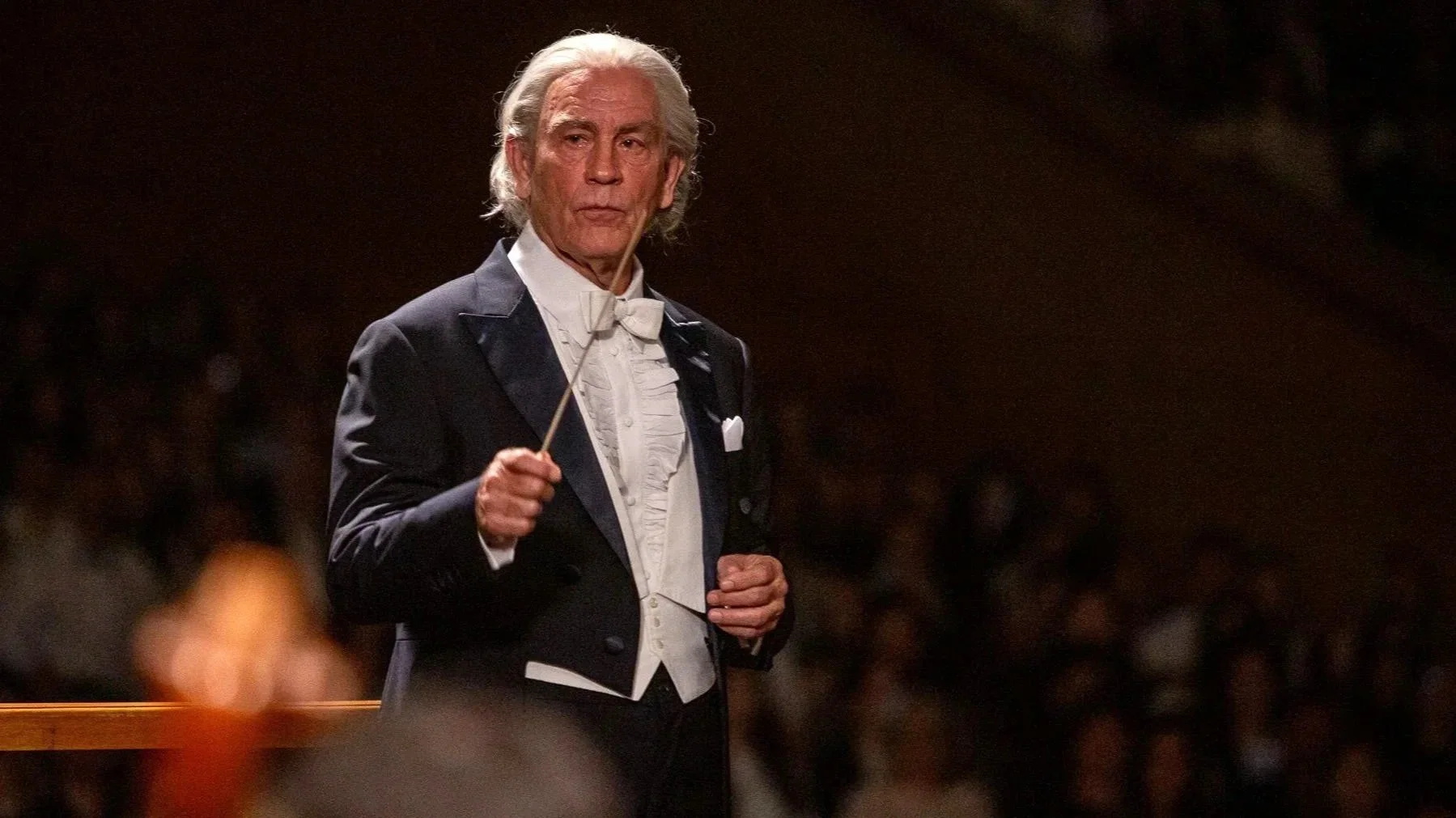
John Malkovich
Image courtesy of Icon Film Distribution.
by MANSEL STIMPSON
For Romanians this film will have a raison d’être which may elude others although this is a well-produced work not lacking in popular appeal. In Romania the late Sergiu Celebidache who died in 1996 is something of a national treasure: a native figure who, in addition to being a composer, a teacher and a music theorist, became an internationally renowned conductor associated with orchestras in many countries. They included Germany, America, Italy, Denmark and England (where he worked with the London Symphony Orchestra) and between 1945 and 1952 he was the youngest ever chief conductor of the renowned Berlin Philharmonic Orchestra. Consequently, this film will for a Romanian audience be an apt tribute to one of the country’s most notable figures and the fact that conductors of classical music are not usually seen as apt subjects for a biopic with a large cast will be irrelevant. For others the appeal will be less evident despite The Yellow Tie being a well-acted piece which entertains and is likely to do so even for those with a limited interest in the kind of music that Celebidache conducted.
The notion of making a dramatic biopic about a conductor is decidedly unusual (Bradley Cooper's Maestro, his 2023 film about Leonard Bernstein, was a rare exception). However, The Yellow Tie is also novel in another way in that the film's director is Celebidache’s own son, Serge Ioan Celebidachi (the surname has at different times been treated as ending in an ‘e’ or an ‘i’). Over the years he has become an established filmmaker both as writer and director. Not infrequently he shares his writing credits with the actor James Olivier and that applies again to The Yellow Tie. His output has also included documentaries and one made much earlier in his career just after his father's death was a long feature entitled Le jardin de Celibidache, thus making this new work his second piece about his illustrious parent albeit in a completely different form.
In The Yellow Tie no less than four actors appear as Sergiu Celebidache if one includes Andrei Isarecu who plays him briefly as a child. Ewan Horrocks takes over for scenes set in his teens and for the greater part of the film Celebidache is portrayed by Ben Schnetzer since this film devoted to his life largely focuses on the period up to 1970. Despite that there is also substantial footage in which John Malkovich appears as the elderly Celebidache. These scenes, intercut throughout the film, effectively reflects his later years and provide a kind of framework from which we look back on his life, a device which usefully gives a sense of unity to what might otherwise have emerged as a very episodic narrative.
Before The Yellow Tie sets out to portray events in chronological order it shows us scenes set in France in 1991 which establish the unusual stance which was crucial to Celebidache's career: his belief that music had to be experienced in live performance in order to be genuine. It was a view which led him to denounce recordings and to refuse to go into the studios with any of the orchestras that he conducted, an attitude which made his career a difficult one since most orchestras were intent on earning through working for the gramophone as well as in concerts. For that matter Celebidache’s pursuit of perfection would lead him to demand a substantial number of rehearsals for each concert, far more than most conductors could obtain. While live performances of classical music are indeed in another league to what recordings offer, it is easy to feel that Celibidache’s views pushed that issue to unnecessary extremes, but his attitude as expressed here is nevertheless intriguing.
Sergiu Celebidache was born in 1912 and in looking into his history the film shows him first as a child in 1920 living in the Romanian city of Iași where we meet his parents Demostene (Sean Bean) and Maria (Lina Sandén) and his siblings who included Sonia (Olivia Popica). Before long we move on to 1927 with Sergiu now a student and one who is at odds with his harsh father who has a governmental career in mind for his son and is hostile to any notion that he should instead want to be a composer. This conflict leads to Sergiu leaving home, spending time in Bucharest where he earns money playing the piano and then on to Berlin. It was there under the influence of Professor Heinz Tiessen (Robert Dölle) that Sergiu was persuaded that despite his desire to compose conducting was his true métier. Established by now in Germany, he remained in Berlin during the Second World War living there as an outsider but not escaping the bombing which indeed led to him being injured in 1944. He recovered and, staying on after the war, was chosen as the new conductor for the Berlin Philharmonic Orchestra and by 1948 was also appearing in London.
While music has a central role here, The Yellow Tie is a drama carried by the appeal inherent in Celibidache’s personal story as a son making his own way in life in a career of ups and downs. It would eventually lead to an encounter at a concert in Buenos Aires in 1955 with a woman who would become his wife, Ioana (a role shared by Kate Phillips and Miranda Richardson). Their son, often referred to as Miki and played here by Charlie Rowe, also features as an on-screen character who respects his father without always sharing his views and is now, as previously mentioned, the director of this film.
For the most part this film sustains its considerable length well. In a rather odd choice of words it is described as being ‘based on a true story’ and there are indeed some elements which are less than wholly persuasive. The scenes in Bucharest have a rather fictional air when the young Sergiu is found sleeping on a street bench and attracts the attention of Ortancia (Tamzin Merchant) leading to a relationship between them. It is also the case that the film builds to an emotional climax (one which in passing explains the film’s title) which is presented in a way that is for me too close to the kind of overtly sentimental scenes found in fiction but which may nevertheless add to the popular appeal of this work. But on balance this is a well-judged piece with effective performances from all its leading players and with good production values too. Furthermore, although only opting for subtitles in the scenes set in Germany, this largely European tale is told in English without that ever feeling out of place. For anybody with an existing interest in Sergiu Celebidache the film is self-evidently worthwhile but, contrary to what you might suppose, The Yellow Tie has in fact got a broader appeal functioning as it does as a family tale touching on three generations and with Celibidache’s relationship with his father as a key issue.
Cast: Ben Schnetzer, Kate Phillips, Miranda Richardson, Sean Bean, John Malkovich, Charlie Rowe, Robert Dölle, Olivia Popica, Anton Lesser, Tamzin Merchant, Orlando James, Ewan Horrocks, Bianca Rogoff, Andrei Isarecu.
Dir Serge Ioan Celebidachi, Pro James Olivier, Andrei Boncea and Adela Vrinceanu Celebidachi, Screenplay Serge Ioan Celebidachi and James Olivier, Ph Peter Menzies Jr, Pro Des Vlad Vieru, Ed Mircea Olteanu, Music Kathryn Kluge and Kim Allen Kluge, Costumes Alessandro Lai.
Oblique Media Film/Robert Cort Productions/Safeframe/Avanpost Media/Frame Film-Icon Film Distribution.
145 mins. Romania. 2025. UK Rel: 9 October 2026. Cert. 15.
