
In Hlynur Pálmason’s disjointed Icelandic drama, a family comes to terms with its inevitable conclusion.
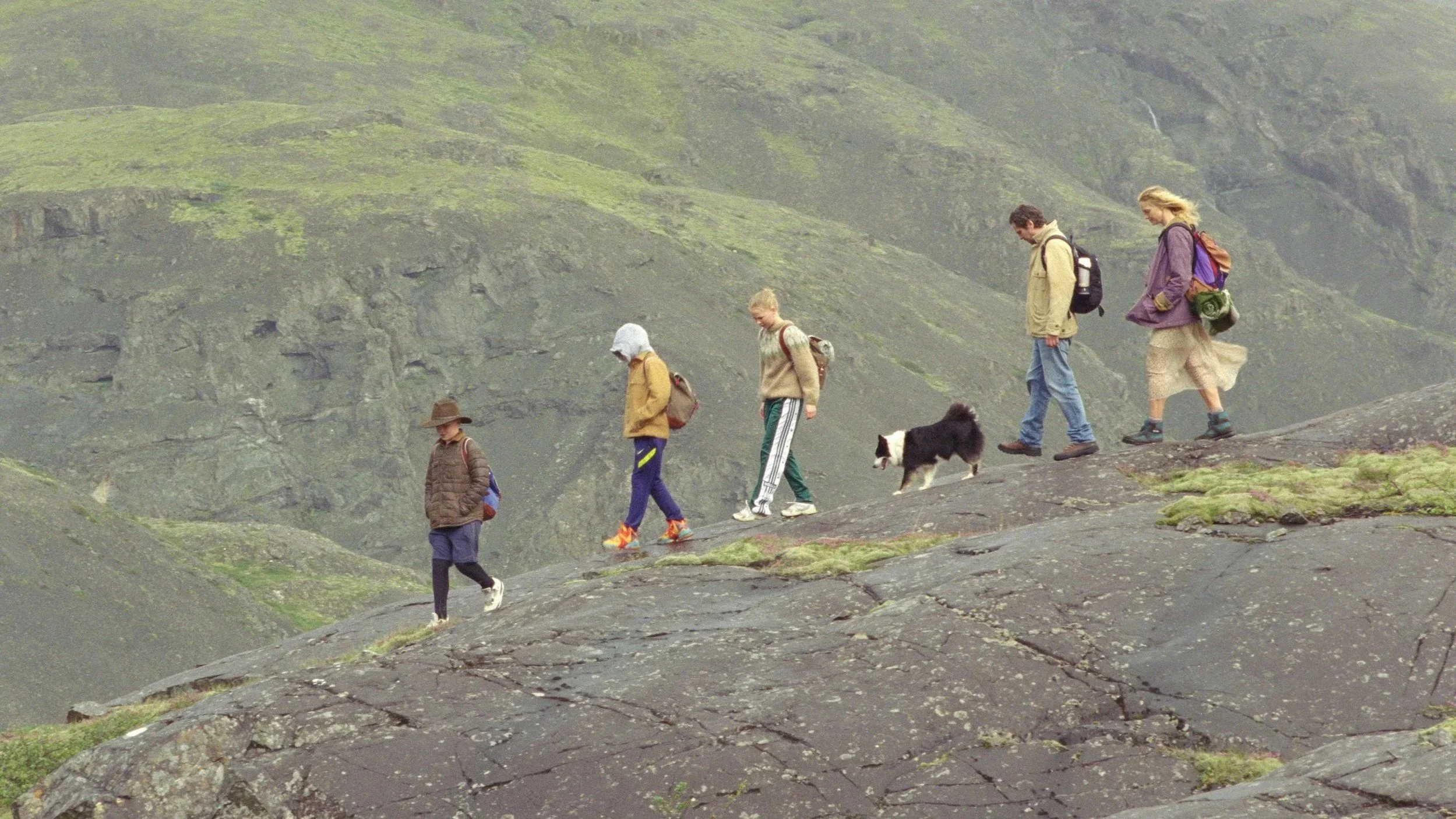
Image courtesy of Curzon Film Distributors.
by MANSEL STIMPSON
This is the third feature film from the Icelandic writer/director Hlynur Pálmason who received special acclaim for the second of them, Godland (2022). I found the first half of that ambitious work (it lasted for 143 minutes) very impressive but, unlike many, felt that the storytelling in its second half left much to be desired. For that reason I preferred his earlier piece, 2019's A White, White Day, but both films suggested that he had a real gift for obtaining fine performances and in each case the quality of the photography was outstanding. In The Love That Remains, once again set in Iceland, Pálmason takes over the photography himself and, although he had only previously done that on some short films of his, the result is again highly impressive. So, too, with the acting here which includes a fine performance from his daughter Ída Mekkín Hlynsdóttir who also featured strongly in his two previous films, while Ingvar Sigurdsson, a key contributor to both of them, takes on a supporting role in this one.
This time around the film centres on a couple who have not yet divorced but have separated. He is Mágnus (Sverrir Guðnason) whose work on a fishing trawler means that he is often away at sea and she is Anna, a visual artist (Saga Garðarsdóttir). The couple have three children: the oldest of them is Ída (that’s the role taken by Pálmason's daughter) and the other two are twins. These roles mark the film debut of Pálmason's two young sons, Grimur and Þorgils, both of whom play very naturally in front of the camera. Despite their separation, both parents continue to see one another regularly. If in part this is for the sake of the children, there is also a sense that Mágnus is hoping that Anna will take him back. But in Anna's case it is clear that she wants her independence. The conflict arising from this and its impact on the children is therefore at the very core of the film.
When described in this way The Love That Remains, which was shot on 35 mm. in the old academy ratio, sounds to be an intimate, naturalistic drama. However, before seeing the film I had heard that it contains surreal elements. That should not have surprised me because a certain amount of stylisation had appeared in Pálmason’s previous features, particularly in A White, White Day which for all its qualities I found self-indulgent in that respect. It is only fair that I should acknowledge here that unless the transition is done with subtlety and conviction the blending of these two contrasted elements is never to my taste. Those who feel differently may well be more at ease than I with the final section of The Love That Remains when what has primarily been naturalistic takes on this other tone to a marked degree. One could interpret some of these images as hallucinations or dreams (an attack by a now giant-sized rooster on Mágnus after he has killed the animal plays like a nightmare). However, Pálmason introduces such elements so abruptly that one tends to be nonplussed. Mágnus himself on being confronted by a kind of golem figure, one that is now alive but built up earlier as an attachment to a stump used as a target by the children when wielding bows and arrows, asks "What are you?" - and well he might.
For me, these passages are problematic and all the more so because when the film is naturalistic we do become involved with the characters and both adult leads, Garðarsdóttir, and Guðnason, are admirably persuasive while the piano music of Harry Hunt on the soundtrack provides a suitably atmospheric accompaniment. But what did take me by surprise is the fact that, even when the surreal element is out of sight, Pálmason appears to be trying something very odd indeed in the way in which he chooses to tell his story. Indeed, I would even say that The Love That Remains is a bizarre dedramatisation of the material.
One would expect a tale of matrimonial disharmony to supply some background to the marriage and what went wrong and to show the ensuing uneasy interrelationship in detail. But here we have a film which seems to show life going on around this situation exploring its fringes while leaving it to the viewer to conjure up the heart of the matter. Instead of a flowing narrative we have bits and pieces often intercut without any deep rhyme or reason. There are shots showing Mágnus and his companions at sea, footage about Anna's art work and a visit from a useless gallery owner (Anders Mossling) who comes to view it, scenes of the children at play, images of the family group out walking or having a picnic and even an episode following an accident (the actual accident unseen). This concentration on casual day-to-day events at the expense of a more detailed study of the central relationship seems perverse. The one incidental pleasure to be found here is in the engaging appearances of the family sheepdog: that Panda won the Palm Dog at the 2025 Cannes Film Festival is no surprise at all. But all the other awards won by the film save for one for the photography strike me as far less deserved although one could treat their existence as evidence that appreciation of the unusual approach adopted here by Pálmason is a matter of personal taste.
Original title: Ástin sem effir er.
Cast: Saga Garðarsdóttir, Ída Mekkín Hlynsdóttir, Sverrir Guðnason, Grimur Hlynsson, Þorgils Hlynsson, Anders Mossling, Ingvar Sigurdsson, Kristinn Guðmundsson, Halldór Laxness Halldórsson, Panda, Katla M. Þorgeirsdóttir.
Dir Hlynur Pálmason, Pro Anton Máni Svansson and Katrin Pors, Screenplay Hlynur Pálmason, Ph Hlynur Pálmason, Pro Des Frosti Fridriksson, Ed Julius Krebs Damsbo, Music Harry Hunt, Costumes Nina Grønaund.
Still Vivid/Snowglobe Films/Hobab/Maneki Films/Film i Väst/Arte France Cinéma-Curzon Film Distributors.
109 mins. Iceland/Denmark/Sweden/France. 2025. US Rel: 30 January 2026. UK Rel: 13 March 2026. Cert. 15.