

Seven women bond in extraordinary ways as they are forced to sample Hitler’s meals in case the food is poisoned.
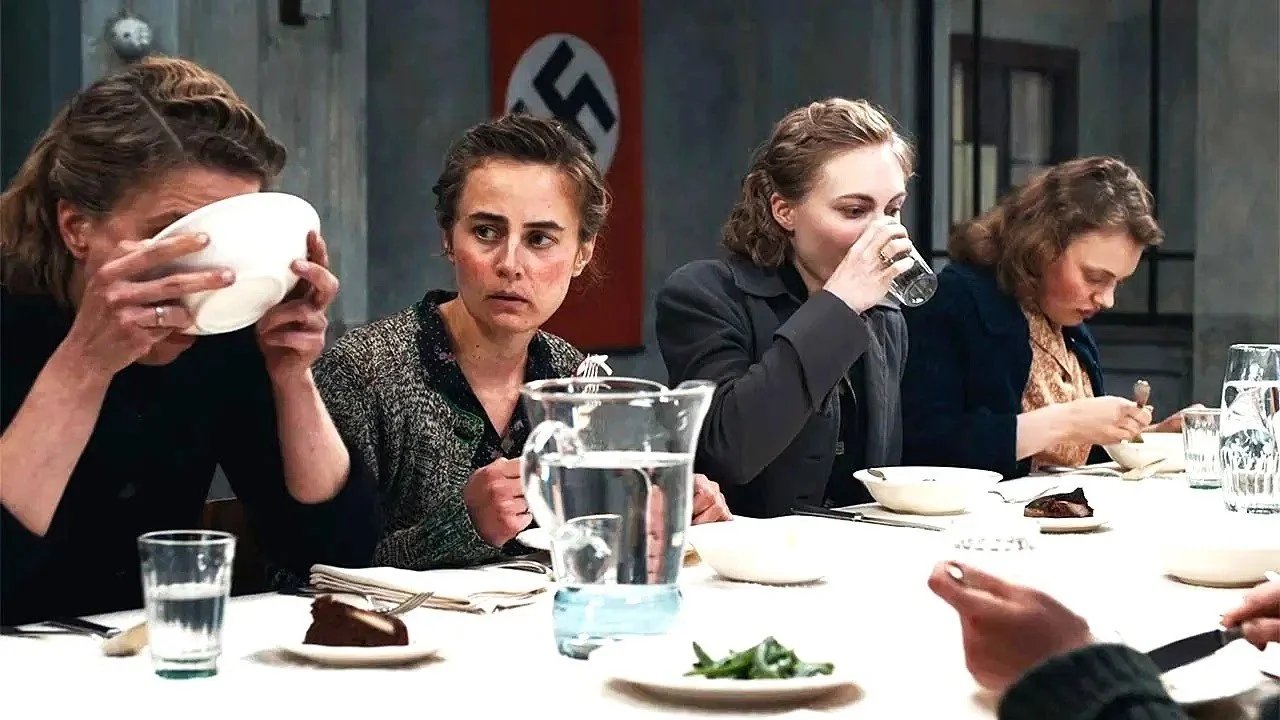
Image courtesy of Metfilm Distribution.
by MANSEL STIMPSON
Although Silvio Soldini's film is set in Germany during the Second World War, it is centred on a situation that has not to my knowledge been treated in any other film. The movie takes place during the course of a year beginning in November 1943. This was a time when Hitler had set up his Eastern Front military headquarters at the Wolf’s Lair in East Prussia near the village of Parcz. Such was the Führer’s fear of a would-be assassin attempting to poison him that a number of local women were employed to taste the food prepared for him before he ate. This they did regularly twice a week when he was in residence. One of them was Margot Wölk who had previously been a secretary in Berlin but who in 1941 had for greater safety moved to Parcz (then known as Gross-Partsch) to stay with her mother-in-law. She would live well into her nineties (she died in 2014) and on her 95th birthday in 2012 in the course of an interview she revealed that she had been one of fifteen young women picked to be tasters in this way and apparently the only one of them to survive the war. The impact of what she said was such that since Margot Wölk's death her story has been the inspiration not only for a stage play but for two novels one of which, At the Wolf’s Table by Rosella Postorino, is now credited as the basis of this film.
The alarming situation in which these women found themselves, each day fearing that they might find themselves eating food that had poison in it, was an extraordinary one. It was so unusual that the telling of it offers something entirely fresh dramatically speaking. But treating this material in that way also carries a risk and that lies in the fact that any plot development at the heart of the piece is limited. The bigger events, such as the attempt to assassinate Hitler at the Wolf’s Lair on 20th July 1944 and the changing situation as the tide of the war turned against Germany, are here peripheral to what was required of the tasters. This creates challenges in the second half of The Tasters and all the more so because the film runs for just over two hours.
During the first half of the film Soldini’s work as writer and director is adroitly judged. In the latter capacity he proves to be unobtrusive but always directs well and his screenplay sets the right tone. The central figure, Rosa Sauer (Elisa Schlott), is presented as akin to Margot Wölk herself in that we meet her as she arrives in Parcz to live with the parents of her husband Gregor whom she had met in Berlin when working there as a secretary. Gregor is now a soldier fighting in Russia and she is warmly welcomed by the elderly Herta (Esther Gemsch) and Joseph (Jürgen Wink). Before long, however, she is taken away and finds herself being checked out along with other young women. This is a process for finding women who will be required to take on the role of tasters (for dramatic simplification their number is reduced in the film to seven). As this set-up is explained and implemented, Soldini opts for a tone that is quietly realistic and avoids any element that might seem melodramatically charged.
This approach is extended to the characterisations of the other six women chosen alongside Rosa, one of whom, Sabine (Kriemhild Hamann), hugely admires Hitler. One also gets the impression that Rosa's in-laws, especially Herta, are supportive of the regime. But when it comes to the other tasters, including Elfriede (Alma Hasun), Leni (Emma Falck) and Heike (Olga von Luckwald), one feels that as women they are simply hoping that the war will come to an end while recognising that until then they have virtually no alternative but to do whatever is required of them. We do begin to learn something of them as individuals but, just like the initial hostility shown to the Berliner Rosa by the others because she is not one of them, what is portrayed seems realistic and part of the everyday life of the period. In keeping with this the cast play very naturalistically.
When it comes to developing the material, Soldini is doubtless following the course set down in Postorino's novel but, in contrast to the earlier scenes, what we now see tends to take on a more fictional air. In the case of Rosa herself, the focus is very much on an affair which develops between her and the SS lieutenant Albert Ziegler (Max Riemelt) who is put in charge of the tasters. By this time we have learnt that Rosa's husband could well be dead (he has been reported as missing in action) and, since both Rosa and Albert are German, an attraction between them is by no means impossible. Nevertheless, it is introduced rather suddenly with little more than the fact that both of them like the music of Schumann being provided as a hint of their impending rapport. In any case Albert is a disciplinarian and, while that may make him a good soldier, the enforced role that Rosa endures as a taster causes one to question how likely it is for her to be drawn to him. However, it is no fault of Schlottt and Riemelt if their relationship doesn't fully convince.
Rather in the same way, the material relating to the other tasters suggests additional dramas created to fit in: one woman is hiding something important which is only revealed late on and another becomes pregnant and undergoes a secret abortion. In both cases that fits in well enough initially but is then treated in a way which smacks increasingly of fiction and especially in its last quarter the film becomes a drama which has no deep connection to the film’s raison d’être, the portrayal of what the tasters went through. These late scenes play out not as something that maintains the originality and authenticity conveyed in the film’s first half but as familiar wartime drama. Those who like that kind of thing even when the storyline comes to seem rather contrived may well be very appreciative of The Tasters. But for others this will be a film which fails to sustain the quality of its first half when the work of the tasters rewardingly offers a novel focus both unusual and involving.
Original title: Le assaggiatrici.
Cast: Elisa Schlott, Max Riemelt, Alma Hasun, Emma Falck, Esther Gemsch, Jürgen Wink, Boris Aljinovic, Olga von Luckwald, Kriemhild Hamann, Thea Rasche, Berit Vander, Nicolo Pasetti, Philipp Seppi.
Dir Silvio Soldini, Pro Lionello Cerri and Cristiana Mainardi. Screenplay Silvio Soldini, from the novel At the Wolf’s Table by Rosella Postorino, Ph Renato Berta, Art Dir Igor Gabriel, Ed Carlotta Cristiani and Giorgio Garini, Music Mauro Pagani, Costumes Marina Roberti.
Lumière & Co./Tarantula/Tellfilm/Vision Distribution-Metfilm Distribution.
123 mins. Italy/Belgium/Switzerland. 2025. UK Rel: 13 March 2026. Cert. 15.