
The Shepherd and the Bear

Max Keegan’s intimate documentary explores community and the natural world in the Pyrenees.
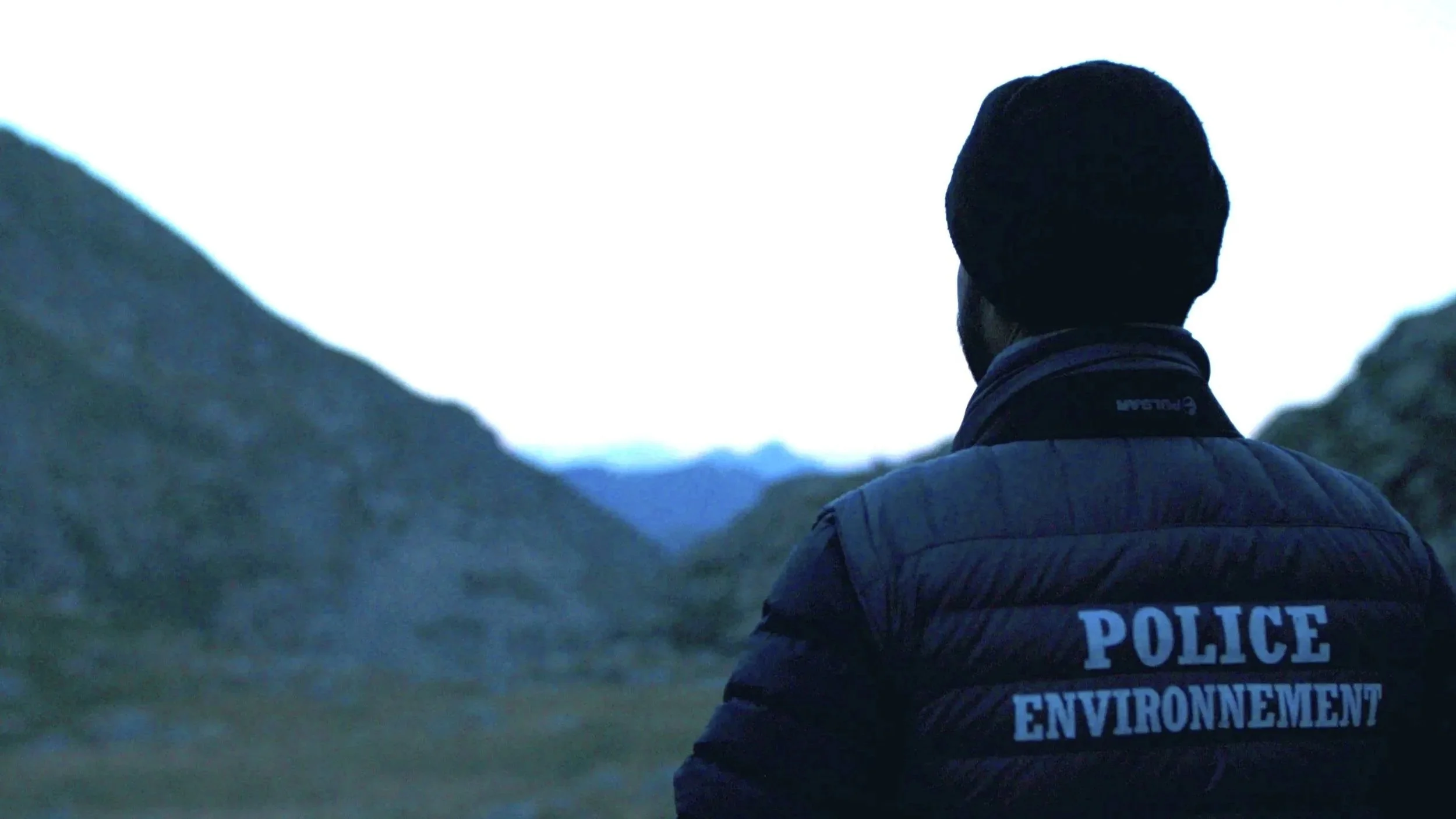
Image courtesy of Conic.
by MANSEL STIMPSON
Max Keegan, the director and producer of this film, is British but nevertheless chose to make his feature debut in the Pyrenees. Since it is a documentary that means that The Shepherd and the Bear is a French language film with subtitles which may be a limitation for some but the setting certainly pays off handsomely when it comes to the great landscape shots that we see. Appropriately Keegan opted for the wide screen and with Clément Beauvois was himself involved in the photography. But, while the appeal of the location is self-evident his film suffers from an inherent problem. At 101 minutes this is a full-length feature film but what it to depicts is more aptly described as a situation rather than a narrative that would justify being called a story.
Admittedly what is portrayed here has a dramatic aspect since it is set in the Ariège uplands where the farmers face what has become a crucial conflict. It is an area once known for its native bears but these faced extinction about twenty years ago and in consequence the French government as part of a rewilding programme have sought to achieve repopulation by bringing in brown bears from Slovenia. But, if some regard this as admirable, people like the shepherd Yves Ragpaud, who is the central figure here, are up in arms due to the way in which these bears are attacking their sheep. Yves has always lived here and has been a shepherd for over sixty years but is frustrated by this turn of events and by restrictions which forbid the killing of even the most ferocious bears.
This difference of opinion is one in which both sides have strong feelings and see themselves as well-intentioned. That might have provided material for a good feature film but, while one can introduce individuals expressing opposite views, in the event there are no pronounced developments to provide a narrative that is leading somewhere. One has the impression that Keegan never faced up to that fact. Admittedly he does select to feature three of the local inhabitants and introduces us not only to Yves but to two others. One is a young woman named Lisa Laguerre who is herself interested in the idea of being a shepherd. With that in mind she is assisting him and is virtually an apprentice. The third person featured is Cyril Balthasar who is completing his studies. He has developed an interest in forest management and is passionate about observing birds and animals. The latter include bears and his parents are among those who clearly deplore the local protests which have extended to the surface of a road being marked out with the slogan ‘No to Bears’.
However, even if these three become recognisable figures, they are not given an adequate context that would render The Shepherd and the Bear a telling portrait of a community. The location shooting is certainly atmospheric and gives us a real sense of the Pyrenees, but we get only a very limited idea of those who live there. We do see visitors from outside including a senator representing regional government and a speaker who arrives and promotes protection of the bears as an environmental issue, but these are just passing incidentals. As for the other inhabitants we get to see a number of them but often without individual identities being clarified and with little sense of their shared lives. It is suggested at the outset that, in addition to the threat represented by the brown bears, Yves now belongs to a dying breed with a very limited number of youngsters wanting to take up the heritage of those who have lived off the land. However, that is the only reference to it that the film makes. Furthermore, even in the case of the three central figures there is something haphazard about what we see and that is particularly so in the case of Lisa. We witness her with Yves early on but she later drops out of the picture. Nevertheless, although the film then chooses to ignore what happens to her next, it subsequently and quite suddenly brings her back later on. That is when she is getting married. Had the film been shaped to create a wider portrait of life in that area to include this would have been apt, but as it is it doesn't really seem to have a natural place in this film.
Despite these reservations, it does need to be acknowledged that the film’s central conflict is one of interest even if as it turns out it would have been better suited to treatment as a programme for television. The film’s portrait of rural live is not sweetened since it includes images of mutilated sheep and shows the preparations for the killing of a pig. Nevertheless, many viewers will relish the wide screen images of this part of the Pyrenees and that aspect does make this an appropriate work to be seen on the cinema screen. But, while the film is not a write-off, the overall impression is that although he spent two years getting to know the place and the people Max Keegan has not found a way of making his film into a more detailed community study. But that was what was needed to compensate for the fact that the conflict at the heart of his film is ultimately revealed as one that goes round in circles.
Cast: Yves Ragpaud, Cyril Balthasar, Lisa Laguerre, Valerie Daude, Cyril Piquet, Christian Balthasar.
Dir Max Keegan, Pro Elizabeth Woodward, Amanda McBaine, Jesse Moss and Max Keegan, Written by Max Keegan and Sabine Emiliani, Ph Clément Beauvois and Max Keegan, Ed Sabine Emiliani, Music Amine Bouhafa.
Salthill Films/WILLA/Mile End Films/Pinky Promise/Impact Partners-Conic.
101 mins. France/UK/USA. 2024. US Rel: 21 November 2025. UK Rel: 6 February 2026. Cert. 15.
