
Twinless

Dylan O’Brien achieves real distinction in James Sweeney’s twisty tale of a twin who loses his brother.
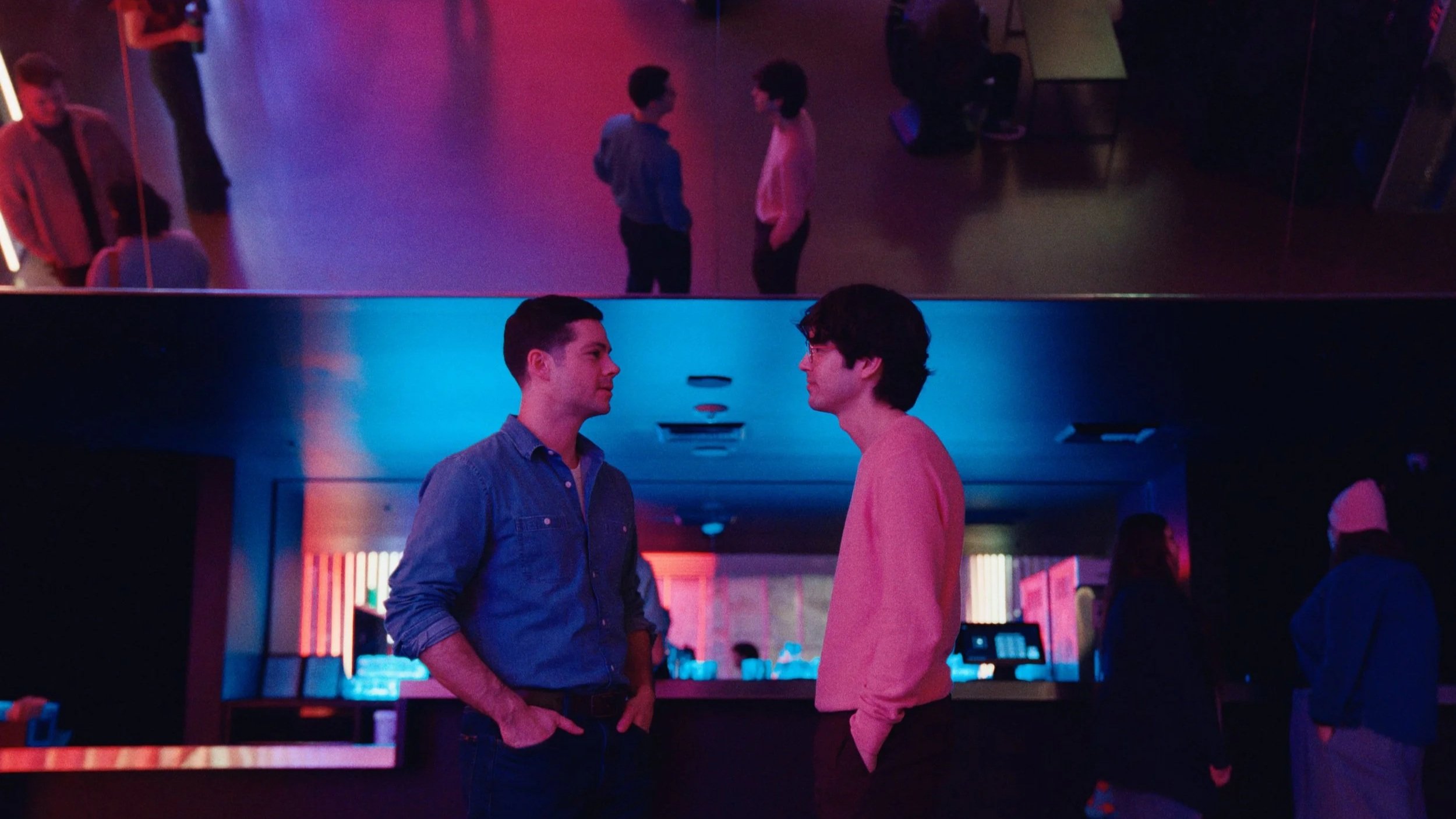
Image courtesy of Park Circus.
by MANSEL STIMPSON
Among the awards won by Twinless is that given by the Palm Springs International Film Festival in 2025 when it recognised James Sweeney as being a director to watch. Even though I have some reservations about his film – it's Sweeney’s second feature following Straight Up (2019) which seems not to have been released in the UK – I totally endorse the view that Sweeney is a talent to be noted. That's all the more appropriate because in addition to directing these two films he wrote and starred in both of them. That is a combination that puts one in mind of Woody Allen and, while Sweeney has his own voice, the social comedy to be found in Twinless makes that comparison wholly apt despite Sweeney choosing first L.A. and now Portland, Oregon as his settings rather than Manhattan. But, if the lively dialogue seems to set the tone, in point of fact Twinless develops in ways that are unexpected and which change its character. The course charted by the film is part of its distinctive personality but also in my case the source of a certain unease.
It is surely beyond dispute that Twinless is very well acted and particularly by its two leading players. One of these is Dylan O'Brien who has made his name on television and by appearing in mainstream movies. Taking on an unexpected challenge here, he rises to the occasion splendidly and appears in two roles, Roman and his twin Rocky. The latter part is not a large one since Rocky dies at the start of the film in a street accident although he will subsequently feature briefly but importantly in flashback scenes. Two very distinct characterisations are involved here because Rocky had been gay and confident whereas Roman is unsure of himself, a straight man who has always felt inferior to his brother and believes that their mother (Lauren Graham) sees him in that light too.
Shaken by Rocky’s sudden death, Roman seeks help by attending a group that deals in grief management and specialises in helping those who have lost a twin. It is at these meetings that he encounters Dennis, the role played by James Sweeney. It emerges that Dennis is gay, but the two men quickly achieve a rapport in supporting each other. Had they met in other circumstances it is unlikely that they would have become close, but Dennis talks of his twin having been straight so in each case it could be considered that a surviving twin by entering into a new friendship is duplicating to some extent the relationship that has been lost. All of this is set up in the film before the delayed credits appear and, while humorous lines are very much present, once the story develops one realises that Twinless is at heart a film about loneliness and the extent to which most people need close human contact whether or not sex is involved.
What can readily be stated is that Sweeney’s screenplay is marked by his ability to go beyond neat comic lines to create rounded characters who, as the story unfolds, convince in dramatic terms. However, Twinless is already noted for being a film in which subsequent revelations take one by surprise. The first of these is arguably rather too suddenly introduced but, even though it comes early on, it is better that audiences should experience the disclosure when it happens and not before. For that reason this review will avoid describing the way in which the story develops but it can be said that how one responds to what follows may well depend on how individual viewers feel about what we learn regarding Dennis. There is certainly a distinction here between Sweeney and Woody Allen in that the on-screen persona of the latter has always been one that sought to appeal to the audience who are invited to find his shortcomings engagingly comic. In Sweeney’s case, however, he is content to portray Dennis in ways that could be considered alarming. It is not just that he is ready to lie to impress people such as Marcie (Aisling Franciosi)- she being the receptionist in the office where he works - but that he can seem calculating and indeed dangerous.
If that is your interpretation – and I myself responded on those lines as some other critics have done too - Twinless becomes somewhat akin to those dramas of menace in which someone inveigles their way into another person's life. But not all of the film plays in that vein and one feels unsure how to take it at times. There is, for example, a very neat use of split screen in a party scene. The stylisation of that feels self-conscious and arguably out of place, yet the writing of that episode makes very good use of that form. Another scene is set within Portland's immersive art gallery known as ‘Hopscotch’ but, unless you know what the location is, its sudden introduction is off-putting even if one is reminded of the famous hall of mirrors in The Lady from Shanghai (1947). Rather too often I found myself worried by not feeling certain about how I was meant to respond due to the film being so open to interpretation.
However, without giving anything away, I can assert that Twinless in its intriguingly individual way does seem to reflect convincingly how in life it can be difficult to assess people and to judge what one's reaction to them ought to be. If here one readily senses the darker side of Dennis, it also emerges that the outwardly more sympathetic Roman has a problem of his own when it comes to issues of anger management. By the time that Twinless reaches its final scene, it is possible to view it as a film which cautions one against any rush to judgment of character because people all have their weaknesses. The first-class performances by O'Brien and Sweeney invite us not just to believe in Roman and Dennis but to reassess to some extent our feelings about them. The conclusion is not readily anticipated, but it is both apt and effective even if it has sometimes been a rather rough journey getting there. For once one genuinely feels that a second viewing might well encourage one to view the film less critically due to having an increased awareness of where it is leading. Even without that it leaves one with plenty to admire and to discuss and it would be no surprise should James Sweeney be in the early stages of a truly significant career.
Cast: Dylan O’Brien, James Sweeney, Aisling Franciosi, Lauren Graham, Tasha Smith, Cree, Susan Park, Chris Perfetti, Francois Arnaud, Crystal Anne Muñoz, Katie Findlay, Jack Clevenger.
Dir James Sweeney, Pro David Permut and James Sweeney, Screenplay James Sweeney, Ph Greg Cotten, Pro Des Priscilla Elliott, Ed Nikola Boyanov, Music Jung Jae-il, Costumes Erin Orr.
Permut Presentations/Three Point Capital/Stage 6 Film-Park Circus.
100 mins. USA. 2024. US Rel: 5 September 2025. UK Rel: 6 February 2026. Cert. 15.
