
The Uprising

Paul Greengrass brings his flair for visceral cinematic realism to Medieval England and the Peasants’ Revolt.
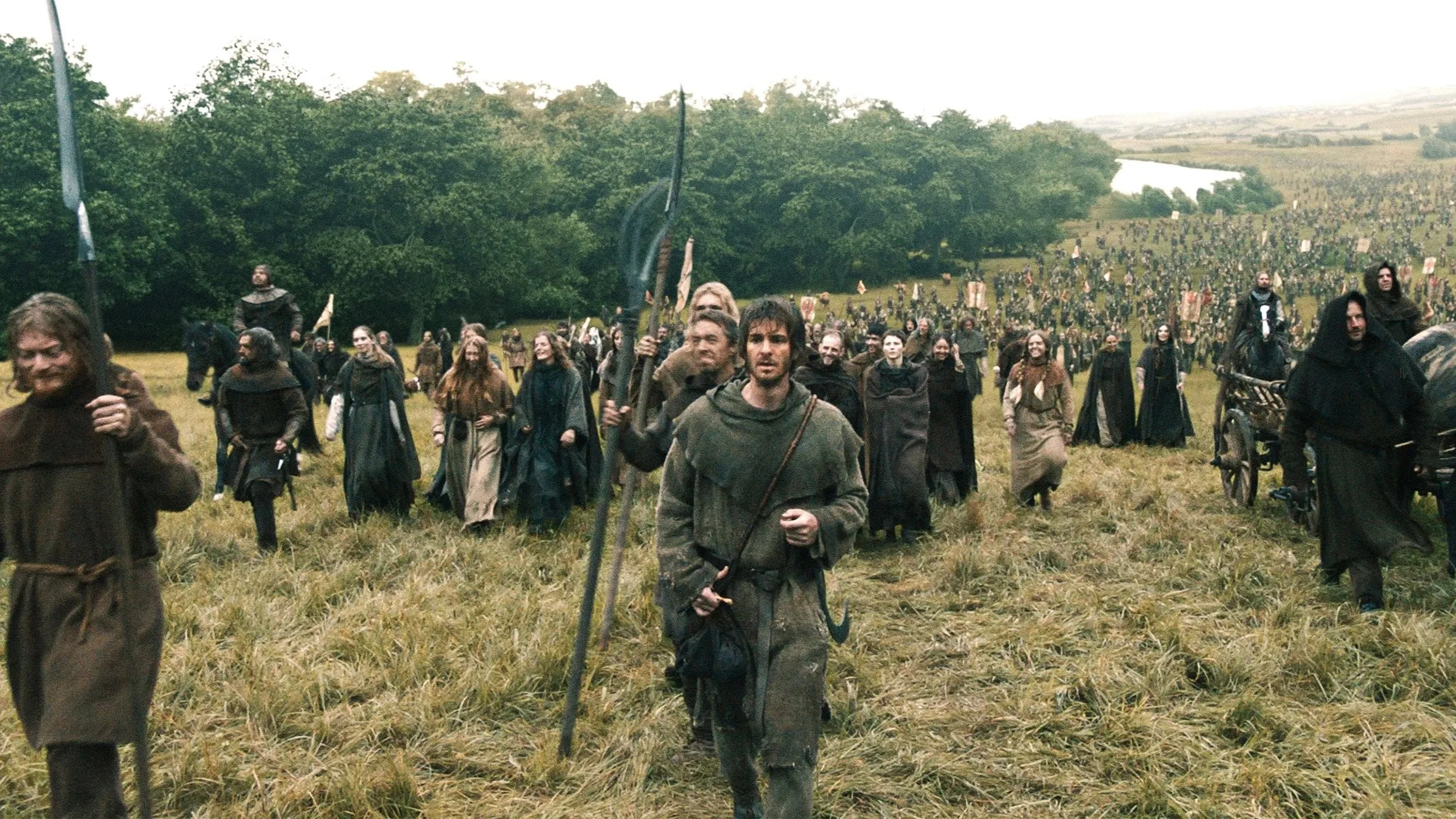
Andrew Garfield (centre) and the revolting peasants
Photo courtesy of Entertainment Film Dists.
by JAMES CAMERON-WILSON
In between his stints working with Matt Damon, Paul Greengrass has directed quite a few devastating exposés of real-life horrors. From his 2002 docudrama Bloody Sunday, which detailed the eponymous massacre in Northern Ireland, through to 22 July (2018) chronicling the 2011 terrorist attacks in Norway, he has repeatedly drawn on his early career as a journalist and documentarian. Now he delves into ancient English history, documenting the Peasants' Revolt of 1381. If you think we have it bad now, life in 14th century Albion was unthinkable. The Black Death had wiped out half the entire population, leaving those left behind to rebuild their lives under the shadow of horrendous grief. On top of which the government of the time – the Council of King Richad II – imposed swingeing new taxes, the penalty for not paying being the loss of a hand. It is perhaps no surprise then that the ‘commoners’ took up arms against the leading elite, their farm tools proving more than a match for the sheriffs’ cumbersome broadsword.
Paul Greengrass sets his scene in the agricultural heartland, where a farmer going by the professional appellation of The Ploughman (Andrew Garfield) balks at the prospect of paying the higher poll tax, in addition to which he is expected to pay death duties on his deceased family as he has no written proof of their passing. He is further riled by the ritual molestation of teenage girls carried out to check their maidenhood in order to ascertain whether they are of an age to make their own financial contribution to the state. In the ensuing mêlée, the Ploughman kills a soldier and ends up joining the rebel leader Wat Tyler (Cosmo Jarvis) and the priest John Ball (an unrecognisable Jamie Bell) as they rally an army of the dispossessed and march on London to seek social reform from the 14-year-old king (an imposing Woody Norman).
Bringing a grim passage of Medieval history to life, Greengrass also sheds a fresh perspective on our own times post-pandemic and of the various new taxes meted out to a British electorate coping with the rising cost of living. Drawing on his favoured use of the so-called ‘shaky-cam’ to bring a documentary-like immediacy to events, the director immerses us into the mud and squalor of the peasants’ everyday lives, in stark contrast to the pristine splendour of the ruling classes. He also makes full use of CGI, in which a drone shot over the cramped quarters of old Londinium is what the new technology was made for. The director’s dialogue also treads a fine line between what makes sense to us now and yet what feels germane to the times (when the Ploughman is asked to write down the names of his comrades as ‘Free Men’ in the Book of Doomsday, he explains that “I do not know words.”). This authenticity and the visceral scenes of combat should encourage many a young viewer to run scurrying to their history books. And history is important as it is prone to repeat itself down the ages, a truism that politicians should continue to heed. Paul Greengrass certainly does it justice.
Cast: Andrew Garfield, Jamie Bell, Stephen Dillane, Tom Hollander, Cosmo Jarvis, Thomasin McKenzie, Jonny Lee Miller, Woody Norman, Katherine Waterston, Stanley Townsend, Sky Young, Simon Kunz.
Dir Paul Greengrass, Pro Jason Blum, Paul Greengrass, Gregory Goodman, Joanna Kaye, Joe Neurauter and Lars Sylvest, Screenplay Paul Greengrass, Ph Pål Ulvik Rokseth, Pro Des Nikolaj Danielsen, Ed William Goldenberg, Music Volker Bertelmann, Costumes Tóth András Dániel and Godena-Juhász Attila, Sound Oliver Tarney, Dialect coach William Conacher.
Blumhouse–Atomic Monster/Thank You Pictures/Supernix-Entertainment Film Dists Ltd.
127 mins. UK/Germany/USA. 2026. US Rel: 11 September 2026. UK Rel: 9 October 2026. Cert. 15.