
Time and Water

Sara Dosa’s striking if over-ambitious documentary takes a look at Iceland’s threatened glaciers.
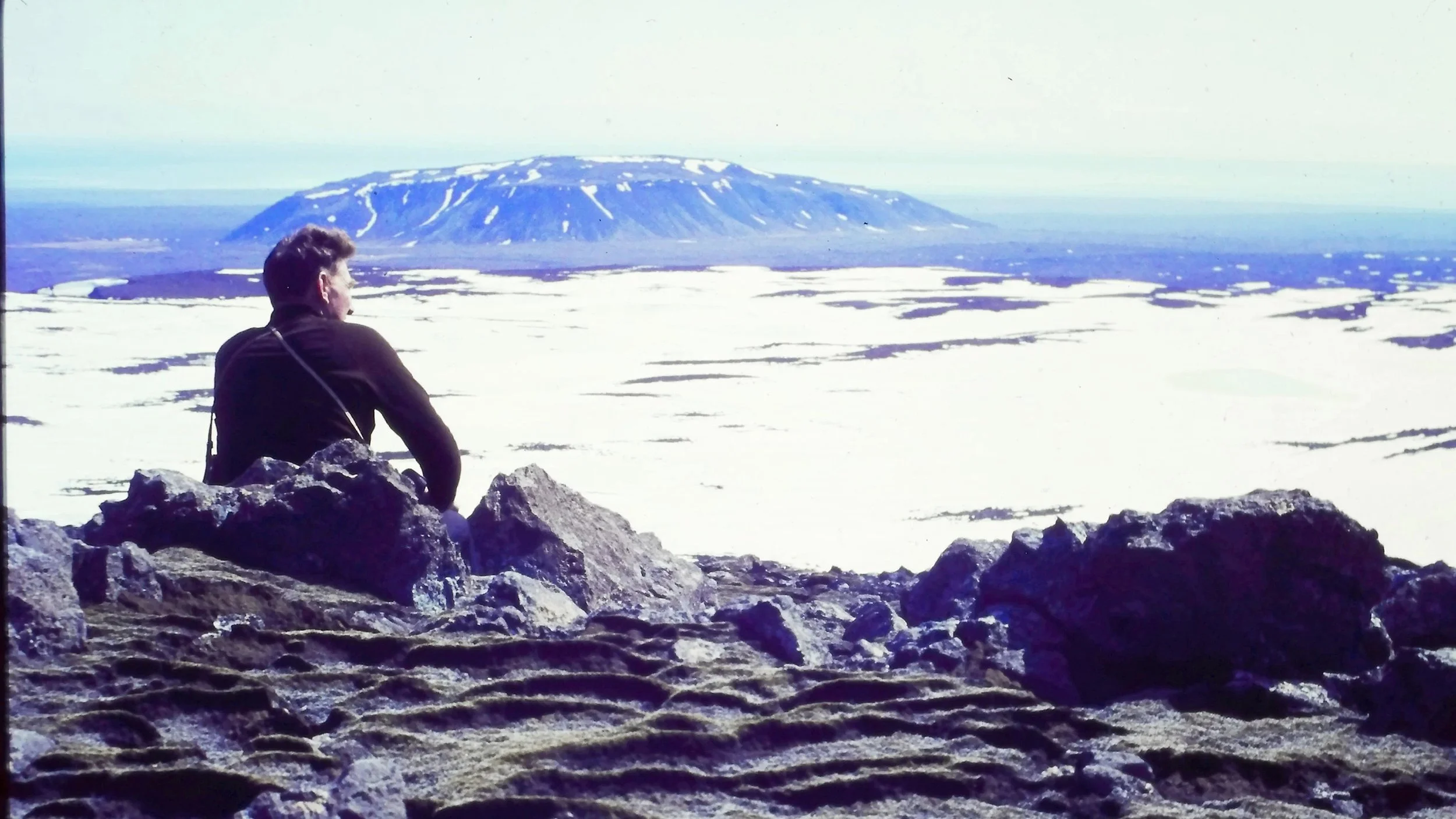
Image courtesy of Dogwoof Releasing.
by MANSEL STIMPSON
The latest documentary made by Sara Dosa offers something that is in some ways different from what the publicity for it might lead you to expect. The film was inspired by a book by the Icelandic author and activist Andri Snær Magnason which bears almost the same title (On Time and Water first appeared in 2019) and, rather than just drawing on that work, Dosa makes Magnason himself central to her film. He not only appears in person and becomes the film’s narrator but is credited as a co-producer and as a contributor to its screenplay. Magnason and indeed his whole family have always had a special relationship with their country’s glaciers and it would hardly be an exaggeration to say that they have a deep love for them. The words that Magnason uses to describe them suggest that he sees them as ice that has come alive. When a glacier ceases to move it can be formally certified as being dead which was what happened in 2014 to the Okjökull otherwise known the OK glacier. Furthermore, when it comes to considering what glaciers can mean to those who live in Iceland, it is worth noting that in this case a ceremonial occasion akin to a funeral took place five years later on OK’s former site. A bronze plaque was put in place carrying an inscription headed ‘A Letter to the Future’ which acknowledged that the passing of OK was due to climate change and stated that unless the right action is taken all Iceland’s glaciers will eventually suffer the fate that overtook OK. This inscription was specially composed by Magnason.
If the plaque could be read as a warning, so too could his book and now we have this film which expresses the same concern. Considered in a cinematic context, Time and Water may be said to echo a classic work of British cinema which dates from 1945. A Diary for Timothy with its commentary written by E.M. Forster was addressed to a baby in anticipation that the child would at some future date see it and be able to gain a direct impression of Britain in the last months of the Second World War and to learn lessons from that. In exactly the same way Time and Water is set up as something created to be seen in the future when it will enable somebody who is as yet far too young to comprehend the environmental crisis that has now become apparent. In addition, it will convey something of the changes that Iceland's glaciers have undergone over the last hundred years while the ancient culture of the country is also touched on in the form of song and legends recalled.
As a theme for a documentary film, this has two great virtues. One is that to emphasise climate change in this context is to deliver a statement which, if hardly new, is important enough to need repeating given that too many people are willing to underestimate the threat. The other is that images of glaciers gain in their expressivity when seen on the cinema screen and the photographer here Pablo Álvarez-Mesa does a fine job while older footage also adds to the impact. Time and Water approaches its concerns with nature and with the changes that have occurred to the natural world by finding a tone that is often close to the poetic and thus in keeping with Magnason’s own sensitivities. Furthermore, Dan Deacon's music score is very much in tune with that.
However, what is surprising about Time and Water is that the focus on what I have described is only half of the story. It would seem that Sara Dosa is a filmmaker drawn to works in which two elements are fused together. One saw that very clearly in her best-known previous work, 2022's Fire of Love. That film was a powerful documentary about volcanoes as told through the story of the married volcanologists Katia and Maurice Krafft. Despite the work’s focus on volcanoes, it was also presented as a love story. In much the same way Time and Water offers itself not just as a film about glaciers in peril but also as a family portrait. As such and in addition to showing Andri Snær Magnason’s young children, it covers three generations within the family. Over the years many home videos had been made so the film is able to go way back. This means for example that we see a lot of Árni Kjartansson who was born in 1922 and who was Andri's grandfather. He had thousands of photographs relevant to the theme of the film since they were linked to researching Iceland’s glaciers in the early 1950s. By incorporating recollections that express the views of all three generations the film is able to bring out the extent to which this landscape has been a treasured part of all of their lives.
But, while that might suggest that both sides of this film would fit neatly together, what Dosa’s film gives us is a work in which the material about the family takes up far too much of the running time. One has the impression that Time and Water is rather too ambitiously trying to treat the notion of the passage of time and the endeavour to keep memories alive in relation not only to the changing landscape but equally to the family members and this family’s history. The two may at times overlap, but even so the blend becomes an uneasy one and there is a certain sense of disruption arising from the fact that the older footage intertwined is in a different ratio from that shot for the film and some of it is in black and white. If we were able to get really close to Magnason's family, including those now dead, the mixture might well have worked. Unfortunately, it is difficult to get on terms with them as individuals since in its utilisation of previously recorded footage the film keeps jumping back and forth in time with bits and pieces presented often without regard for chronological order as different family members are given a place. There is so much material of this kind present that it could have been the basis of a separate film and one which, if developed more straightforwardly and clearly, might well have appealed in its own right. Here, however, it too often takes the focus away from our key concern, the glaciers themselves and their fate in this age of climate change.
Footnote: Contrary to our usual practice the names listed below of those appearing in the film includes those seen in archive footage some of whom have since died. This is in accordance with the film’s own credits which seem to reflect the notion of keeping them alive in memory so we have followed suit.
Featuring Andri Snær Magnason, Árni Kjartansson, Hulda Filippusdóttir, Herdis Sigurjónsdóttir, Jón Sigurǒur Pétursson, Margret Sjöfn Torp, Hlynur Snær Andrason, Kristín Lovísa Andradóttir, Elín Freyja Andradóttir, Hulda Filippía Andradóttir.
Dir Sara Dosa, Pro Shane Boris, Elijah Stevens, Jameka Autry and Sara Dosa, Screenplay Sara Dosa, Jocelyne Chaput, Erin Casper and Andri Snær Magnason, Ph Pablo Álvarez-Mesa, Ed Erin Casper, Jocelyne Chaput and Mark Harrison, Music Dan Deacon, Animation Lucy Munger.
National Geographic Documentary Films/Sandbox Films/Ninmah Foundation/Signpost Pictures/Compass Films-Dogwoof Releasing.
93 mins. Iceland/USA. 2026. US Rel: 29 May 2026. UK Rel: 12 June 2026. Cert. PG.
