
Two Prosecutors

At the height of his powers, the Ukrainian filmmaker Sergei Loznitsa proffers a portrayal of life in the USSR under Stalin.
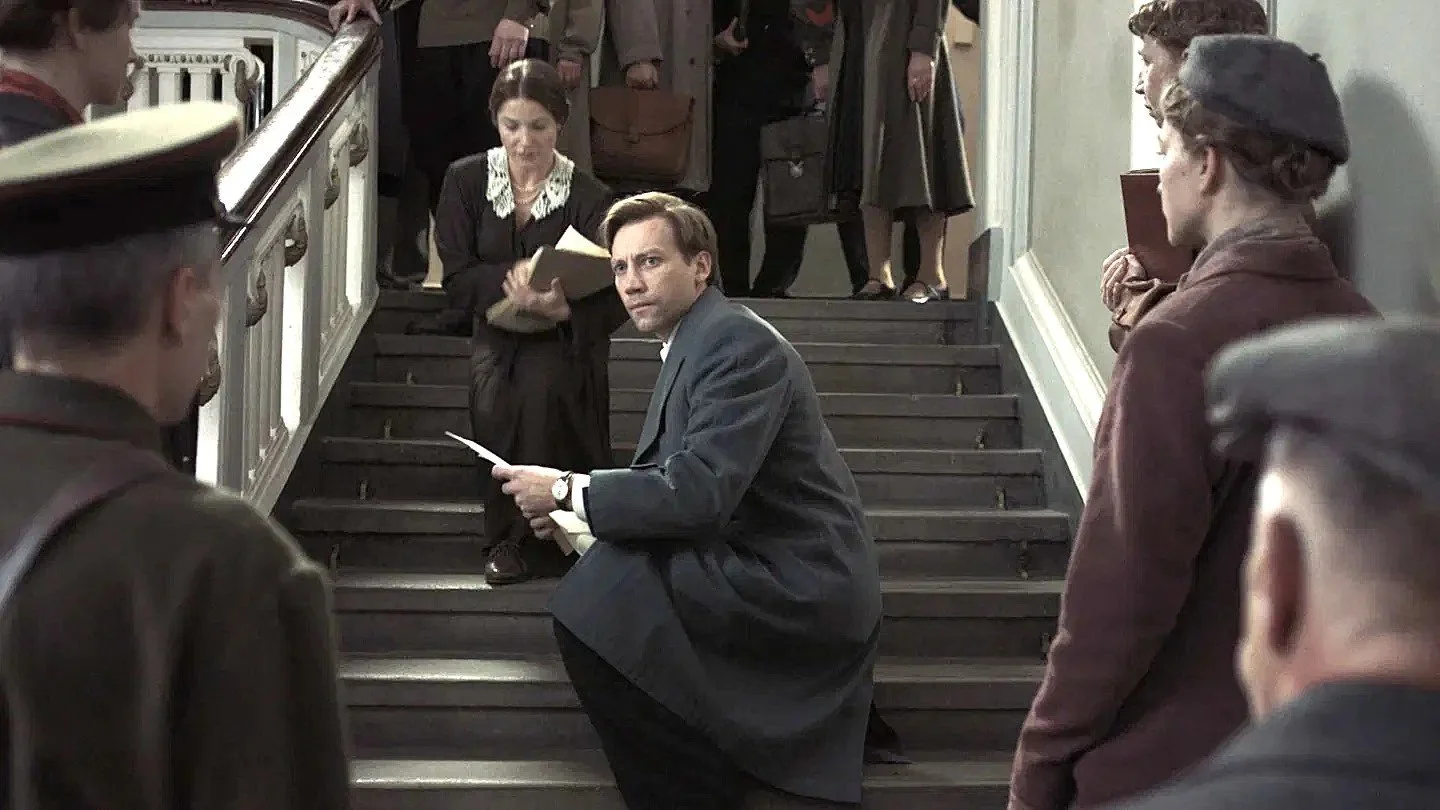
Aleksandr Kuznetsov
Image courtesy of Curzon Film Distributors.
by MANSEL STIMPSON
Although the Ukrainian filmmaker Sergei Loznitsa is a noted documentarian and was the man who gave us Maidan that memorable studying of the uprising in Kyiv in 2014, he has also made a number of features with actors. These dramas have always contained notable work and his latest film of this kind is one of his most successful yet. Working once again with the outstanding photographer Oleg Mutu, Loznitsa is here adapting a story by Georgy Denidov which set out to depict what it was like to live in the Soviet Union in 1937. Indeed, the film opens with a reference to the time and the place which appears alongside the description ‘The Height of Stalin's Terror’.
The main location here is the city of Bryansk and the film opens with a prologue which takes us into that city’s prison where one of the inmates is ordered to burn a bagful of letters. It becomes apparent that the items being destroyed are all addressed to Stalin seeking aid on the grounds that the writers are people falsely imprisoned and that any confessions made by them were obtained under torture. The destruction of these letters is duly carried out save for one of them which stood out by reason of being written in blood. This item is kept back contrary to the order given and, as the main narrative gets under way, we learn that it was eventually smuggled out of the prison and has reached the offices of the local prosecutor.
We now meet the film’s central character, a naive law student who has been appointed to the role of prosecutor, a man with a duty – theoretically at least – to deal with complaints from citizens. This young man is Kornyev (Aleksandr Kuznetsov) who earnestly investigates. He starts out by visiting the prison and approaches its governor (Vytautas Kaniušonis) demanding to see the prisoner, Stepniak, who had been so desperate that he had resorted to using his blood in order to write. The governor is deliberately slow to oblige and eager to encourage Kornyev to delay the interview, but the prosecutor is acting in accordance with the law and the meeting is allowed when he persists. Stepniak (Aleksandr Filippenko) is suspicious but is persuaded that Kornyev genuinely wants to help and speaks out in a private conversation during which he reveals the terrible marks on his own body.
Two Prosecutors becomes the tale of how Kornyev is horrified by what he has discovered and how, believing that the corruption is due to the NKVD infringing the socialist laws of the country, he sets out for Moscow. En route he encounters an old veteran who had lost an arm and a leg (a second role taken on by Filippenko) and who talks of having asked for alms from Lenin thus gaining a place in an actual alms house. Kornyev is hoping for a comparable success by revealing to the higher authorities what is happening. His belief is that they and only they will be able to exercise sufficient power to investigate and expose this corruption of Soviet ideals. Eventually, Kornyev does get an interview with the film’s second prosecutor, the Prosecutor General. This man is Vyshinsky (Anatoliy Beliy) and those viewers who know of this man's reputation in history will not be in suspense as to the outcome of their meeting.
Two Prosecutors is for the most part a finely constructed work. The skill to be found in the compositions and in the editing (the latter being by Loznitsa's regular collaborator Danielus Kokanauskis) ensures that the pacing of the film is such that it vividly conveys the delays and tribulations that Kornyev has to survive to get anything done at all but without these scenes ever dragging for the viewer. Some critics have described this element as Kafkaesque and when it comes to the section set in Moscow that is fair comment (it is also something that has arisen in Loznitsa’s earlier work and not least in 2017’s A Gentle Creature). However, the procrastinations over the prison interview play much more as a comment on direct authoritarian control. But all of these episodes of distressful waiting provide an effective surround to three big dialogue scenes each of some power. These big moments are dominated in turn by Stepniak’s account of himself, by the Leninist’s story evoking a parallel and a comparison with Kornyev’s endeavour and by Vyshinsky's response to what he is told.
The film which was actually made in Latvia is very successful in its sense of period and gains from very able acting all round but not least that by Aleksandr Filippenko especially in his appearance as Stepniak which is magnificent. For its last scenes Two Prosecutors returns to Bryansk and it ends very effectively. But before its closing scenes it incorporates an episode depicting Kornyev’s return train journey. His interchanges with two travelling companions at ease with the condition of things in the Soviet Union contain an ironic note that is something fresh in the film (they even offer a song about the country greeting a new day and rising to glory). Some may feel that this section while not out of place is rather overextended but in all other respects this is masterly filmmaking. Given other works by Loznitsa linked to Ukraine and Russia in recent times, it is easy to believe that this period tale is being offered with the intention of it having a modern resonance. But, even if it does so, some viewers may still take the view that a grim reminder of the Stalinist era is a downbeat testimony of a history already known to us and that may discourage audiences who, experiencing the current bleak times, prefer not to seek out a film of this kind. But what truly matters is that Two Prosecutors is a deeply felt work realised with anger yet with absolute artistic control. It is an outstanding achievement.
Original title: Zwei Staatsanwälte.
Cast: Aleksandr Kuznetsov, Aleksandr Filippenko, Anatoliy Beliy, Dmitrij Denisiuk, Vytautas Kaniušonis, Andris Keišs, Nerijus Gadliauskas, Varis Klausītājs, Einǎrs Simsons, Orest Pasko, Sergey Podymin.
Dir Sergei Loznitsa, Pro Kevin Chneiweiss, Screenplay Sergei Loznitsa from a story by Georgy Demidov, Ph Oleg Mutu, Art Dir Kirill Shuvalov, Ed Danielus Kokanauskis, Music Christiaan Verbeek, Costumes Dorota Roqueplo.
SBS Productions/LOOKSfilm/Atoms & Void/White Picture/Avonport Media/Studio Uljana Kim/The Match Factory-Curzon Film Distributors.
118 mins. France/Germany/The Netherlands/Latvia/Romania/Lithuania. 2025. US Rel: 20 March 2026. UK Rel: 27 March 2026. Cert. 12A.
