
Virginia Woolf’s Night & Day

Tina Gharavi’s frantic, semi-comic take of a 1919 classic is both misjudged and redundant.
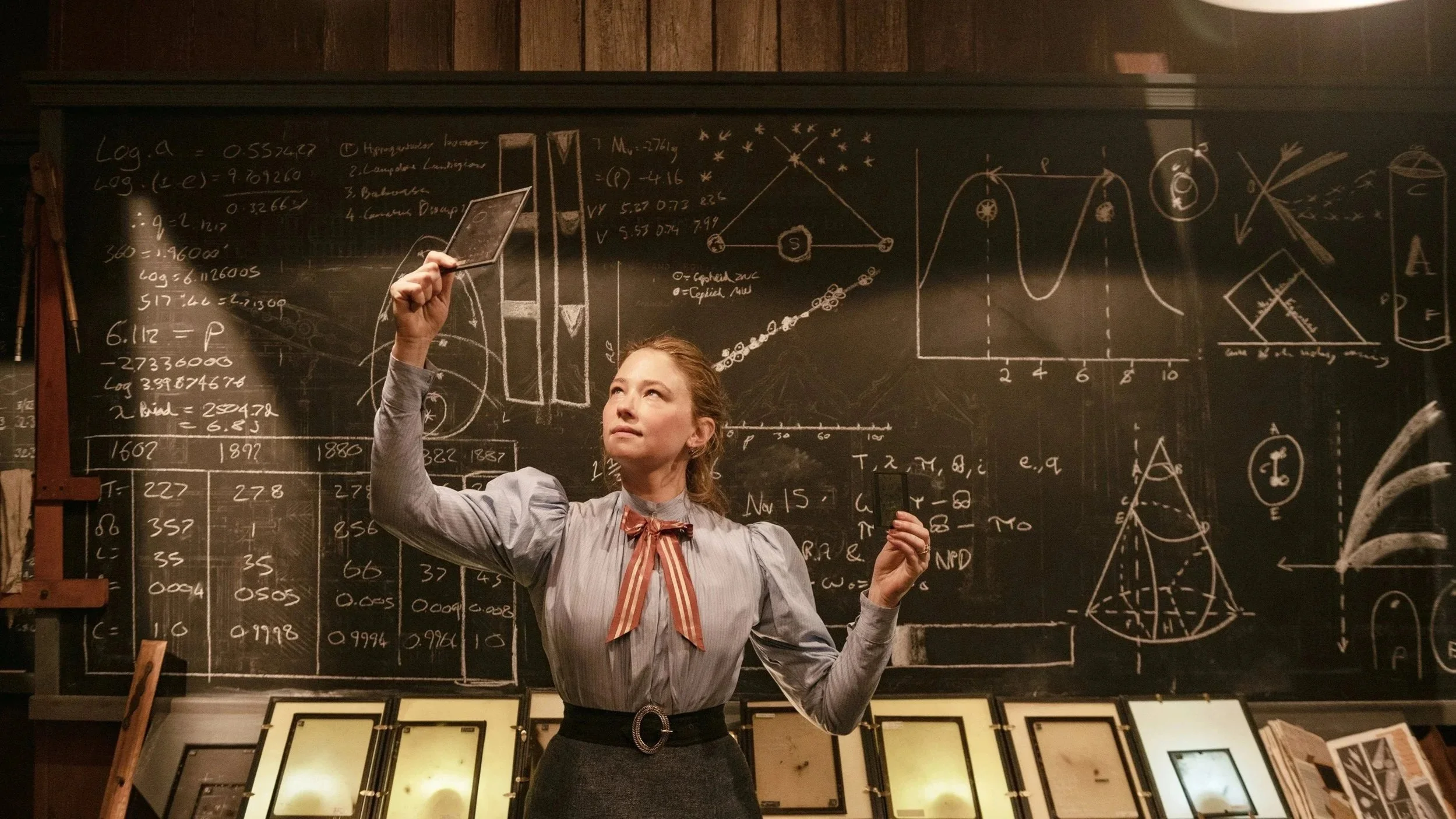
Haley Bennett as Katherine Hilbery
Image courtesy of Vue Lumière.
by MANSEL STIMPSON
The title of Tina Gharavi’s film raised doubts in my mind even before I viewed it. To make Virginia Woolf's name part of the title is not in itself inappropriate since this is a work based on her second novel published in 1919, but it is a reminder that, despite the success of Sally Potter’s Orlando and Marleen Gorris’s Mrs Dalloway, Woolf’s writing style is such that achieving the same impact on film is extremely difficult. Already in this early novel Woolf was constantly describing in detail the thoughts and feelings of the characters from the inside and thus pointing towards her later, better known works which have been praised for their psychological intensity. Yet in adapting it for the screen Justine Waddell finds no way to transmute that crucial element into cinematic terms, that being exactly what I had feared might be the case. A second doubt that I had may sound like a mere quibble. Nevertheless, given that Woolf's prose was so fastidiously crafted, it is hard to believe that she would not have been shocked to find her own title being changed from Night and Day to Night & Day for this film version.
I may have anticipated that there would be shortcomings but what I was not expecting was that in the light of its title the film would deliver a big shock. That comes from discovering that Virginia Woolf’s Night & Day has turned her novel into something that the original never was. In Waddell’s treatment this is first and foremost the tale of an upper-class young woman, Katherine Hilbery (Haley Bennett), who since she lives in London in 1910 is on account of her sex unable to further her interest in astronomy by obtaining a place at the University of Cambridge. In the novel she has no such aim but it is made central here and turns this piece into a feminist tract. Woolf did indeed link Katherine with a woman named Mary Datchet (Lily Allen) who is involved in a group working for women's rights but Night and Day is in part a comedy and, if Woolf's critical eye satirises the upper classes and their affectations, she is also no less keen to spotlight the comic limitations of Mary's group however well-meaning they are.
At the heart of the novel one finds a portrait of London society centred on four main characters and their romantic entanglements. Katherine is the key focus as she comes to accept the fact that her parents (Timothy Spall and Jennifer Saunders) regard the standing of William Rodney (Jack Whitehall) as making him a suitable match for her. Meanwhile, a more humble figure following a legal career, Ralph Denham (Elyas M’Barek), encounters Katherine and soon finds himself obsessed by her and is oblivious to the fact that Mary Datchet, whom he likes as a friend, is in fact in love with him. Thus, it is that, although Katherine has become engaged to William, the narrative is constantly exploring the complex and changing emotions felt by these two and by Ralph and Mary with a fifth figure also taking a role in this in the story’s later stages – this being young Cassandra (Camilla Borghesini). The interplay between them invites reflections on society's expectations, on misunderstandings that can involve seeing in a person you love your own romanticised version of them and on whether or not one should in love and in life reach out to fulfil one’s dreams however long the wait and regardless of how unattainable they may seem.
The novel is sometimes more fascinating for what it seeks to do than for what it achieves and being a long work it needs to be cut down for the screen. However, Waddell’s approach to it is extraordinary. Ralph Denham’s role is drastically reduced despite its prominence and a character briefly referenced in the book as a relative to be deplored (he is a father living with his children's mother but not married to her) is elevated from a brief mention into becoming an important figure in the tale. This is Cyril (Misia Butler) who is now shown as a strong influence on Katherine. Furthermore, his shocking behaviour now lies instead in the fact that he is gay. He is only present in the film’s first half but his role in it distracts from the romantic triangle which is all the more central here - or should be - because Mary Datchet’s role is so much more limited.
These changes and especially the feminist slant mean in effect that Virginia Woolf’s Night & Day is simply not Virginia Woolf's Night and Day. The question that remains is whether Gharavi’s film is a good period piece if one judges it without reference to its origin. It is the kind of material which was once the preserve of Merchant Ivory who knew exactly how to handle these things but Waddell’s screenplay shifts uneasily between comedy and drama (Spall is the actor who best handles the mix) and as a feminist piece it often seems too knowing by half. That it has an eye on today's world despite its setting is suggested by Simon Goff's modern-sounding music score and by the use of songs including ‘Sparks in Stars’ at the film’s close. That decision grates with me but in view of that approach it also seems weird that one sequence is accompanied on the soundtrack by part of Beethoven’s 7th Symphony! For that matter the actor cast as Ralph, Elyas M’Barak, happens to have a Tunisian father and an Austrian mother and comes across as a foreigner without that fact being commented on (as the character’s name suggests he was created as an Englishman). Elsewhere the film sometimes opts for unexpected intercutting including for some reason one long montage sequence repeating earlier shots.
The inconsistencies of style together with the fact that characters are often viewed in a drastically slimmed down version of how Woolf created them mean that for the most part the cast have little chance to make a strong impression. The one minor consolation here is that, helped by the fact that the role of Katherine is the most fully developed, Haley Bennett is able to make her rather more engaging than you might expect given the film’s manifold weaknesses. Even so, judged as a period comedy drama this is a weak offering and, despite featuring characters who appeared in the novel, Virginia Woolf has very little to do with what is on the screen.
Cast: Haley Bennett, Elyas M’Barek, Jack Whitehall, Lily Allen, Misia Butler, Timothy Spall, Jennifer Saunders, Simon Phillips, Camilla Borghesani, Sally Phillips, Elizabeth Edmonds, Frances Barber.
Dir Tina Gharavi, Pro Justine Waddell, Christopher Figg, Meg Thomson, Stephen Julius, Julie Link and Philipp Steffens, Screenplay Justine Waddell, from the novel by Virginia Woolf, Ph Sebastian Edschmid, Pro Des David Hindle, Ed Hansjorg Weissbrich and Ben Wilson, Music Simon Goff, Costumes Esther Walz, Sound Corinna Fleig, Dialect coach Jan Haydn Rowles.
West End Films/Asterisk Films/Elevation Films/M.Y.R.A. Entertainment/Piccadilly Pictures-Vue Lumière.
95 mins. UK/Germany/USA/Singapore. 2025. UK Rel: 19 June 2026. Cert. 12A.
