
Killing Anna

Sam Benstead’s powerful and fascinating documentary follows a catfish operation to expose a Syrian war crime.
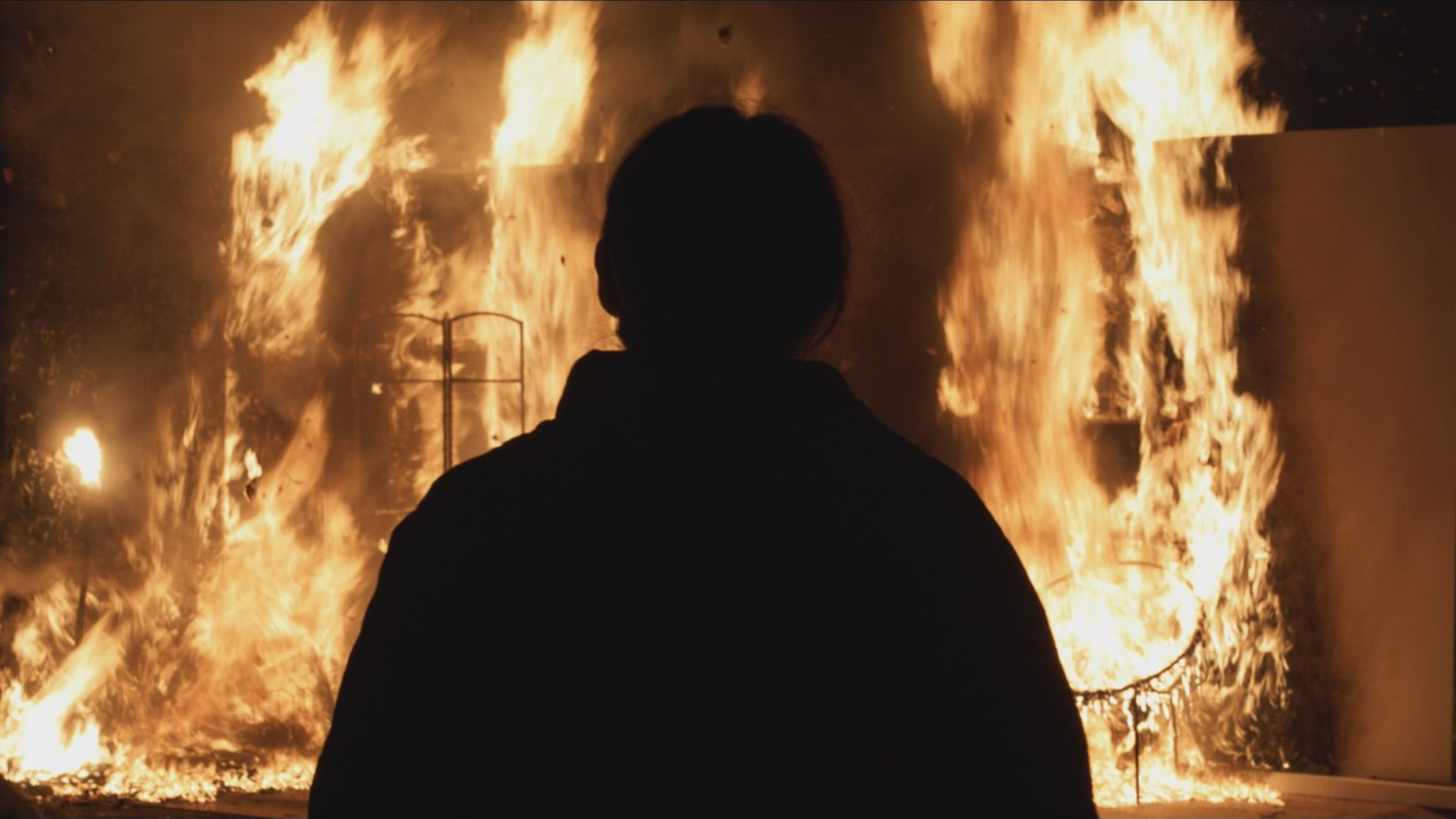
Image courtesy of Dogwoof Releasing.
by MANSEL STIMPSON
Sam Benstead’s documentary has the advantage of having an unusually fascinating story to tell and because of that it becomes a rewarding watch. Even so, the manner of its telling often irritated me since I am firmly of the view that self-conscious dramatisation is not the right approach for a documentary, a genre in which a sense of authenticity is key. I will return to those aspects of Killing Anna that go against that belief, but it is only right that I should first explain why the subject matter is so intriguing that it carries the day.
Killing Anna is a film about a major enterprise carried through by two researchers who first met in 2016 and acted together as academics working for the Holocaust and Genocide Centre linked to the University of Amsterdam. One was the Syrian Annsar Shahhoud and the other Ugur Ümit Üngör who is of Dutch and Turkish ancestry. The project they undertook was to bring to justice a man seen on a video who back in 2013 on the 16th of April had executed forty-one people in Damascus, part of what became known as the Tadamon massacre. Altogether it was estimated that there were close on three hundred civilian victims in total during this action carried out by Ba’athist Syrian soldiers serving President Assad. The video in question was one that had been leaked and which came to the attention of Shahhoud and Üngör. That their task would take years was unsurprising: first there was the matter of identifying the exact location of the killings and then the huge task of trying to track down and identify the man in charge (a facial scar being the one helpful distinctive feature). Once that had been achieved, it became a question of how it might be possible to obtain evidence that would confirm his guilt, this being an even greater hurdle to overcome.
Other more recent acts of genocide that have been called out leave one with doubts as to whether or not those responsible will ever be brought to court and face sufficient evidence in law to lead to a conviction. That concern adds to one's interest in following this particular case regardless of the fact that some might dismiss what was done in Damascus as part of what can now be considered yesterday's war. Once the man was known to be an intelligence officer, Amjad Yousef, it became apparent that a plan would need to be devised in order to entrap him. Accordingly, Annsar Shahhoud took on a new identity going online on Facebook in a catfishing exercise. She approached him in this way as somebody known only as Anna Sh. This involved Annsar in building up the identity of Anna Sh by claiming to be somebody who was living abroad but was very supportive of the Assad regime. In due course she would express interest in being told of Yousef’s experiences to aid a thesis which she was preparing as a second-year university student and the subject of which was Syria’s National Defence Force.
Although other sources played a part in building up a picture of what happened in the Tadamon massacre, the film focuses more and more on the recorded online communications between Yousef and Anna Sh. Their first contact had suggested that Yousef was asking questions to check out just how authentic this stranger was and a period of silence followed. Subsequently, however, he contacted her and this then led to regular and increasingly intimate conversations during which she drew him out about his life (including the impact of the death of his brother whom he described as having been martyred). Ultimately it resulted in crucial admissions on his part: "I killed many" leads on to " I was just doing my job" and then to "I'm proud of what I did”.
At 76 minutes, the film avoids being overstretched and the grip of the piece grows ever tighter. Nevertheless, quite early on we feel the power of the video of the massacre and here the film is well judged in the way it utilises this footage in a manner that shows enough to achieve real impact but without gratuitously exploiting the horror of it. But in other respects I found myself distracted by Sam Benstead's approach as director. Oddly enough for a documentary, the publicity for Killing Anna describes it as a psychological thriller. It is indeed the case that Benstead favours a music score by Nir Perlman which seeks to play up the drama when the material is already dramatic enough not to call for that. Similarly, the directorial style is often of a kind which favours touches more suited to a work with actors despite the fact that for much of the time Shahhoud and Üngör are simply telling us what they did next.
The one psychological element involved lies in the strain experienced by Annsar Shahhoud in keeping up the persona of Anna Sh for so long and having to pretend to views that were utterly contrary to her real ones. This is acknowledged but not gone into in detail which may be a course taken to be protective of Annsar Shahhoud herself. On the same grounds it could be that the considerable footage showing the exchanges between Yousef and Anna Sh are all a blend of the authentic (the images of Yousef himself) and the reconstructed. This is not made clear in the film but buried deep in the end credits is an acknowledgment that the actress Sherine Chalhie appears as Anna. If the pressure on Annsar Shahhoud is not discussed in depth, it is nevertheless made clear that it ultimately led her to feel the need to cleanse herself by in effect burying her assumed alter ego (hence the title of the film). But for Sam Benstead this means representing it through another dramatisation, one that involves burning down a stage set. As shown here this symbolical act is totally at odds with the documentary tone of his film. Ultimately, then, Killing Anna is a documentary which is far from being ineffective although for the most part this is on account of its compelling narrative rather than on the way in which it has been presented.
Featuring Annsar Shahhoud, Ugur Ümit Üngör, Sherine Chalhie.
Dir Sam Benstead, Pro Matt Cole and Charly Wu Feldman, Ed Leigh Berezki, Music Nir Perlman.
KEO Films/Bellingcat/VPRO/Placeholder Films/Channel 4-Dogwoof Releasing.
76 mins. UK/Netherlands/France/UK/Syria. 2026. UK Rel: 19 June 2026. No Cert.
