Da-Dum: ‘Jaws’ Celebrates 50 Years on Martha’s Vineyard
by CHAD KENNERK
Image courtesy of Martha's Vineyard Museum.
Welcome aboard Amity Boat Tours! What better way to talk about Jaws than a return trip to the shores of Amity, also known as Martha’s Vineyard, the picturesque island off the coast of Massachusetts where Steven Spielberg, the cast and crew filmed the classic adventure in the summer – and fall – of 1974. Following the world’s introduction to that clever shark, tourism on Martha’s Vineyard exploded, and it’s been ‘Jaws Island’ ever since, with visitors flocking to filming locations and ‘Amity’ landmarks annually.
To celebrate the 50th anniversary of Spielberg’s 1975 classic, Martha’s Vineyard Museum is rolling out the ‘blood’ red carpet welcoming Jaws finatics and islanders to explore a new landmark exhibit, Jaws at 50: A Deeper Dive. Through rare photographs, oral histories, original artwork, and authentic movie props, the museum’s galleries recount how Martha’s Vineyard played a starring role in cinema history. In addition to the summer-long exhibition, the museum proudly presents Amity Homecoming Weekend. The robust five-day event from the 19th to the 23rd of June will swallow fans in exclusive talks, with special guests sharing behind-the-scenes insights into the making of Jaws.
In conversation with Martha's Vineyard Museum staff Anna Barber
(Curator of Exhibitions), Cathy Mayone
(Managing Director), Laurel Redington
(Director of Programming and Audience Engagement), and Bow Van Riper (Historian and Research Librarian).

Film Review (FR): Anna, I want to read this quote from you, which I love. You said, “There's a special kind of magic in this exhibition where movie history meets island memory.” What were your goals with this exhibit, and what has that been like for you getting to share it with the public?
Anna Barber: It really feels like Jaws is an island story, in a way that only we can tell, because so many folks from this island took part in it: behind the scenes, in front of the camera, and the island itself was transformed — with very little transformation, I might add — to become Amity. We're so often rooted in these historical stories and trying to get people to connect with the history of our island and the people of this island. This celebration is such a different take; it's so light-hearted and so fun — although not light-hearted for the folks who were working on the movie at the time, some of them anyway.
Just to add another quote to this, there's a woman named Edith Blake who was a photographer and basically chronicled the filming every week in one of our local papers, The Vineyard Gazette, and took an incredible catalogue of behind-the-scenes photographs. They're amazing. If you see a black-and-white photograph of the filming of Jaws, there’s a good chance that it probably was one of hers. She opened up a whole world of what it looked like behind the camera. She had a great quote where she was talking about the island premiere on June 20th in 1975. It sounds like nobody was really watching the movie; they were just looking for their friends. She likened watching Jaws to watching a home movie, which I thought was really something beautiful. It is, in essence, archival footage of the island with island people in the 70s.
It is this incredible movie that deserves the accolades and deserves to remain among the top movies of our time. But when you look at it through a different lens, here on the island, it is in some ways like a home movie. We get to see the island as it is no longer, and I think that's really special. For the exhibit, it really is a place for us to say: without the island, without its people, there would be no Jaws.
(FR): Living on the island, what have been some of your personal encounters with Jaws?
Cathy Mayone: My husband was a summer kid, so he was here in 1974 when they were filming. He wasn't an extra, like many islanders, but he talks about being down at the docks and watching it. He talks about how back then, many people thought it wasn't going to amount to much. You heard all the stories about the shark not working or that they're having these problems with it. It's really fun now to hear all of the islanders talk about the movie, and the museum has recorded a number of oral histories that we're going to have as part of our 50th anniversary exhibit. Some of those people are no longer with us, so it's great we've been able to capture those. What I'm really looking forward to with this 50th anniversary is being able to get so many of the islanders that were involved in the movie to tell their stories because we only have a limited amount of time to capture all those stories.
Laurel Redington: When I first started coming [to the island], in the mid to late 80s, the remnants of the original Orca II were still up in Menemsha Pond. I got to see that, but I never got to actually get on it like a lot of my peers. One of the things we're going to have at the museum this summer is an exact, meticulously recreated interior of the wheelhouse of the Orca on display in our Doherty barn building, which is going to be so amazing for all the Jaws finatics and anybody on Martha's Vineyard who was in the movie. Cort Corino is coming from Michigan to bring this here. He spent years watching the movie and freezing scenes to look at it. It's going to be an extraordinary moment to see that.

(FR): Bow, your family has a long history on the island.
Bow Van Riper: My father started as a summer kid in the 30s, and then my grandparents also first started coming in the 30s. They moved here permanently in 1940. I started as a summer kid when I was three months old, and here I am; a third-generation wash ashore. Wash ashore is the local slang for people who live here permanently but weren't born here.
(FR): Take us back to the summer of 1974 and an 11-year-old Bow on the set of Jaws.

Bow Van Riper: We knew that Jaws was filming on the island, and I thought it would be fun to go over and watch what it looked like to film a movie. So my friend and I were driven over to State Beach, and we were sitting on the sand watching them do their thing, and the assistant director picked up a bullhorn and said, “Okay, we need a hundred brave people to get in the water and look like you're having a great time.” My friend and I looked at each other and went, ‘Sure. Why not?’
There we were, standing knee-deep in the water off State Beach, and the assistant director picked up the megaphone and said, “Okay, so we're going to shoot a scene where you're all out there having a great time, and then suddenly you think there's a shark in the water, and you panic and run for shore. So when the yellow helicopter flies over, panic and start swimming for shore.” We're all out there, knee-deep in the water, getting down, trying to pretend we're in water over our heads. We moved out a little further, but we can't move out too far because the cameras are on the beach, and they need to be able to see us. The whole ‘hundred brave people’ comment was starting to make a lot more sense.
We splashed around, looking like we're having a good time in water that’s over our heads. The helicopter flies over, and everybody reflexively stands up and starts running for the shore. The director yells, “Cut. No, no, you're supposed to be in water over your head, remember? Pretend you have to swim for shore.” So we all gamely go back and get set up. The helicopter flies over again. Now we're in water somewhere between our knees and our waist, trying to make it look like we're swimming through water over our head. As you get closer to the beach, the water gets shallower and shallower, and it becomes harder and harder. By the end of it, we go from doing the crawl to pantomiming dog paddling to pulling ourselves along the bottom, digging our fingers into the sand. I can't remember how many times we set back up and did that, four or five. Anyway, it felt like a dozen at the time, at which point, we were all waterlogged and freezing cold.

We'd learnt a really important lesson about filmmaking, which is that you never do anything just once. And that there's a whole lot of hurry up and wait. Get out there and wait for them to get the helicopter where it needs to be. Wait for them to get the cameras set up. Wait for them to do whatever else they need to do. And then a brief burst of action. Then go back, wait, and do it again. It was really cool for 11-year-old me to be inside the making of a movie and to realise, as you looked up and down the beach, just how much went into putting even a short scene like that together. Of course, none of us knew at the time that Jaws was going to be the big deal that it was. Not until the movie came out the following summer, and my parents and I were watching it. It was so much more impressive on the screen than it looked when we were all shivering in the water off of State Beach the previous June.
(FR): For all everyone knew on the island, this could have just been another B-movie creature feature.
Bow Van Riper: Exactly. Everybody on the island, even those people that were much more involved with the film than I was and saw much more of it being done, were seeing it done out of sequence and without the advantage of the special effects, the music and the editing. One of the most commonly reported reactions from people on the island who weren't filmmakers and weren't part of the crew but were deeply involved in it was, ‘Holy cow, I had no idea it was going to come together this well because it seemed like such chaos when it was being made.’ To have it all come together and gel as perfectly as it did seemed impossible, and yet…
(FR): You first encountered Jaws on the set, but when did you see the finished film?
Bow Van Riper: At the seven o'clock show of the Island premiere in June of ‘75 at the packed Island Theater in Oak Bluffs. Most of the people dressed like they were going to a garden party in Edgartown, because that was the vineyard in 1975. It was great fun watching it with a local audience because there was a lot of ‘Oh my gosh, I know that guy who's got one line in the background of the scene on the Edgartown docks.’ Or someone pops up briefly on the beach. There was a lot of hooting and hollering about the geographic liberties the film takes with the island. Brody leaves his house in Oak Bluffs, and seconds later, you cut to him driving by a lighthouse that's 18 miles away to the west, and then another cut, and he's pulling up to the scene of the first victim, which is another 20 miles back in the direction he came from. Somebody at the island premiere yelled out, “That was a quick trip!”
If you're local, you’ll notice the fact that when the Orca steams into what's supposed to be Amity harbour, they're coming into Edgartown, but when it steams out of Amity harbour, it's leaving from Menemsha at the other end of the island. The beach that Chrissie runs across on the way to her ill-fated midnight swim is in one place, and the dunes where she and the rest of the crowd were sitting around the fire, drinking and listening to music are in a totally different place. More photogenic for a beach party, but harder to run into the water smoothly. It's the same, I think, with any movie. I'm sure doctors go through this watching movies that are about doctors and pilots go through this watching aeroplane movies. Somebody who watches a movie who's deeply immersed in whatever the movie's about. In the case of Jaws, it's the people who actually lived here on the island.
(FR): The bulk of that cast, outside of the leads, is made up of islanders.
Anna Barber: Jeffrey Kramer, who is still very connected to the island, is coming back to be with us this summer, but so many of the others are no longer with us. It's probably the most video footage I've ever seen of Craig Kingsbury, although his daughter has some wonderful footage that is being digitised. At our museum, we've always had a special interest in stories, so we've had a dedicated oral history curator for many years whose job it is to go and collect stories of people on the island.
If you listen to Quint, in some ways, it's Craig Kingsbury. The fact that so much of it really was kind of organic; there were so many ad-libbed lines that it does read, in some ways, like an island story. It does parallel a lot of times. When you think about island bureaucracy, and you think about the reality of living in a place where you're sharing your waters with sharks. So many of the fictional plot lines are things that we, at times, grapple with. It does feel closer to home in that way too.

(FR): Islanders were such an important part of making the movie. Casting director Shari Rhodes talked about how they weren't able to find actors that were as authentic as the people on Martha's Vineyard. In addition to celebrating the film, these events and the exhibition are also a celebration of the community on Martha's Vineyard.
Cathy Mayone: Yes, absolutely. We have our opening exhibition event, and a number of the Islanders who were involved in the production of the film will be joining us for that. They will also be joining us for events like our Amity Homecoming Weekend and specifically our Reunion Day event that we have on Sunday, 22nd June, in partnership with The Vineyard Gazette. The whole idea is to really bring the community of islanders together with the community of Jaws fans and have a celebration together. Bringing these two communities that are so passionate about the movie and have different perspectives of the movie together.
Laurel Redington: Another really special thing that's going to be happening at the museum as part of our summer-long tribute to Jaws — John Campopiano and Kristen Kingsbury Henshaw, who is the daughter of Craig Kingsbury, the larger-than-life island character that was the inspiration for Quint's character. He's no longer with us, but there's a film that's going to be released called The Farmer and the Shark, and it's going to be another layer of the amazing phenomenon that Jaws is, not only to finatics around the world but to our local community.
(FR): And to think that the production almost didn't happen on Martha's Vineyard.

Bow Van Riper: Exactly. When Joe Alves, the production designer, was originally thinking of locations. He naturally talked to Peter Benchley, and Benchley suggested a number of places along the coast of Long Island Sound, which Alves dutifully went to look at. None of them really seemed right. Then he decided he'd go to Nantucket. He got to Woods Hole, the jumping-off point for both the Nantucket and Martha's Vineyard ferries, and got on the ferry to Nantucket. About half an hour out of Woods Hole, the captain came on the loudspeaker and said, “I'm sorry, folks, the weather's too bad. We're not going to get to Nantucket. We're turning around and going back to Woods Hole.”
The boat pulls in, Alves gets off the boat, and there's another ferry tied up at the next pier. He asks somebody who works there, “Where is that boat going?” And the guy says, “Martha's Vineyard.” Alves says to himself, ‘All right, I guess I'll go to Martha's Vineyard.’ The next morning, he starts driving around the vineyard and realises when he gets to Edgartown, with its white clapboard houses, picket fences and its scenic harbour, that this is exactly what he envisioned for Amity. The film that might, but for a winter storm, have been made on Nantucket got made on Martha's Vineyard instead.
(FR): This project seems like a massive undertaking. Cathy, how did you approach tackling and spearheading all of the 50th Anniversary plans across the museum and Amity Homecoming Weekend?
Cathy Mayone: I've been sitting on the Jaws 50th planning committee that the Chamber of Commerce has had. As an island, we've really been trying to come together. There really is no single organiser for all of the Jaws 50th events. As part of this planning committee with the Chamber of Commerce, we've really tried to map out our different events so that they don't conflict with each other and so that people coming for the weekend can map out their whole experience. I do encourage visitors that are coming to see our beautiful island too, because there are so many other things to see.
For our Reunion Day, our partners at The Vineyard Gazette, Monica and Tresa, have been really great. They are organising all of the activities we're going to have on our front lawn — the meet and greets, the VIP tent and the food and merchandise vendors. The bus is free on Martha's Vineyard all summer long, so it's a great way to get around. If people want to take a Jaws tour, they'll be able to understand how to take the bus there. We're really, as an island, trying to make sure we're doing everything we can to have a great experience for our visitors.
(FR): Laurel, you've been working with the lineup of speakers for Amity Homecoming Weekend, which is such an enticing mix of people who worked on the film and others like conservationist Wendy Benchley. What's that process been like?
Laurel Redington: This has been an exciting weekend to plan. On Thursday, we're going to kick it off with Let’s Talk Jaws Live. It’s going to be exciting to bring that show to the island and to the museum. The next morning, Bow Van Riper is doing a three-hour masterclass. That's going to be an exciting talk diving into the importance of the film and why it's been such a part of us. In the afternoon, we just added a talk with Guy Masterson, the man who was really instrumental, along with Ian Shaw, in creating The Shark is Broken play. Later in July, they're going to have multiple performances at our performing arts centre here on the island. The next afternoon, we're going to have Christopher Shaw Myers; he wrote this incredible book that he's going to be talking about. Wendy Benchley is going to be talking about shark conservation in the evening, and then on the big day, on Sunday, we'll be having talks on the inside while everything is happening on our front lawn.
We'll start off Reunion Day with [Jaws production designer] Joe Alves and Dennis Prince, who actually just wrote a second book about Joe Alves’ work in the industry. He's just an icon in movies, but it started with Jaws. After that, it's going to be Greg Nicotero, who's the man behind The Walking Dead, but his career started from a fascination with Jaws, which kicked off so many careers. And then Jeffrey Kramer, who was Deputy Hendricks in the film, is going to be here to have a wonderful talk. He's just a beautiful human being, always joyful and has so many stories. Each talk is going to be covering pretty much every aspect [of the film.] And throughout the summer, we're going to be taking a lot of the local people who were in the movie, and we're going to have around-the-campfire kind of story sessions that will bring these locals in to share.
(FR): Did any buried treasures from locals emerge as you were putting this exhibit together?
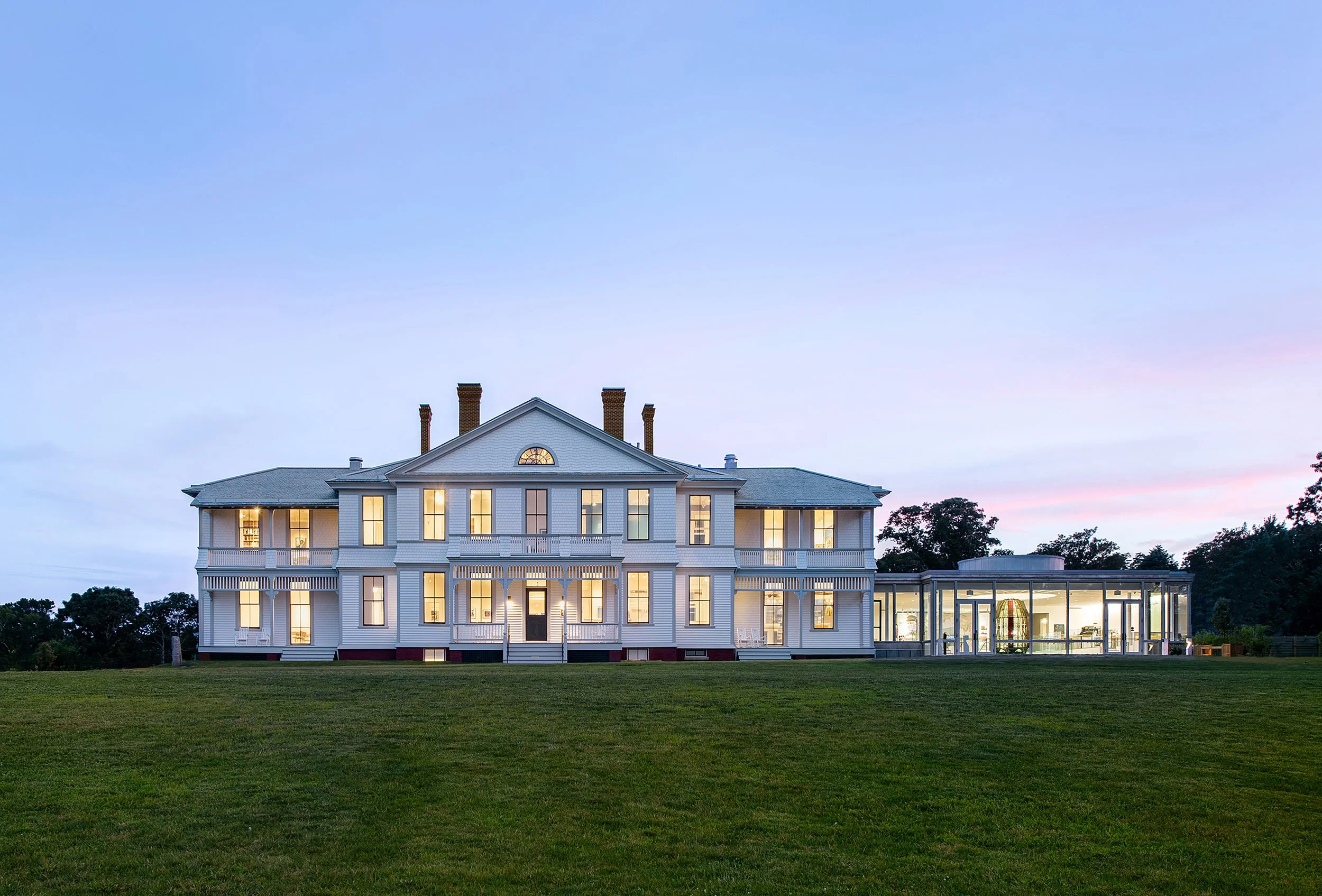
Anna Barber: For sure. Even though I'm saying it's the biggest exhibit we've ever done at the museum, our museum is in an old marine hospital that was built in 1895, and so we have this sort of collection of smaller rooms that make up our exhibit galleries. We've had to be really thoughtful about what we can fit in the space. As I said before, we're a museum that's always collected stories, first and foremost. The fun process is listening to folks, especially people maybe you knew in one capacity, and then they come to find out that they had a small speaking part, or they were helping as an assistant to an assistant, or they had some part behind the scenes that you had no idea about. The stories are really wonderful.

Photographs for sure people have been giving us. We just got an amazing collection of photographs that we’re attributing to being taken by Roy Campbell and were part of Roy Campbell's personal collection. He ran the tugboat Whitefoot, which helped out with the production side of things. He was really integral to making sure that a lot of the lights and mechanics were able to be safely transported around. He has this amazing collection of colour photographs from the Whitefoot that offer a lot of really interesting perspectives of the Orca, of the [tiny support boat nicknamed the] SS Garage Sale and of the sharks and filming sequences which we hadn't seen before. His niece donated those to us and let us borrow a copy of Jaws that was given to Roy on his birthday, which was signed by all of the cast and crew, including Spielberg, a lot of whom had some really funny messages for him. In Carl Gottlieb's book, he talks a little bit about Roy Campbell and how he was a very serious but beloved member of the behind-the-scenes island crew. He really brought, like Lynn Murphy, like so many others, this sense of how to work on the ocean, which many of the others didn't have.

We have a barrel that was used on-screen that is owned by a guy named Wayne Iacono, who was also heavily involved. He helped run the city of Chappaquiddick and was up in the helicopter during filming and was also stand-in for Roy Scheider in a couple of scenes. He’s a really soft-spoken, lovely, quiet guy who is a fisherman out in Menemsha. It's really nice to be able to have a mix of things that were used in the movie, photographs, the stories and little things like a belt buckle that was made by a guy named Thaddeus McDowell, who lived on the island. He was making these shark belt buckles for some of the production crew. That one just sort of showed up one day; a guy came in and offered it to us to use in the exhibit. So it's those little things that I think really tie to some of those behind-the-scenes stories. But I do know that when you go to an exhibit about a movie, you want to see some of the things that were actually in the movie. We've got a little bit of both.
(FR): Bow, the scene that you shot was the shark hoax scene and one of the boys behind the hoax in the film is now the real local police chief.
Bow Van Riper: He is now, in fact, the police chief in Oak Bluffs. Talk about coming full circle. It's interesting because he and his brother, the other kid in the cardboard fin scene, were the sons of an Edgartown police officer who went on to become the police chief in Edgartown. They originally auditioned for the roles of Chief Brody's two kids in the movie. Shari Rhodes, the casting director, picked somebody else but offered them the parts of the kids with the cardboard fin. The two little miscreants with the cardboard fin have been tied to the police department now for two generations.
(FR): Jaws seems to consistently attract larger-than-life stories. Bow, you’ll be sharing a lot of those in your talk, Jaws Deep Dive: A FINatic’s Look at a Classic Film.
Bow Van Riper: Before I worked at the museum, I was a history professor for 21 years, but for fun — or what passes for fun in academia — I wrote a lot about pop culture in an academic vein, particularly the movies, and this programme I'm doing over Amity Homecoming Weekend is my chance to revisit my ‘I'm somebody who thinks in way more depth about film than the average human being does’ days and to basically geek out over Jaws with a room full of people who also, in the case of this particular film, are really into the details of the movie. My goal is to try, using clips and stills from the movie and stories from the production, to take them on a deeper dive into why Jaws, after 50 years, is still this incredibly gripping, compelling movie that speaks to people even after endless numbers of other ‘nature run amok’ and ‘monster eating people’ movies from the same era have been consigned to $1.99 DVDs and the bargain bin at Walmart.
Also looking at some of the ways in which the extensive casting of locals, not just the Searle brothers as the kids with the cardboard fin. Lee Fierro as Mrs Kintner. The actual Edgartown medical examiner is the Amity medical examiner. Donald Poole, the lifelong Menemsha fisherman, is the harbormaster who's watching all the lunatics going out in their little boats, hunting for the shark, and just sort of smiling benevolently. It gives the film a feeling of realism, and having it shot on location, on the Vineyard, on the actual waters around the Vineyard, gives it a feeling of authenticity it wouldn't otherwise have. Hopefully the talk will draw an audience of people who get excited, rather than rolling their eyes when you stop a film clip and say, “Okay, now look how they positioned Quint relative to Hooper and Brody here.”
(FR): For guests coming and experiencing the exhibit, what are some of the areas they will see?
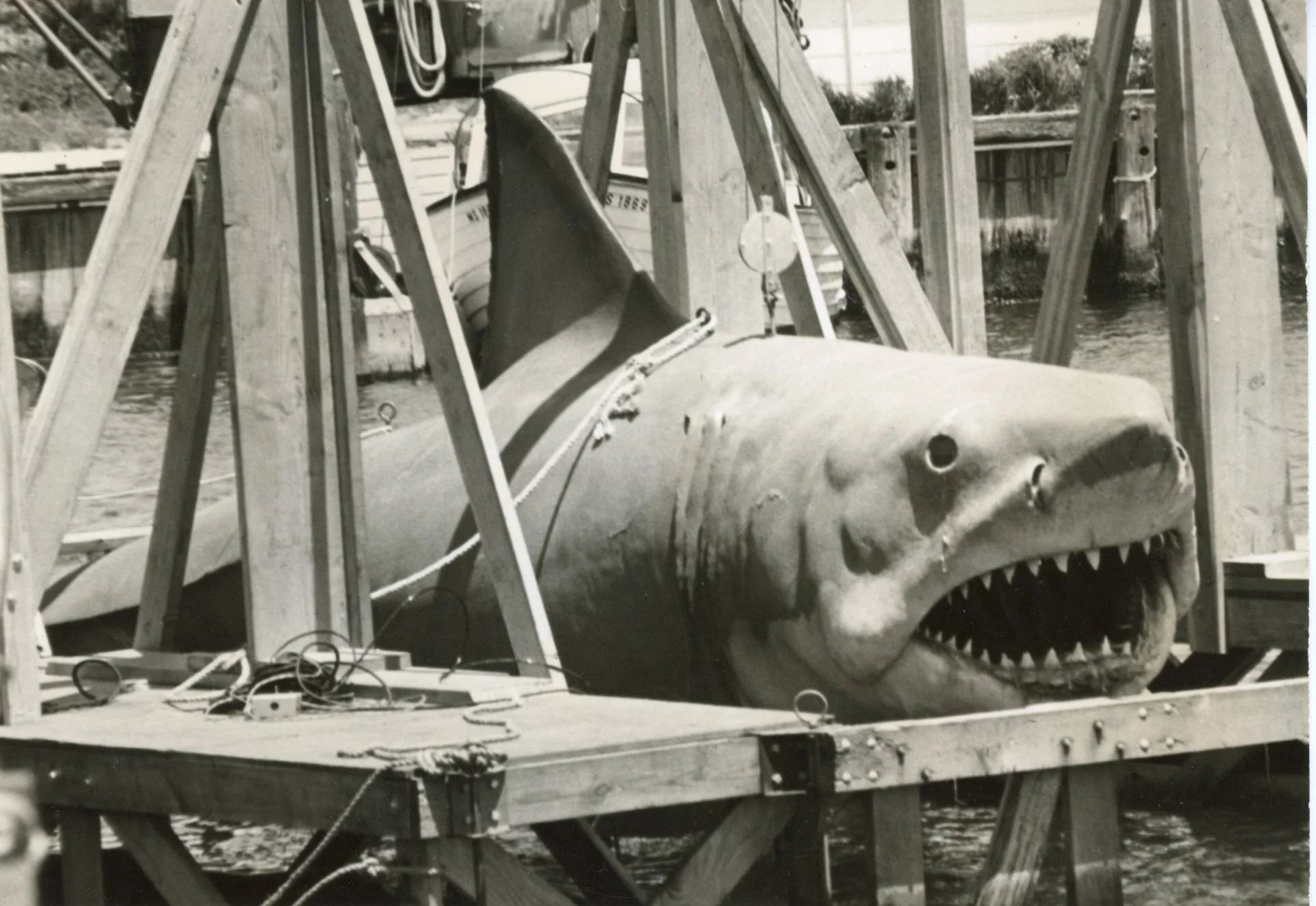
Anna Barber: Our exhibit is on the second floor, and it's a mix of office spaces and small galleries that are along this long hallway, which we're treating as an exhibit space. It was a place for us to really dive into the story of the ‘Bruces’ [Spielberg named the shark Bruce after his lawyer] and how they were made. We have some of Joe Alves’ concept sketches that he used from the novel to help pitch the idea to Universal about turning this into a movie. We also took the technical drawings that Frank Wurmser did of one of the sharks and blew them up to scale. The hallway is really long, so we're able to make this 25-foot-long shark appear to scale. We took a small blueprint and blew it up, so when people walk down the hallway, they can really get a sense of how big these sharks were.
We have a gallery that grounds the story in why they chose Martha's Vineyard and how the people really made this film happen. We profile some of the islanders behind the scenes, in front of the camera, and those who captured it. In our larger gallery, we have some aspects inside the world of what it was like filming here. Just about half the movie takes place on the Orca, so we tell the story of the Orca and the Orca II. We have what is believed to be, after extensive research by the owner, Mayor Vaughn's jacket on display.
In our small homage to the jump scare, we have one very small room that's always been kind of an awkward space to tell any story in. We were able to borrow one of the original Ben Gardner heads from Greg Nicotero out in California. We also have an incredibly lifelike fan-made replica of Ben Gardner's head that's emerging from the hull of the Flicka that's in this small room. So when you turn a corner, you’ll be surprised by it.
Then we talk a little bit about how that scene was re-shot in Verna Fields’ pool, and how they used a gallon of milk and some black plastic tarp to make the magic that we see. That's a credit to Spielberg's brilliant vision, not being happy with what they ended up with and knowing he could do more. With a really interesting mixture of things, he was able to create that magic. We have a gallery that looks at the premiere both here on the island and the legacy beyond. We have a lot of memorabilia and merchandise that all came out in 1975 that marked the start of this entire cottage industry of Jaws merchandise that still continues today.

(FR): Comprehensive merchandising goes all the way back to Snow White and the Seven Dwarfs, but Jaws was really the first modern film to capitalise on the merchandising aspect, from t-shirts to Halloween costumes.
Anna Barber: It's incredible. We've been working with collector Jim Beller, whose focus is really on the kind of stuff that was made and sold after the movie came out. It was really hard to choose. I wanted to focus on just the things from 1975 to show the range at the time. There are just random things like ladies’ knee socks with the shark on them or kids’ nightgowns with the shark on them. Someone just brought us a Jaws paddle ball, also from 1975. It was everything you could possibly imagine. Halloween costumes, squirt guns, puzzles, backpacks — you name it. It's funny how that exploded and why Jaws? It's such iconic imagery. It's easily recognisable: the colours, the shark face, and the logo. It's wild to think that just about everything that could be made and sold with Jaws on it was.
(FR): And without that iconic poster art, do we have all of that merchandise?
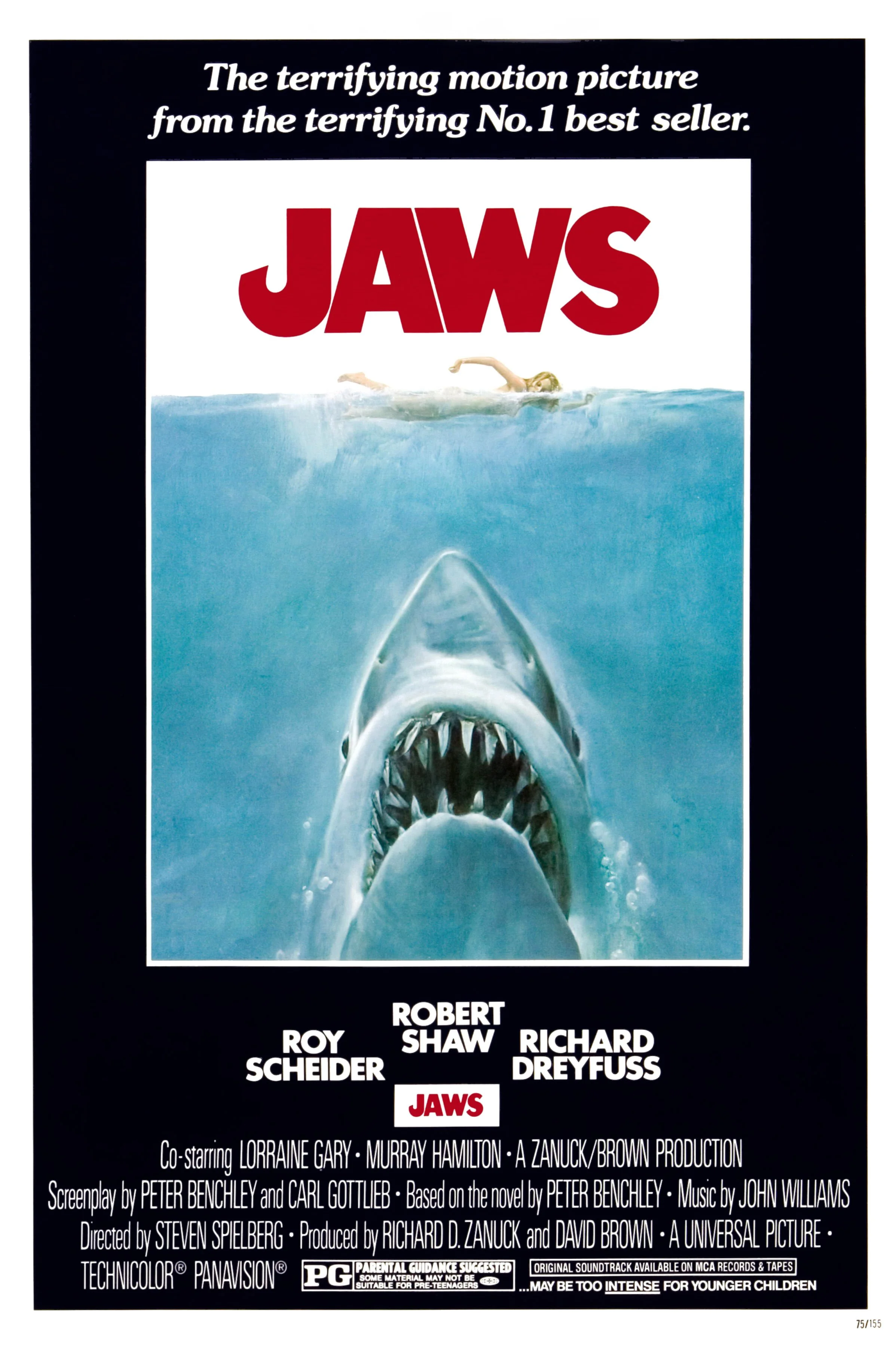
Anna Barber: Yeah, it's true. Being someone who loves museums and believes so strongly in the power of museums to help create and ignite, I was really excited to learn about the fact that Roger Kastel, the artist behind the iconic Jaws face, was trying to figure out how to do this shark face. He went to the American Museum of Natural History in New York. He looks up and sees sharks suspended from the ceiling. Looking up, you're seeing that same angle of the shark. He snapped a photo of it that we have in the exhibit as well, and it's an exact replica of what you see [in the art]. Those are the little moments where I get really excited, because the inspiration behind this iconic piece of art goes back to a museum and someone's experience in a museum. You never know where the inspiration will come from.
(FR): Speaking of the sharks themselves, there’s a focus within the exhibit and this summer’s events on shark conservation and education.
Anna Barber: We have a really big family audience and recognise that not all little ones will have seen Jaws, or maybe should see Jaws, yet. So we have one room that talks a little bit about Peter Benchley's journey after Jaws came out and seeing the effect that his book had on how people view sharks. He went on to really spend the rest of his life in support of shark conservation efforts, along with his wife, Wendy. One of our gallery spaces is dedicated to learning about shark biology and how cool sharks are, as well as getting to know some of our local sharks, not only the Great Whites but other shark species. It explores the ways in which we're learning about sharks by tagging and following their paths, as well as learning about shark biology to help ground everyone in the reality that we do share our oceans with them and they are vulnerable. They’re not the monsters that were portrayed in the movie.
Laurel Redington: From the conservation end, I was around when the shark tournaments were happening, and they were just like that scene in the movie when everybody was just hanging sharks; they had this barbarian mentality. It was really unpopular because of the fact that after the movie came out, there was such remorse on the part of Peter Benchley for making these sharks villains. After a couple of years, popular opinion won out and the shark fest never returned, which was a good thing. We're going to have Wendy Benchley here a few times this summer to talk about conservation, as well as Greg Skomal, a shark expert who used to live on the Vineyard, to talk about the magnificence of this creature and why we shouldn't necessarily fear them but respect them.
(FR): Reflecting back on your experiences with Jaws at 11 and now walking into this deep dive talk into the film, what is this moment like for you Bow?
Bow Van Riper: It's absolutely wild to think that Jaws would be the part of my life 50 years ago that I would be revisiting now. It’s deeply satisfying to have been a part of something that, 50 years on, thousands upon thousands of people are excited enough to come from all over the country and all over the world to Martha's Vineyard and celebrate it.
Learn more about Jaws at 50: A Deeper Dive, the Martha’s Vineyard Museum, and additional events on the island for Jaws 50th Anniversary.
ANNA BARBER
is the Curator of Exhibitions at the Martha’s Vineyard Museum, where for the last twenty years she has been leading the development and interpretation of exhibitions that illuminate the rich cultural, historical, and environmental heritage of the Island. With a deep commitment to community engagement and storytelling, she brings a thoughtful and inclusive approach to curatorial practice, striving to make the museum’s collections accessible and relevant to diverse audiences. Anna holds a BS degree in archaeology from the University of Indianapolis and a graduate certificate in museology/museum studies from the Harvard Extension School. When she’s not in the galleries or archives, Anna enjoys exploring the Vineyard’s landscapes with her son Silas.
CATHY MAYONE joined Martha's Vineyard Museum as Managing Director in September 2024, where she is dedicated to overseeing the Museum’s marketing and business operations, as well as collaborations and partnerships with local Vineyard organisations. Previously, Cathy spent 34 years working in the consulting, marketing and advertising client service industries. Cathy’s husband Mike, who witnessed the filming of Jaws in 1974, introduced Cathy to the island in 1991, and they officially washed ashore as year-round residents in 2020. They, along with their English Bulldog Nala, routinely swim, bike and run from sharks as part of the island’s running and cycling clubs.
LAUREL REDINGTON serves as the Director of Programming and Audience Engagement at the Martha’s Vineyard Museum where she leads the Museum's visitor services, curates dynamic public programmes, and fosters community connections that amplify the Museum's mission to preserve and share the Island’s rich history. Redington's approach is deeply collaborative, drawing from her extensive experience in community-focused storytelling and her longstanding ties to Martha’s Vineyard. Before joining the museum, Redington had a distinguished 34-year career in radio broadcasting, with 24 years at WMVY Radio. Redington’s connection to Martha’s Vineyard began in 1989 when she assisted her father in building a home in Oak Bluffs. She later returned to the island with her family, recognising it as her true home.
A BOWDOIN ‘BOW’ VAN RIPER is the Historian and Research Librarian of Martha’s Vineyard Museum. Bow has been a historian for 40 years (so far). He received his BA from Brown University and his MA and PhD from the University of Wisconsin-Madison, taught at the university level for 21 years, and is the author, editor, or co-editor of twenty-two books and over 100 articles on history and popular culture. He has been the research librarian at the Martha’s Vineyard Museum since 2014 and lives on the shores of Vineyard Haven Harbor in a 19th-century house where, as far as he can determine, nothing of historical significance ever happened.
This interview has been edited for length and clarity.
Watch Jaws: