
Darling │ StudioCanal
Courtesy of StudioCanal
by JAMES CAMERON-WILSON
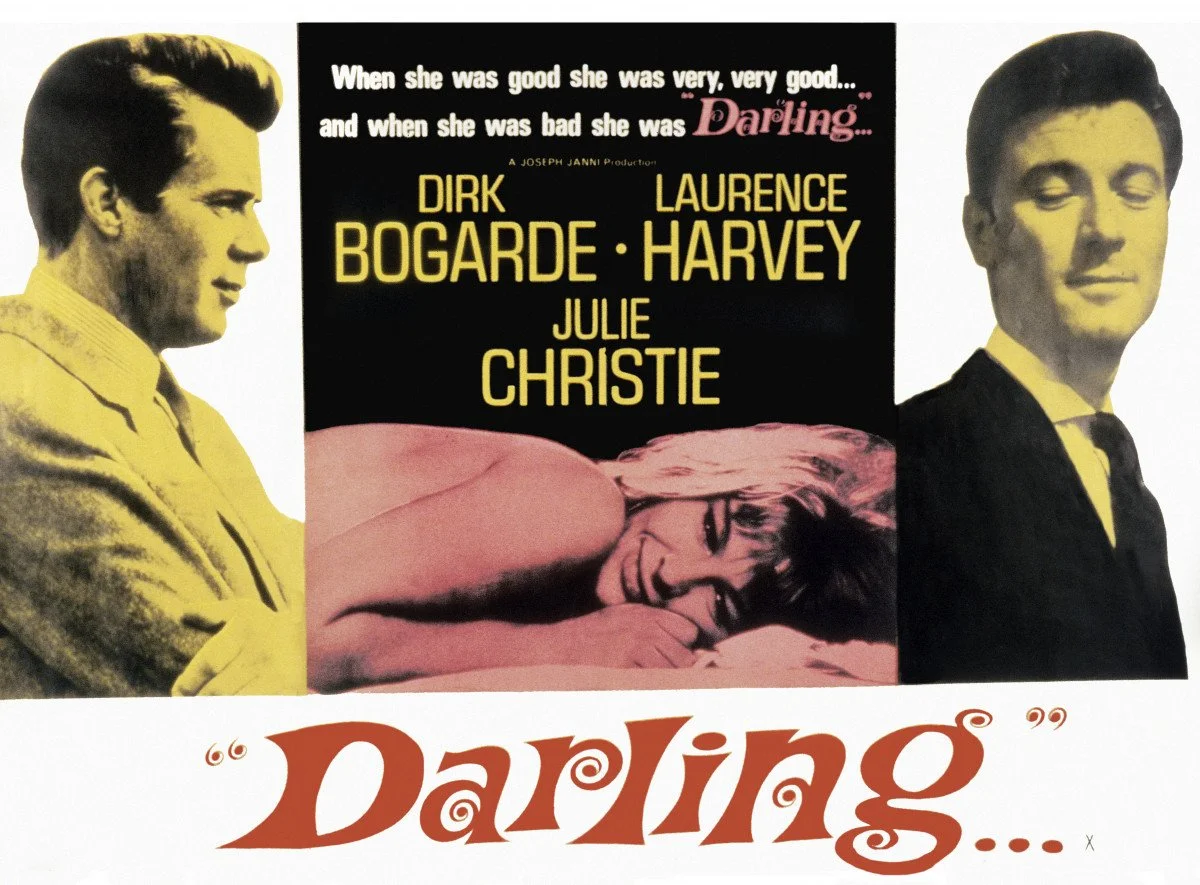
Few films in the Swinging Sixties were as much a part of their time as John Schlesinger’s Darling. Chronologically positioned between Godard’s Breathless and Antonioni’s Blow Up, it is a microcosm of the tail end of an empire that was enjoying its last twitch of cultural significance. The Darling of the title is the extremely beautiful, self-absorbed and cosseted Diana Scott played by the It girl of the day, Julie Christie, the face of Ideal Woman magazine. And she would seem, indeed, to be the Ideal Woman, beloved of cads, intellectuals and royalty. The thumbnail premise is attributed to three men, the scenarist Frederic Raphael, the director John Schlesinger and the producer Joseph Janni, and it is Raphael who has provided the sparkling dialogue. Essentially it’s a satire of Britain in the mid-1960s, with Julie Christie the Carnaby Street siren whose accent you could cut with a diamond, who’s “awfully, awfully,” you know, Darling…
Diana Scott is our narrator, who is looking back over her life of high fashion, betrayal and luxury, a girl from Sussex who has become “terribly Chelsea.” John Schlesinger, who had made his name with such working-class classics as A Kind of Loving and Billy Liar, was now playing with the upper classes and having enormous fun with it. The character of Robert Gold, played with world-weary nuance and grounded resignation by Dirk Bogarde – by far the best actor on view – plays a BBC interviewer and at one point he’s on the street asking questions about the state of Britain, precariously balanced between The Beatles and the infamous miners’ strikes. Robert Gold asks if “Britain is a place that has lost pride in itself?” while one of his interviewees complains about the traffic congestion of the capital, another feels that homosexuality has got out of hand. It should be pointed out that in real life both Schlesinger and Bogarde were gay, while there’s little traffic in Trafalgar Square when Julie Christie takes Laurence Harvey for a spin, using the square as a racing track. Oh, those were the days.
The film is basically a rather episodic biography of a spoiled brat, as she encounters all the hiccups of a young woman of the time, from adultery to pregnancy and on to a shoplifting spree at Fortnum & Mason’s – all in the best possible taste. Julie Christie actually won the Oscar for her performance, although I wasn’t so convinced this time round, but I think Frederic Raphael’s Oscar-winning screenplay is a thing of beauty (the film also won for Julie Harris’s costume design). When Laurence Harvey enters the fray as a louche advertising executive, he’s accused by an old flame as “a man after his own heart,” to which he replies, “that remark was young when you were.” Then his advertising executive, Miles Brand, says of a politician at a charity bash: “he’s a man of few words and all of them long ones.” Ken Higgins’ cinematography is also ace, capturing the more fashionable corners of London, Paris and Capri, as Julie Christie decorates each and every one, while John Dankworth’s jazzy score is so terribly 1960s’ English.
Courtesy of StudioCanal
Presenting yet another angle on this scepter’d isle, Julie Christie reads the “this England” speech from Shakespeare’s Richard II. This may have been the Swinging Sixties of London, but it was nowhere near as salacious as what was going on in Paris. On a trip to the French capital with Laurence Harvey, ‘Darling’ is taken to a sex party where she meets a very beautiful woman who used to be a man and then watches a couple make love, before a very provocative round of cross-dressing and strip-dance mind games. And all this before Diana becomes a princess and a huge media sensation, presaging another very English Princes Diana sixteen years later. Often, I find, films can be much more interesting in retrospect and Darling really was ahead of its time, not least being the first mainstream title to use the ‘f’ word. When Diana gets an anonymous phone call from a man who refuses to divulge his name, she snaps “For Christ’s sake, stopping fucking around, who is it?”. Film reference books – and Google – will tell you that the F-bomb was first dropped by Barbara Jefford in 1967 in the big-screen adaptation of James Joyce’s Ulysses followed a few months later by Marianne Faithfull in Michael Winner’s I’ll Never Forget What’s’isname and then three years after that by John Schuck in Robert Altman M*A*S*H, being the first American film to do so.
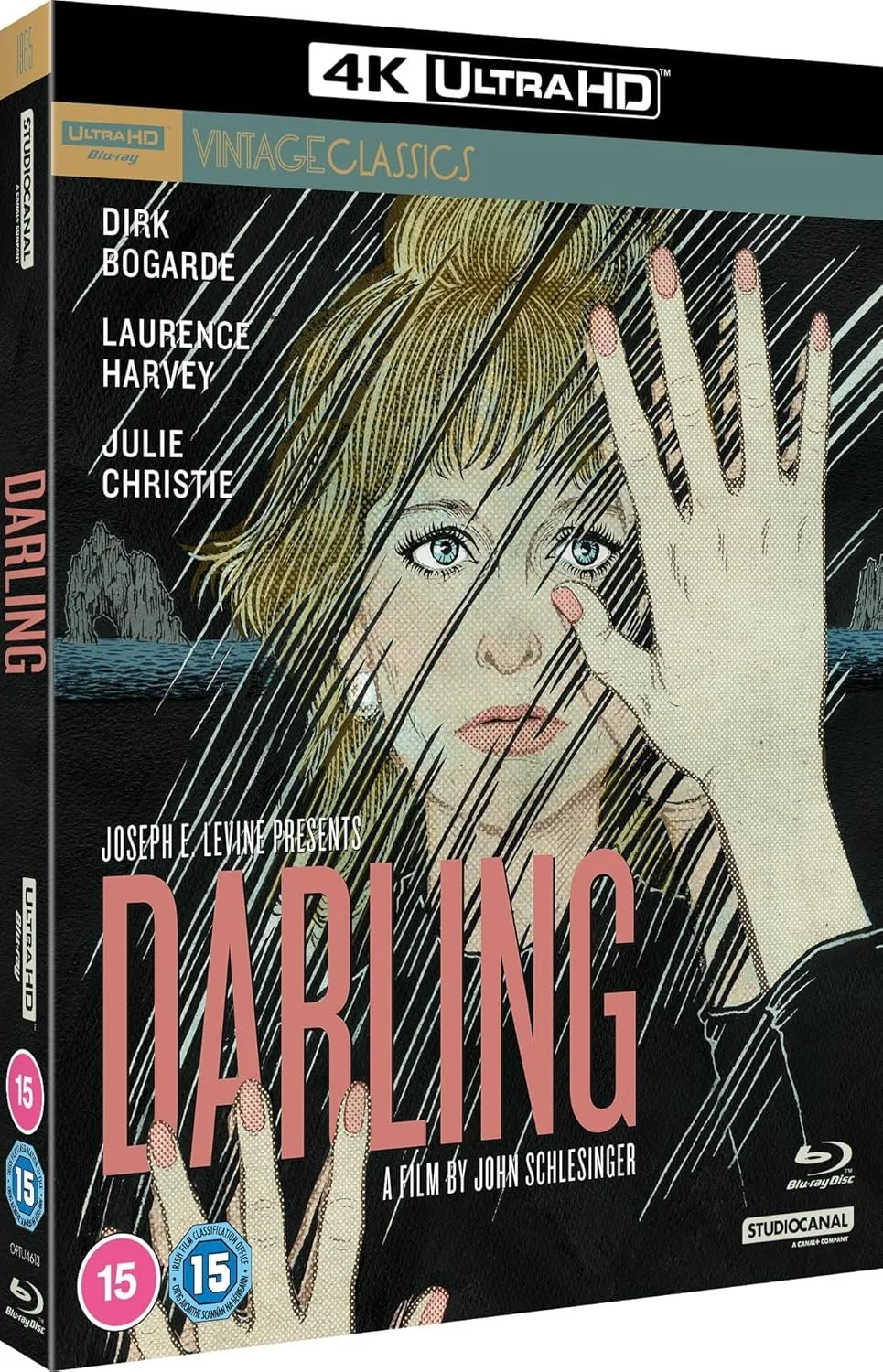
Darling, with all its forgotten secrets, is being released by Studio Canal in a new 4K restoration which took 350 hours to eliminate all the scratches and to reduce flicker and density fluctuations (and other imperfections). I couldn’t have enjoyed it more, darling – and the bonus interview with a sparkly-eyed, 93-year-old Frederic Raphael is a joy.
STUDIOCANAL’s release of Darling is now available on Blu-ray
STUDIOCANAL is Europe’s leader in production, distribution and international sales of feature films and series, operating in all nine major European markets - France, United Kingdom, Germany, Poland, Spain, Denmark and Benelux - as well as in Australia and New Zealand. It owns the largest library in Europe and one of the most prestigious film libraries in the world, boasting more than 8,000 titles from 60 countries, which span 100 years of film history. 20 million euros has been invested into the restoration of 750 classic films over the past 5 years. Known for releasing a stunning roster of incomparable vintage classics titles, StudioCanal’s releases include outstanding thrillers, heart-rending masterworks, horror favourites, war dramas, Ealing comedies, and plenty of lesser-known gems. The collection boasts some of the greatest and beloved stars of British cinema.